

Beehiiv wins for media-first newsletters that monetize primarily through native sponsorships, advertising networks, and premium subscriptions with zero platform take rates. Kit (formerly ConvertKit) wins for educators and creator businesses selling digital products, coaching, and courses who require multi-branch visual automations, advanced tagging logic, and deep third-party e-commerce integrations.
Beehiiv wins this matchup for publishers building a standalone media business, but the reason is not just its modern newsletter editor—it comes down to unit economics and built-in monetization infrastructure. While legacy email service providers treat newsletters as simple broadcast channels, Beehiiv treats your publication as a full-fledged media company with an integrated ad network, zero-take-rate premium subscriptions, and scalable pricing. However, if your revenue comes from selling courses, coaching, or software through complex branching funnels rather than editorial content, Kit (formerly ConvertKit) remains the superior technical choice.
The choice between Beehiiv vs Kit represents two fundamentally different creator business models: the digital publisher vs. the automated sales funnel operator.
The 30-Second Answer: Beehiiv vs Kit
- Choose Beehiiv if: You are building an editorial publication, daily digest, or media brand. You want native access to brand sponsorships through an integrated Ad Network, paid recommendations via Boosts, custom web hosting with SEO indexation, and flat, predictable pricing that does not penalize massive list growth.
- Choose Kit if: You sell high-ticket digital products, recurring cohort courses, or professional services. You need a visual automation canvas with conditional logic (if/then branches based on link clicks or purchase tags), granular contact scoring, and integration with 100+ external tools like Teachable, Circle, and Shopify.
Core Comparison: Key Differences at a Glance
| Feature / Dimension | Beehiiv | Kit (formerly ConvertKit) | Winner |
|---|---|---|---|
| Free Tier Limit | 2,500 subscribers, unlimited sends | 10,000 subscribers, unlimited sends | Kit |
| Free Tier Restrictions | Basic analytics, no automated sequences | 1 visual automation, 1 sequence, Kit branding | Kit |
| Paid Entry Price (1k Subs) | $43/mo (annual) / $49/mo (monthly) (as of August 2026) | $33/mo (annual) / $39/mo (monthly) (as of August 2026) | Kit |
| Paid Price at 50,000 Subs | $199/month (Scale monthly, as of August 2026) | $379/month (Creator monthly, as of August 2026) | Beehiiv |
| Paid Subscription Take Rate | 0% on Scale & Max (Stripe fees only) | 3.5% + $0.30 on Kit Commerce (as of August 2026) | Beehiiv |
| Monetization Engine | Native Ad Network, Boosts, Paywalls | Kit Commerce, Tip Jars, Sponsor Network | Beehiiv |
| Automation Capabilities | Linear drip sequences & trigger steps | Multi-branch visual automation canvas | Kit |
| Website & CMS Builder | Full blog/publication CMS, custom SEO | Basic landing pages & profile link-in-bio | Beehiiv |
| Ecosystem & Integrations | Webhooks, MCP server, core native apps | 100+ native integrations & Zapier/Make ecosystem | Kit |
Pricing and tier limits verified August 2026 against official vendor documentation.
1. Monetization: Ad Networks vs. Digital Funnels
The most dramatic operational difference between Beehiiv and Kit is how they generate revenue for creators.
Beehiiv is constructed around media-native monetization. On the Scale plan ($43/month billed annually as of August 2026), users gain access to the Beehiiv Ad Network. Instead of cold-pitching sponsors or negotiating individual insertion orders, creators apply for pre-negotiated sponsorship opportunities directly inside the dashboard. Beehiiv matches relevant brands to your subscriber demographic and pays on a verified Cost-Per-Click (CPC) or Cost-Per-Mille (CPM) basis. In addition, Beehiiv’s Boosts feature creates a secondary marketplace where you get paid to recommend other newsletters or pay to acquire verified subscribers.
For direct revenue, Beehiiv operates a pure 0% take rate model on paid subscriptions on paid plans. If you charge subscribers $10/month for a premium issue, Beehiiv takes zero cut beyond standard Stripe credit card processing fees.
Kit approaches monetization through a creator-commerce lens. Through Kit Commerce, creators can sell ebooks, coaching sessions, templates, and newsletter subscriptions. However, Kit charges a transaction fee of 3.5% plus $0.30 per sale across all tiers as of August 2026. For creators generating $20,000/month in digital course sales or memberships through native checkout, those transaction fees rapidly eclipse software subscription costs.
Creator Business Model Breakdown:

Beehiiv Model:  Content -> Audience -> Native Ads + Premium Subscriptions (0% Cut)
Kit Model:      Content -> Segmentation -> Visual Funnel -> Digital Products / Courses
If your revenue model is content-first (sponsorships, paid readerships), Beehiiv’s native ecosystem generates revenue with significantly less operational friction. If your model is product-first (lead magnets converting into course sales), Kit’s pipeline is purpose-built for conversion.
2. Automations and List Architecture: Tagging vs. Segmentation
Where Kit firmly defends its market reputation is in workflow automation and contact tagging.
Kit pioneered the subscriber-centric, tag-based data model for creator marketing. Every subscriber is a single entity in your database, regardless of how many forms they fill or sequences they join. Kit’s Visual Automation Builder offers an interactive flowchart canvas where you can design multi-branch logic:
- If a subscriber clicks a specific link in Email 3, apply the
Interested in Mastermindtag and delay subsequent pitches by 48 hours. - If a user purchases via webhook, instantly remove them from the promotional sequence and trigger the onboarding sequence.
- Branch journeys based on custom fields, location, or past email open engagement.
Beehiiv’s automation capabilities have expanded with triggers and conditional branching on paid tiers, but the experience remains fundamentally linear. You can create welcome drips and basic segmentation workflows, but managing complex nested funnels with multiple decision trees is noticeably clunky compared to Kit.
For teams used to enterprise e-commerce platforms like those analyzed in our Klaviyo vs Mailchimp review, Kit’s tagging architecture feels natural, while Beehiiv feels closer to a modern publication CMS.
3. Pricing Curves and the Free-Tier Traps
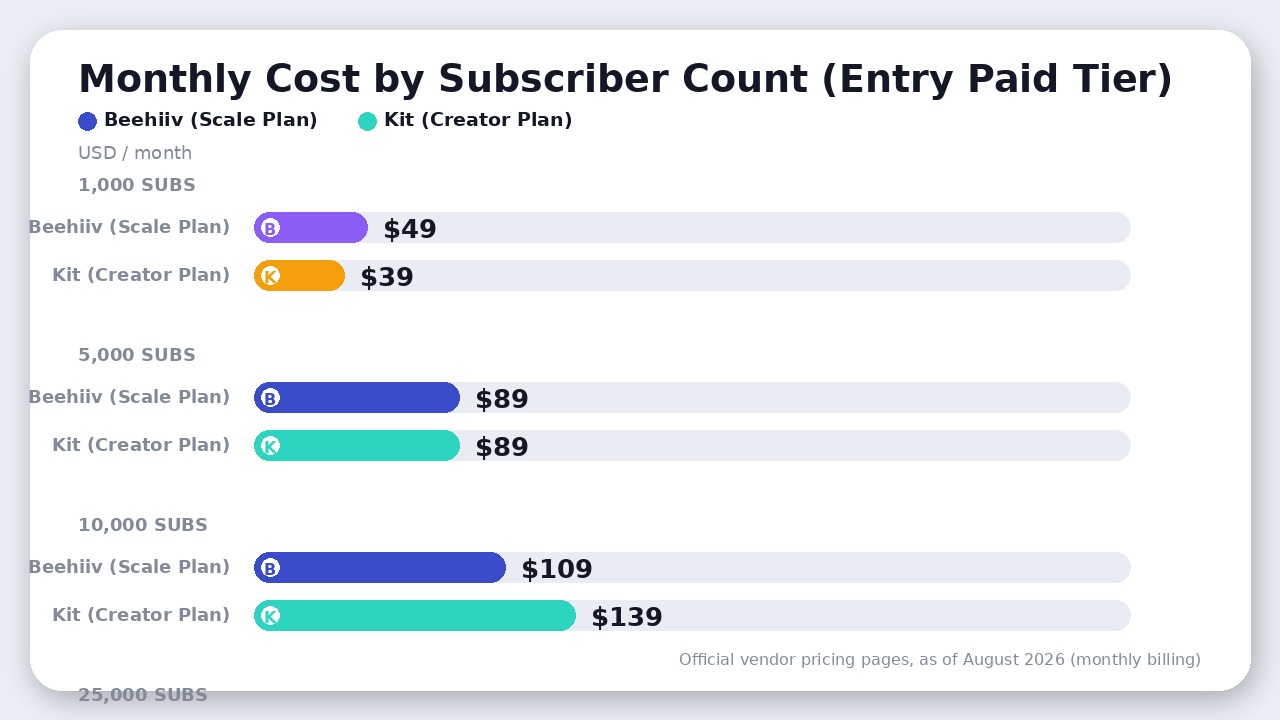
SaaS pricing comparisons in the newsletter space frequently mislead creators by focusing exclusively on entry-level costs. Both platforms utilize subscriber-band pricing, but their cost trajectories diverge sharply as audiences scale.
The Kit Free Tier Trap
Kit made headlines by expanding its free Newsletter Plan to support up to 10,000 subscribers at $0/month. For beginners, this appears unbeatable. However, the hidden constraint is the “10k cliff”:
1. The free plan limits you to exactly 1 automation workflow and 1 sequence.
2. As soon as your list hits 10,001 active subscribers, you cannot simply pay a low entry fee—you are pushed directly into Kit’s 10k–15k paid tier, which jumps immediately to $169/month on monthly billing (or $139/month on annual billing as of August 2026).
The Beehiiv Scaling Advantage
Beehiiv’s free Launch Plan is capped at 2,500 subscribers. While smaller than Kit’s free allowance, Beehiiv’s paid plans scale far more favorably for mid-size and large publications (prices as of August 2026 on monthly billing):
- 10,000 Subscribers: Beehiiv Scale is $109/month vs. Kit Creator at $139/month.
- 25,000 Subscribers: Beehiiv Scale is $169/month vs. Kit Creator at $199/month.
- 50,000 Subscribers: Beehiiv Scale is $199/month vs. Kit Creator at $379/month.
By the time a publication reaches 50,000 subscribers, Kit costs nearly double the price of Beehiiv on standard monthly billing ($379/month vs. $199/month). For a media publisher operating on standard CPM margins, that $180/month difference ($2,160/year) directly impacts profitability.
Where Kit Actually Wins
Despite Beehiiv’s momentum in the newsletter sector, Kit maintains distinct advantages for specific creator workflows:
- Deep Native Integrations: Kit connects directly with over 100 creator tools, including Teachable, Podia, MemberPress, Circle, Shopify, and Crowdcast. Beehiiv relies heavily on webhooks and Make/Zapier connections for non-native tools.
- Granular Lead Magnet Delivery: Delivering dozens of unique PDF opt-ins across different blog posts without cluttering your master list is effortless in Kit using isolated forms and tags. Beehiiv requires custom redirect configurations and tag workarounds.
- Subscriber Signals and Scoring: Kit’s Pro tier ($79/month entry as of August 2026) offers advanced engagement scoring, allowing creators to automatically filter out unengaged contacts before they trigger billing thresholds.
- Generous Zero-Cost Starting Runway: For creators with zero initial budget who want to build up to 10,000 subscribers with simple weekly broadcasts, Kit’s free tier provides four times the subscriber capacity of Beehiiv.
The Verdict
Beehiiv wins for 70% of modern newsletter creators. If your goal is to publish high-quality editorial content, grow an audience via recommendations, monetize through built-in sponsor matching and 0% take-rate paywalls, and keep software expenses predictable as your audience expands into tens of thousands, Beehiiv is the superior platform.
Choose Kit if you operate a multi-product funnel. If your business relies on course launches, webinar sequences, automated lead-magnet distribution, and granular behavior-based email routing, Kit’s visual automation canvas and deep third-party ecosystem justify its steeper pricing curve at scale.
Frequently asked questions
Is Kit really free for up to 10,000 subscribers?
Yes, Kit’s free Newsletter plan supports up to 10,000 active subscribers with unlimited broadcast emails and landing pages. However, it restricts users to one visual automation, one sequence, and charges a 3.5% plus $0.30 transaction fee on digital product sales as of August 2026.
Why did ConvertKit change its name to Kit?
ConvertKit rebranded to Kit in late 2024 to reflect its expansion from a pure email broadcast tool into an operating system for creator businesses, encompassing commerce, app integrations, and creator networking.
Does Beehiiv take a percentage of paid subscription revenue?
No. Beehiiv charges a 0% platform take rate on paid newsletter subscriptions on its Scale ($43/month billed annually as of August 2026) and Max plans, meaning publishers only pay standard Stripe payment processing fees.
Can Beehiiv replace a website builder like WordPress or Ghost?
Yes, Beehiiv includes an integrated content management system with custom domains, SEO indexation controls, web templates, and RSS feeds, allowing creators to run an entire blog and newsletter from one interface.
Which platform offers better email deliverability: Beehiiv or Kit?
Both maintain strong shared IP reputation. Kit provides custom deliverability monitoring and dedicated IP options on its Pro tier, while Beehiiv leverages automated subscriber verification and engagement-driven warmups across its infrastructure.
Final Recommendation
Beehiiv wins for media publications and newsletter-first creators who monetize through sponsorships and premium subscriptions. Kit remains the superior pick for educators and creators selling products through complex multi-branch automation funnels.

Leave a Reply