

DeepSeek is accessible worldwide via web, mobile, and API with direct USD billing. Hosted inference stores all prompts on servers in China and permits training on user inputs by default. However, because DeepSeek releases open weights under permissive MIT licenses, teams requiring data sovereignty can self-host or deploy via Western cloud providers without sending data to China.
DeepSeek is accessible worldwide via web, mobile, and API with direct USD billing. Hosted inference stores all prompts on servers in China and permits training on user inputs by default. However, because DeepSeek releases open weights under permissive MIT licenses, teams requiring data sovereignty can self-host or deploy via Western cloud providers without sending data to China.
When Hangzhou-based DeepSeek (杭州深度求索) disrupted the artificial intelligence landscape with its V3 and R1 reasoning architectures, it fundamentally reset software economics. For developers, technical founders, and product teams outside China, evaluating DeepSeek is rarely an argument about benchmark capabilities. Its reasoning models routinely trade blows with Western closed-source flagships from OpenAI and Anthropic across mathematical, algorithmic, and coding benchmarks.
The real friction centers on three operational questions that standard SaaS roundups consistently gloss over: Where does your application data go when you hit the endpoint? Can an engineering team in North America or Europe integrate the API without regulatory fallout? And what are the true token costs once cache dynamics and concurrency are factored in?
This profile unpacks the legal, infrastructural, and financial realities of using DeepSeek in 2026.
1. Where Does My Data Go?
If you use DeepSeek’s hosted services—whether through the consumer interface at chat.deepseek.com or the developer API at platform.deepseek.com—your data leaves Western jurisdictions.
The Direct Hosted Pipeline (Servers in China)
According to DeepSeek’s official privacy policy, all personal data, user-submitted prompts, generated completions, and uploaded files are directly collected, processed, and stored on servers located within the People’s Republic of China (PRC). The data controller of record is Hangzhou DeepSeek Artificial Intelligence Basic Technology Research Co., Ltd. (杭州深度求索人工智能基础技术研究有限公司), headquartered in Hangzhou, Zhejiang.
[Client Application]
       │ (HTTPS / TLS 1.3)
       ▼
[api.deepseek.com Gateway]
       │
       ▼
[Data Centers in Mainland China (PRC)]
  ├── Inference & Context Processing
  ├── Prompt & Completion Logging
  └── Training Ingestion (Default Active)
Operating under PRC jurisdiction subjects DeepSeek’s hosted infrastructure to local regulatory frameworks, including China’s Cybersecurity Law, Data Security Law, and the National Intelligence Law of 2017. Under these statutes, domestic commercial entities must assist state authorities when legally mandated.
Model Training on User Prompts
Unlike Western API providers like OpenAI or Anthropic—which maintain default zero-data-retention and no-training policies on their paid commercial API tiers—DeepSeek’s terms of service specify that customer inputs and outputs can be used to optimize, improve, and train future machine learning models.
- Consumer Chat: Conversations submitted on the web or mobile app are automatically included in general data pools for continuous model alignment and training.
- Developer API: The standard platform agreement permits data processing for model maintenance and improvement unless explicitly exempted. While DeepSeek documents an opt-out channel (via written contact at privacy@deepseek.com or specific account-level settings), there is no programmatic, contractually indemnified Zero Data Retention (ZDR) guarantee available for self-service accounts.
The Compliance Vacuum
For enterprise engineering leaders, the hosted API lacks standard Western compliance documentation:
- No SOC 2 Type II Report: DeepSeek does not publish an audited SOC 2 compliance report.
- No HIPAA BAAs: There is no mechanism to execute a Business Associate Agreement; processing Protected Health Information (PHI) through DeepSeek’s hosted API violates HIPAA rules.
- No Standard DPA for GDPR: DeepSeek does not provide standard contractual clauses (SCCs) or a legally binding Data Processing Agreement tailored to EU GDPR export regulations.
The Structural Workaround (Self-Hosting): Because DeepSeek publishes its foundational weights under the permissive MIT license, companies can bypass Chinese data centers entirely. Deploying DeepSeek open-weight checkpoints on internal private clusters (using vLLM, SGLang, or Ollama) or routing through Western cloud hosts (such as AWS Bedrock, Microsoft Azure, Together AI, or Groq) ensures that every prompt remains within your chosen legal jurisdiction.
2. Can I Actually Use It Outside China?
Yes. DeepSeek is built for international consumption, and accessing it from North America, Europe, or the Asia-Pacific region is remarkably frictionless compared to traditional Chinese enterprise software.
Platform Availability & Region Blocks
- Web and Mobile: The web client (chat.deepseek.com) and native iOS/Android applications are globally accessible. No VPN (Virtual Private Network) is required to access the interface from Western IP ranges.
- Account Registration: Signup requires an email address or mobile phone number. International country dialing codes (including +1 for the US/Canada, +44 for the UK, +49 for Germany, and +61 for Australia) receive SMS verification codes reliably. Direct email registration with OTP verification is the simplest method and avoids carrier delivery hiccups.
- API Endpoint Compatibility: The API endpoint (
https://api.deepseek.com) supports standard REST protocols and is natively drop-in compatible with the OpenAI SDK format as well as the Anthropic Messages API format (https://api.deepseek.com/anthropic). Developers migrating from other tools can point existing client libraries to DeepSeek simply by modifying thebase_urland inserting their API key.
Government and Corporate Restrictions
While DeepSeek does not block Western users, certain Western institutions restrict DeepSeek. As of 2026, several US federal agencies, state governments, Australian government departments, and defense contractors have prohibited installing DeepSeek applications on government-owned hardware due to the PRC server residency outlined in its privacy notice. Commercial software builders serving non-classified enterprise clients remain legally free to integrate DeepSeek, provided their customer contracts do not contain geographic processing exclusions.
Payment & Billing Mechanics
Unlike platforms that demand domestic Chinese payment mechanisms (such as verified WeChat Pay or Alipay linked to mainland identity cards), DeepSeek’s developer portal operates on standard global billing rails:
- Currency: The developer platform quotes, bills, and settles directly in US Dollars (USD).
- Accepted Cards: International credit and debit cards (Visa, Mastercard, American Express) process cleanly via global payment integrations.
- Top-Up Model: DeepSeek operates on a prepaid credit balance model. Developers deposit funds in increments (e.g., $10, $50, $100), and token consumption deducts automatically from the available balance.
- Free Credits: New developer accounts receive 5,000,000 complimentary tokens upon registration to validate endpoints and test prompts prior to depositing funds.
3. What Does DeepSeek Cost in USD?
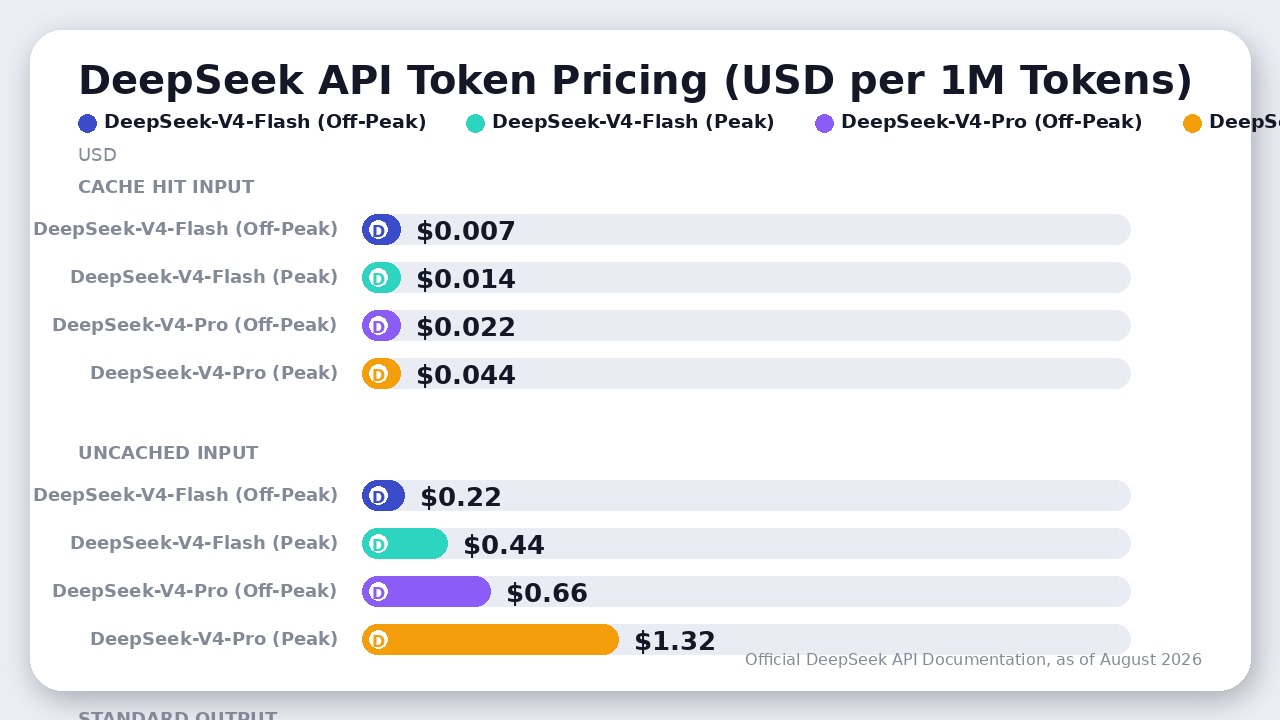
DeepSeek’s commercial pricing operates on a dual peak/off-peak schedule with substantial prompt-caching discounts. The vendor publishes explicit USD pricing schedules that operate without currency conversion markups.
Verified Hosted API Pricing (As of August 2026)
All rates below represent official rates per 1,000,000 tokens published in DeepSeek’s developer documentation:
| Model Tier | Context Window | Cache Hit Input (Off-Peak / Peak) | Uncached Input (Off-Peak / Peak) | Output (Off-Peak / Peak) |
|---|---|---|---|---|
| DeepSeek-V4-Flash | 1,000,000 tokens | $0.007 / $0.014 | $0.22 / $0.44 | $0.66 / $1.32 |
| DeepSeek-V4-Pro | 1,000,000 tokens | $0.022 / $0.044 | $0.66 / $1.32 | $1.98 / $3.96 |
(Source: Official DeepSeek API documentation, verified August 2026. Peak hours are 01:00–04:00 and 06:00–10:00 UTC; off-peak hours cover all other times and receive a 50% discount against peak rates).
Context Caching: The Real Cost Reducer
DeepSeek implements automatic prompt caching at the gateway layer. If an incoming request shares an identical system prompt, document context, or multi-turn conversational prefix with previous requests, DeepSeek automatically routes the tokens through cached memory.
- On DeepSeek-V4-Flash, off-peak cached input drops from $0.22 down to $0.007 per million tokens—a 96.8% cost reduction.
- On DeepSeek-V4-Pro, off-peak cached input drops from $0.66 down to $0.022 per million tokens—a 96.7% cost reduction.
For agentic workflows, complex Retrieval-Augmented Generation (RAG) pipelines, and coding loops where large source files or documentation sets are repeatedly sent in each prompt turn, caching pushes effective blended token costs down sharply.
The Cost Comparison with Western Flagships
To contextualize these numbers against Western counterparts:
- A high-volume coding agent running on Claude 3.7 Sonnet or OpenAI’s comparable flagship typically costs roughly $3.00 per million input tokens and $15.00 per million output tokens.
- DeepSeek-V4-Pro delivers comparable reasoning and code-synthesis performance at $0.66 input and $1.98 output off-peak ($1.32 input and $3.96 output peak).
- For a pipeline generating 50 million output tokens and 200 million input tokens monthly, switching from a $3/$15 Western model stack ($1,350.00/mo) to DeepSeek-V4-Pro off-peak ($231.00/mo uncached, or under $170.00/mo with 50% prompt caching) reduces operational LLM expenditure by more than 80%.
4. Where DeepSeek Genuinely Wins
DeepSeek’s market presence is not just a byproduct of aggressive pricing; the tool excels across several specific structural vectors:
- Permissive Open-Weight Licensing: DeepSeek releases full model weights under the MIT License. Unlike restricted research licenses, the MIT terms grant engineering teams complete freedom to modify, fine-tune, commercialize, and self-host the models without paying recurring royalties or seeking vendor approval.
- Algorithmic and Mathematical Reasoning: In multi-step logical deduction, competitive coding challenges, and symbolic mathematics, DeepSeek’s specialized reasoning iterations achieve accuracy benchmarks that rival or outperform models costing significantly more.
- Native OpenAI & Anthropic API Parity: Developers do not need to rewrite complex schema parsers. DeepSeek supports JSON-mode outputs, function calling/tool use, and multi-turn message schemas out of the box.
- Million-Token Active Context: Both Flash and Pro variants support up to 1,000,000 tokens of input context window and up to 384,000 output tokens, accommodating entire codebase repositories or technical manuals in a single inference call.
5. Where DeepSeek Genuinely Fails
Despite its technical prowess, DeepSeek presents clear operational liabilities that make it unsuitable for specific production use cases:
- Zero Regulatory Shielding: If your product processes sensitive European customer records under GDPR, Protected Health Information under HIPAA, or payment credential metadata, using DeepSeek’s hosted endpoints violates compliance standard operating procedures. You cannot sign a valid BAA or enterprise DPA with the vendor.
- Peak-Hour Latency Surges: During major global model releases or traffic spikes, DeepSeek’s first-party hosted API status has historically experienced elevated latency, concurrency throttling, and intermittent rate-limit errors. Production systems requiring sub-500ms time-to-first-token (TTFT) SLAs often require multi-provider fallback routing.
- Absence of Dedicated Enterprise Support: Unlike OpenAI, Google Cloud, or Anthropic, DeepSeek does not offer dedicated customer success engineers, contractual uptime SLAs (e.g., 99.99%), or 24/7 emergency incident war rooms for self-serve developers.
- Model Censorship Guardrails on China-Sensitive Topics: While coding, mathematics, and general business tasks are unhindered, political or historical queries touching sensitive PRC domestic topics will trigger refusal guardrails or sanitized completions. Notably, these safety guardrails are partially baked into the base training data, meaning even locally self-hosted weights will reflect these alignment patterns.
The Decision Framework: How to Deploy DeepSeek
When deciding whether and how to incorporate DeepSeek into your software stack, the choice is rarely binary. It depends entirely on whether your data profile permits third-party offshore transmission:
                     Do you handle regulated PII, HIPAA, or strict IP?
                                    │
                    ┌───────────────┴───────────────┐
                   YES                              NO
                    │                               │
        Do you have internal GPU          Do you need sub-dollar
        infrastructure to manage?         million-token API costs?
          ┌─────────┴─────────┐                     │
         YES                 NO                     ▼
          │                   │             Use Hosted DeepSeek API
   Self-Host via        Deploy via Western   (platform.deepseek.com)
   vLLM / Ollama        Managed Cloud Hosts  • From $0.22/M Input
   (MIT License)        (AWS / Together AI)  • Direct USD Billing
- Path 1: The Direct API Route (
api.deepseek.com). Ideal for solo developers, startup prototypes, automated web scraping, content generation pipelines, synthetic data synthesis, and internal developer tooling where prompts do not contain confidential enterprise intellectual property or regulated PII. You get the lowest possible market pricing with zero infrastructure overhead. - Path 2: The Managed Western Cloud Route (AWS Bedrock / Azure / Together AI). Ideal for commercial SaaS products that want DeepSeek’s reasoning capabilities and cost efficiency, but require US/EU data residency, SOC 2 compliance, and standard enterprise master service agreements (MSAs). You pay a slight hosting premium over DeepSeek’s direct rate, but maintain enterprise compliance posture.
- Path 3: The Self-Hosted Air-Gapped Route. Ideal for enterprise engineering teams with on-premise GPU clusters or private virtual clouds. Downloading the open weights ensures 100% data sovereignty, zero external data leakage, and complete immunity from provider outages or terms changes.
For teams comparing Chinese AI models across the board, our detailed DeepSeek vs Qwen analysis explores how Alibaba’s enterprise-ready open ecosystem contrasts with DeepSeek’s pure research-driven architecture. If you are evaluating multimodal generation platforms, review our deep dive into Hailuo AI or our breakdown of Kling AI for video workflows.
The Verdict
DeepSeek represents the most aggressive price-to-performance ratio in the global AI ecosystem. For open-ended reasoning, coding copilots, and massive batch-processing tasks, its models deliver frontier intelligence at commoditized utility rates.
However, do not route confidential customer data or regulated PII through DeepSeek’s hosted cloud API. The absence of Western compliance certifications and default server residency in China make direct hosted endpoints a non-starter for regulated enterprise production. Instead, leverage DeepSeek’s open-source ethos: pull its MIT-licensed weights into your own infrastructure or deploy through a Western cloud host to capture the intelligence while retaining complete control over your data sovereignty.
Frequently asked questions
Where does DeepSeek store my conversation data?
DeepSeek’s official privacy policy explicitly states that personal data, user inputs, and uploaded files sent through chat.deepseek.com and the hosted API are stored on servers located in the People’s Republic of China. For compliance-sensitive workloads, hosting the open weights independently on Western cloud infrastructure keeps all data within your own jurisdiction.
Does DeepSeek train its AI models on user prompts?
Yes, by default. DeepSeek’s terms of service and privacy policy allow the company to use user inputs, prompts, and system outputs to improve and train its machine learning models. While users can submit an opt-out request via privacy@deepseek.com, the platform lacks the automated zero-retention enterprise guarantees found on Western enterprise API tiers.
Can I pay for DeepSeek with a US or international credit card?
Yes. The DeepSeek developer platform (platform.deepseek.com) directly bills in USD and accepts international Visa, Mastercard, and American Express credit cards via global payment processors. International developers do not need a Chinese bank account, UnionPay card, or Alipay account to fund their API balance.
Is DeepSeek blocked or restricted in Western countries?
DeepSeek is fully accessible from the US, UK, EU, and globally without requiring a VPN. However, several government agencies and enterprise security policies in the US, Australia, and Europe have banned the consumer app on government-issued devices due to Chinese data-residency laws. Developers can freely integrate the API or run open weights locally.

Leave a Reply