


Choosing between Ahrefs and Semrush used to be a simple choice between backlink accuracy and all-in-one marketing features. In 2026, that decision has been completely reshaped by two major platform changes: usage-based pricing structures and AI search visibility tracking. While both platforms cover traditional keyword research, rank tracking, and site audits, their pricing models and AI strategies have diverged dramatically.
If you pick the wrong tool today, you will either burn through monthly report quotas midway through a campaign or pay hundreds of dollars in hidden add-on fees just to track where your brand appears in ChatGPT, Perplexity, and Google AI Overviews. Here is the definitive, unfiltered verdict on Ahrefs vs Semrush.
Ahrefs vs Semrush: The 30-Second Verdict
For 80% of marketing teams, agencies, and growth leads, Semrush wins this matchup in 2026. Semrush offers a far more predictable cost structure for multi-domain research, packs superior PPC and content marketing tools, and bundles AI search tracking into its core plans through Semrush One without forcing massive price hikes.
Ahrefs remains the top pick exclusively for technical SEO purists and dedicated link builders. If your daily work centers around granular backlink audits, disavow files, and analyzing link velocity across a massive 35-trillion external link index inside a clean, distraction-free interface, Ahrefs is still the undisputed gold standard—provided you can tolerate its pay-as-you-go credit meter.
| Decision Dimension | Semrush | Ahrefs |
|---|---|---|
| Primary Specialty | All-in-one marketing (SEO, PPC, Content, AI Search) | Technical SEO & Backlink Intelligence |
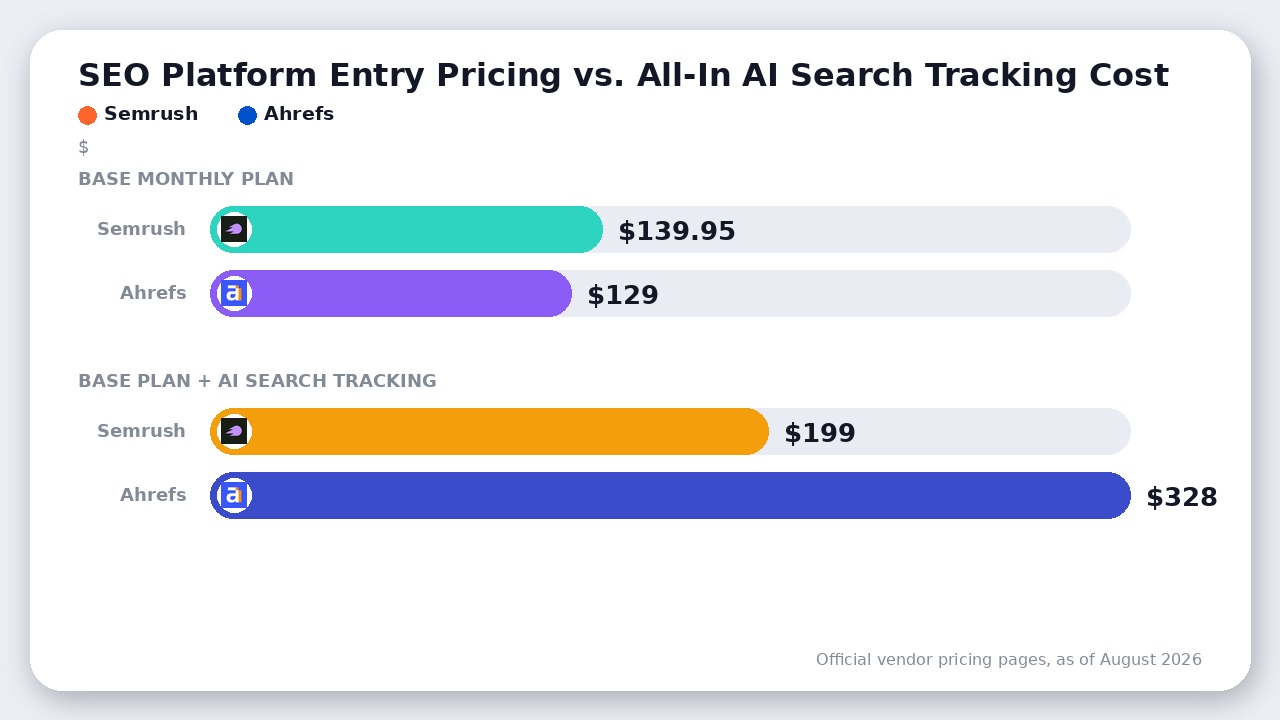
| Base Plan Monthly Cost | $139.95/mo (Pro) / $117.33 annual | $129/mo (Lite) / $108 annual |
| All-In AI Search Cost | $199/mo (Semrush One Starter) | $328/mo ($129 Lite + $199 Brand Radar) |
| Usage Limits Model | Fixed Project Caps & Daily Requests (3,000/day) | Metered Report Credits (500/mo) & Row Limits |
| Extra Seat Cost | $45–$100/seat/mo | $20–$80/seat/mo |
| Backlink Index Size | ~43 Trillion Backlinks | ~35 Trillion External Backlinks |
| PPC & Ad Intelligence | Advanced (Google Ads, PLA, Display) | Basic (Search Ads only) |
| Free Tier / Trial | 14-Day Free Trial + Free Basic Account | Ahrefs Webmaster Tools (Own Sites Only) |
Pricing data verified against official Semrush and Ahrefs documentation as of August 2026.
Pricing & Limits: The Ahrefs Credit Trap vs. Semrush Project Caps
As of August 2026, on paper, base entry pricing looks comparable: Ahrefs Lite starts at $129/month ($108/month billed annually), while Semrush Pro starts at $139.95/month ($117.33/month billed annually). However, looking at list prices alone hides the operational realities of how each tool meters usage.
Ahrefs’ Credit Consumption Model
Ahrefs bills using a pay-as-you-go report credit meter across its standard plans (as of August 2026):
* Lite ($129/mo or $108/mo annual): Includes 1 user seat, 500 report credits per month (or 1,000 for an active power user), 5 tracked projects, and 750 tracked keywords.
* Standard ($249/mo or $208/mo annual): Includes 1 user seat, 600 report credits per month, 20 tracked projects, and 2,000 tracked keywords.
* Advanced ($449/mo or $374/mo annual): Includes 1 user seat, 750 report credits per month, 50 tracked projects, and 5,000 tracked keywords.
The critical limitation is what consumes an Ahrefs credit. Opening a report, changing a filter, or clicking deep into a competitor’s organic keywords deducts 1 credit from your monthly allowance. According to Ahrefs’ official documentation, exceeding your monthly allocation triggers auto-billed overages at $50 per 500 additional report credits. For freelancers or agencies conducting aggressive competitive analysis across dozens of domains, 500 credits can disappear in less than a week.
Semrush’s Project-Based Allocation
Semrush uses a traditional, request-based allowance structure (as of August 2026):
* Pro ($139.95/mo or $117.33/mo annual): Includes 5 projects, 500 tracked keywords daily, and up to 3,000 report requests per day.
* Guru ($249.95/mo or $208.33/mo annual): Includes 15 projects, 1,500 tracked keywords daily, 300,000 page crawls per month, historical search data, and the Content Marketing Toolkit.
* Business ($499.95/mo or $416.66/mo annual): Includes 40 projects, 5,000 tracked keywords daily, 1,000,000 page crawls per month, and API access.
On Semrush, running search queries, filtering results, or clicking through domain overviews does not burn a pay-as-you-go meter. You are capped by the number of active Projects (verified domains you set up for continuous rank tracking and site audits) and daily request limits (3,000/day on Pro). For exploratory research, Semrush is significantly more forgiving on budget predictability.
AI Search Visibility: Ahrefs Brand Radar vs. Semrush One
As of August 2026, as search behavior shifts toward conversational platforms like ChatGPT, Perplexity, Gemini, and Google AI Overviews, monitoring brand presence in AI-generated answers has become critical. Both platforms offer dedicated AI visibility tracking features, but their pricing models differ sharply.
Ahrefs Brand Radar
Ahrefs offers AI visibility tracking via its Brand Radar add-on. Brand Radar scans brand mentions, sentiment, and prompt presence across AI models. However, according to Ahrefs’ pricing structure, Brand Radar requires an add-on fee of $199/month per index on top of your base plan. If you subscribe to Ahrefs Lite ($129/mo) and add AI search monitoring for an engine, your all-in commitment jumps to $328/month ($129 + $199).
Semrush One
Semrush integrated AI visibility directly into its core offering through the Semrush One subscription tier (as of August 2026):
* Starter ($199/mo or $165.17/mo annual): Combines core SEO tools with AI Visibility tracking across Google Search, ChatGPT, Perplexity, and Gemini (includes 50 daily prompts and 300 daily AI reports).
* Pro+ ($299/mo or $248.17/mo annual): Includes 15 websites, 1,500 tracked keywords, and 100 daily AI tracking prompts.
By bundling traditional SEO with AI search monitoring into Semrush One, Semrush delivers a complete brand visibility stack for $199/month—saving growth teams $129 per month compared to an equivalent $328/month setup on Ahrefs ($328 – $199 = $129).
Backlink & Keyword Intelligence: Raw Link Depth vs. Intent Data
When comparing raw data depth, both platforms maintain massive infrastructure, but they specialize in different areas of the growth funnel.
Backlink Auditing and Link Graphs
Ahrefs built its reputation on link intelligence, and its Site Explorer remains unmatched in UX speed and visual clarity. The Ahrefs external backlink index monitors over 35 trillion external links (and over 43 trillion total links including internal connections). Semrush indexes over 43 trillion backlinks from 390 million referring domains. Where Ahrefs stands out is its filtering accuracy, link freshness (updated every 15 to 30 minutes), and live link graph.
Ahrefs makes it effortless to filter out spam networks, inspect broken redirect chains, and isolate lost links down to the exact anchor text date. For teams executing sophisticated outreach campaigns or conducting off-page competitive intelligence alongside B2B tools like Clay vs Apollo, Ahrefs provides cleaner, more actionable backlink data.
Keyword Research and PPC Analysis
Semrush dominates in search intent analysis and paid acquisition data. As of August 2026, Semrush’s Keyword Magic Tool holds a database of over 28.8 billion keywords across 142 geographic databases, offering granular metrics on Search Intent (Informational, Navigational, Commercial, Transactional), Keyword Difficulty (KD%), and Search Volume updates.
Where Semrush pulls away from Ahrefs is multi-channel marketing intelligence:
1. Advertising Research: Semrush reveals competitors’ exact Google Ads text ads, ad copy history, Product Listing Ads (PLAs), and display ad creative formats. Ahrefs offers basic search ad keywords but lacks display and shopping ad intelligence.
2. Content Marketing Toolkit: On Semrush Guru ($249.95/mo), you get built-in topic research cards, SEO writing assistants, and content gap analysis that maps content to target keywords.
3. Local SEO: Semrush features listing management and local map pack tracking natively, whereas Ahrefs treats local rank tracking as standard geo-targeted coordinates.
Where Ahrefs Actually Wins
Despite Semrush’s advantage in multi-channel capabilities and pricing flexibility, Ahrefs holds distinct strengths that keep top SEO specialists loyal:
- Unmatched Site Explorer UX: Ahrefs’ user interface is noticeably faster, cleaner, and less cluttered than Semrush. Navigating between organic keywords, backlink profiles, and top-performing pages requires fewer clicks and zero administrative noise.
- Link Intersect & Content Gap Tools: Ahrefs’ Link Intersect tool allows you to plug in five competitors and instantly uncover sites linking to all five of them but not to you. It is the single most efficient way to build a high-converting link prospect list.
- Ahrefs Webmaster Tools (AWT): Ahrefs offers a genuinely useful free tier for site owners. If you verify domain ownership via Google Search Console, AWT provides free Site Explorer and Site Audit access for your own properties without requiring a paid subscription.
- Organic Traffic Accuracy: Industry benchmarks consistently show that Ahrefs’ organic traffic estimations align more closely with actual Google Analytics numbers for non-US markets and niche B2B sites.
The Verdict: Which SEO Tool Should You Pick?
There is no room for neutral hedging in 2026: both tools are powerful, but they target fundamentally different users.
Choose Semrush if:
- You run a full marketing function: You need SEO, PPC keyword analysis, content marketing tools, and ad copy monitoring under one platform.
- You want affordable AI search visibility: You need to track your brand in ChatGPT, Perplexity, and Google AI Overviews without paying a $199/month standalone add-on fee.
- You hate per-click credit meters: You want predictable monthly billing based on project caps and daily limits rather than watching individual report credits tick down every time you run a filter.
- You are a mid-sized agency or business: Semrush Guru ($249.95/mo) delivers historical data, 15 project slots, and content optimization tools that scale across multiple client properties smoothly.
Choose Ahrefs if:
- You are a dedicated backlink strategist or technical SEO: Your core KPIs depend on link acquisition, disavow cleanup, anchor text distribution, and link graph accuracy.
- You demand a clean, distraction-free workflow: You dislike Semrush’s upsell banners and multi-menu dashboard and prefer a streamlined workspace focused strictly on organic search.
- You want free auditing for your own domains: You want to leverage Ahrefs Webmaster Tools to monitor your owned sites for free while keeping paid software expenses lean.
Final Recommendation
Semrush wins for most marketing teams in 2026 due to its broader feature suite, predictable project-based limits, and affordable bundled AI search tracking through Semrush One, whereas Ahrefs penalizes heavy research with strict per-report credits and a $199/mo AI add-on.

Leave a Reply