


Mixpanel is best for product teams wanting fast, self-serve funnel and retention analysis without data engineering overhead, whereas Amplitude is best for scaling enterprises needing native A/B experimentation, strict taxonomy governance, and deep behavioral cohort modeling.
Mixpanel is best for product teams wanting fast, self-serve funnel and retention analysis without data engineering overhead, whereas Amplitude is best for scaling enterprises needing native A/B experimentation, strict taxonomy governance, and deep behavioral cohort modeling.
Every product team reaches a moment where basic pageview trackers fail. You need to know why signups abandon onboarding step three, which feature triggers 30-day retention, and how free-to-paid conversion fluctuates across customer segments. For over a decade, Mixpanel and Amplitude have stood as the two undisputed industry standards for event-based behavioral tracking. Yet choosing between them remains one of the most contentious software decisions for modern tech companies.
While both platforms track events, funnels, retention cohorts, and user journeys, their core architectures serve fundamentally different operational models. One optimizes for self-serve velocity; the other builds a full digital optimization platform.
The 30-Second Answer
- Choose Mixpanel if: You want your product managers, designers, and marketers to build their own reports in seconds without learning SQL or relying on data engineers. It offers a cleaner UI, lightning-fast exploratory querying, transparent event-based pricing, and native session replay integration.
- Choose Amplitude if: You run a dedicated data team, manage a complex multi-product digital ecosystem, or require built-in A/B experimentation (Amplitude Experiment) and customer data platform (CDP) activation directly alongside your behavioral metrics.
Mixpanel vs Amplitude: Core Differences at a Glance
| Dimension | Mixpanel | Amplitude |
|---|---|---|
| Core Philosophy | Ad-hoc exploratory querying & speed-to-insight | Structured taxonomy & end-to-end growth platform |
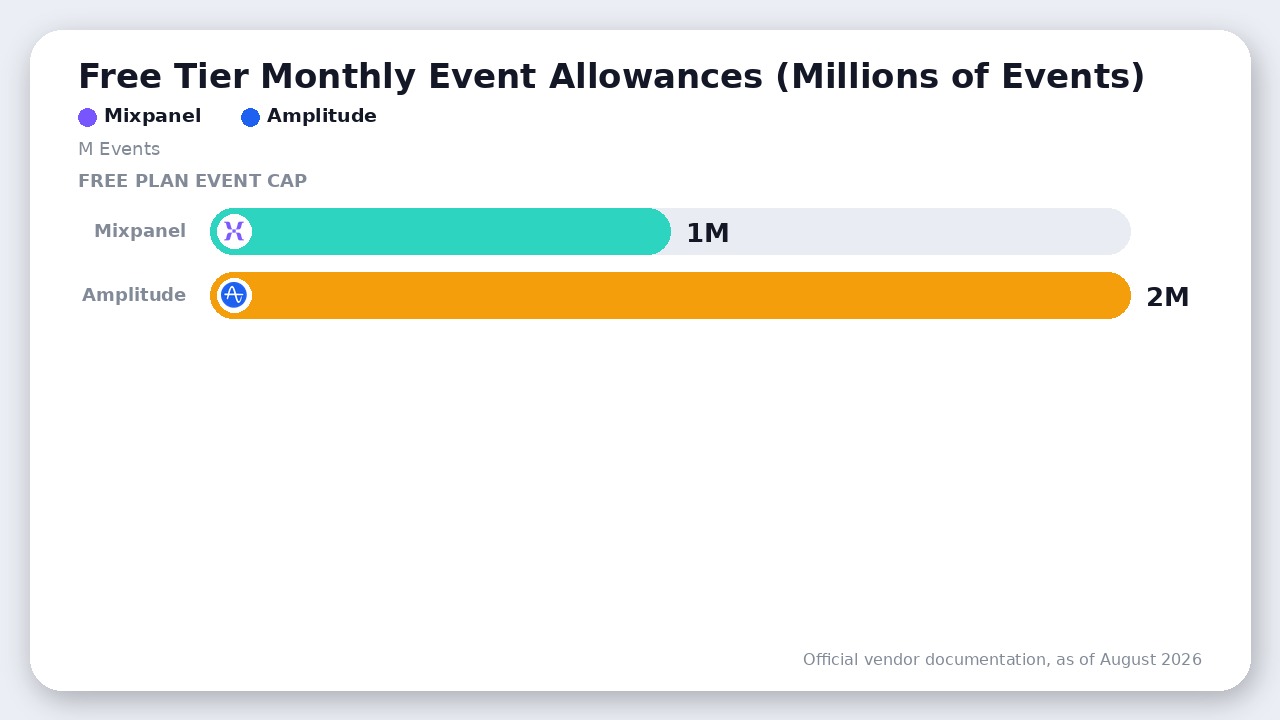
| Free Tier Allowance | 1,000,000 monthly events (10k session replays) | 2,000,000 monthly events (basic session replay) |
| Entry Paid Pricing | Growth starts free (1M free), then $0.28 / 1k events | Plus starts free (2M free), then scales up to 70M events/mo |
| Mid-Market / Enterprise Cost | Scales predictably by event volume (~$2.5k/mo at 10M events) | Custom contracts (median ~$64k/year via procurement benchmarks) |
| Native Experimentation | Paid add-on / third-party integration required | Built-in (Amplitude Experimentation module) |
| Data Governance | Mixpanel Lexicon (data dictionary & cataloging) | Amplitude Govern (strict schema validation & branching) |
| AI & MCP Support | Mixpanel Agent + Official Mixpanel MCP Server | Amplitude AI Agents + Official Amplitude MCP Server |
| B2B Account Analytics | Group Analytics (paid add-on on Growth) | Accounts add-on / native enterprise capability |
Note: Pricing and plan limits verified against official vendor documentation as of August 2026.
1. Event Modeling Philosophy: Ad-Hoc Agility vs. Strict Governance
The fundamental divide between Mixpanel and Amplitude is how each system expects your data to arrive.
Mixpanel: The Flat, Exploratory Event Stream
Mixpanel operates on an open, flexible event ingestion model. Any JSON payload sent with custom properties is immediately indexed and available for ad-hoc querying. If an engineer fires Document Created with a new property word_count, that property is immediately filterable across all funnel and breakdown reports without prior schema declaration.
This architecture makes Mixpanel exceptionally fast for exploratory analysis. When a product manager wants to test a hypothesis, they do not need to file a data governance ticket. They select the event, apply property breakdowns, and generate charts instantly. While Mixpanel offers Lexicon to merge, hide, and document event schemas, it does not lock down ingestion by default.
Amplitude: The Governed Taxonomy
Amplitude approaches behavioral data with the discipline of an enterprise data warehouse. Through Amplitude Govern, the platform treats your tracking plan as a versioned codebase with branching, approval workflows, and schema validation. If an incoming event violates the defined taxonomy, it can be flagged, transformed, or quarantined.
This structured approach pays dividends at enterprise scale. When hundreds of developers across distributed teams send event data, schema drift (such as user_signup versus User_SignUp) frequently degrades data trust in open architectures. Amplitude eliminates schema decay, ensuring that complex cohort definitions remain reliable across multi-year analyses. However, this discipline requires dedicated administrative oversight.
2. Pricing Structures and Hidden Budget Traps
Both vendors have transitioned to event-volume billing, but calculating total cost of ownership requires looking past the homepage headline.
Mixpanel Pricing
As of August 2026, Mixpanel provides a free tier covering up to 1 million events per month, complete with core funnels, flows, retention curves, and 10,000 session replays. However, free accounts are restricted to 5 saved reports per user account.
Mixpanel’s Growth Plan charges $0.28 per 1,000 events above the 1 million free event baseline ($0.00028 per event). At 10 million monthly events (9 million billable events), self-serve Growth costs approximately $2,520 per month (or roughly $30,240 annually).
The Mixpanel Pricing Trap: For B2B SaaS companies, the primary watch-out is Group Analytics. If you want to analyze metrics by company account rather than individual user ID, Group Analytics is a paid add-on on Growth. Similarly, automated Data Pipelines (exporting raw events to Snowflake, BigQuery, or Amazon S3) require an additional line item or an Enterprise upgrade.
Amplitude Pricing
As of August 2026, Amplitude offers a free Starter tier that provides 2 million events per month forever with unlimited team seats, basic session replay, and access to out-of-the-box templates.
Amplitude’s self-serve Plus Plan begins scaling past 2 million events up to 70 million events per month. Above the Plus tier, Amplitude’s Growth and Enterprise plans transition entirely to quote-based sales contracts. Procurement dataset benchmarks (including market data from Vendr) show the median annual Amplitude contract landing near $64,724 per year for mid-market and enterprise tiers.
The Amplitude Pricing Trap: Amplitude applies an event guardrail averaging up to 1,000 events per Monthly Tracked User (MTU) on certain standard agreements. If your application features highly engaged power users who trigger tens of thousands of telemetry events per session, unexpected volume overages can trigger rate multiplier adjustments unless negotiated upfront.
If you want an open-source or self-hosted alternative that combines product analytics with session replay and feature flags under one predictable bill, read our comparison of PostHog vs Mixpanel and PostHog vs Amplitude.
3. Beyond Analytics: Native Experimentation and Full-Stack Capabilities
Where Mixpanel focuses sharply on deep visual analytics and session replay, Amplitude has expanded into an all-in-one digital optimization suite.
Amplitude Experiment and CDP
Amplitude features native A/B testing and multivariate experimentation via Amplitude Experiment. Because experiments run on the exact same behavioral data layer, you can create a dynamic cohort (e.g., “Users who dropped off during checkout in the last 7 days”) and immediately target that exact group with an experimental UI variant. There is zero data lag between experiment exposure and funnel measurement.
Furthermore, Amplitude Activation acts as a built-in customer data platform (CDP), allowing teams to sync behavioral cohorts directly back into external marketing automation tools like Braze, HubSpot, and Google Ads.
Mixpanel Focus
Mixpanel deliberately avoids becoming a bloated all-in-one suite. While Mixpanel supports feature flag tracking and integrates smoothly with specialized experimentation tools (like LaunchDarkly, Statsig, or Optimizely), it treats experimentation as an adjacent workflow rather than a replacement for dedicated testing platforms. Mixpanel instead doubled down on tight visual analytics, intuitive retention breakdowns, and embedded Session Replay.
4. AI Workflows and Model Context Protocol (MCP)
Both platforms have heavily integrated AI agents and LLM tooling, transitioning product analytics from static dashboards into conversational interfaces.
Mixpanel AI and MCP Server
Mixpanel provides Mixpanel Agent, a system of specialized sub-agents that interpret data schemas, construct visual reports, and summarize retention anomalies.
Mixpanel also provides an official hosted Model Context Protocol (MCP) server. By adding Mixpanel’s MCP endpoint into AI clients like Claude Desktop, ChatGPT, or Cursor, developers and product managers can query events, funnels, retention, and dashboards in natural language.
The MCP server inspects your Lexicon schema, compiles the JSON analytics query, executes it against Mixpanel’s backend, and returns a verified data response and chart link directly inside your development flow.
Amplitude AI Agents and MCP
Amplitude introduced its Global Agent suite, designed to act as an automated product analyst. Amplitude AI Agents run proactive anomaly investigations in the background, generating causal hypotheses when key metrics drop and recommending targeted experiments.
Amplitude also maintains an official Amplitude MCP Server, exposing charts, cohorts, taxonomy schemas, and session replay queries to Claude, Cursor, and other MCP clients. Because Amplitude’s data structure is strictly governed, LLMs connecting through its MCP server encounter fewer ambiguity errors when parsing complex multi-step user properties.
Where Amplitude Actually Wins
To give credit where it is due, Amplitude is the superior platform in three specific scenarios:
- Unified Experimentation & Measurement: If your organization wants to run statistical A/B testing and feature flags without paying for a separate tool like LaunchDarkly or Statsig, Amplitude Experiment provides an integrated feedback loop.
- Complex Predictive Cohorts: Amplitude’s Compass and Personas engines surface behavioral correlations automatically better than manual ad-hoc slicing.
- Strict Enterprise Data Governance: In organizations with hundreds of engineers and strict compliance requirements, Amplitude Govern prevents the messy schema sprawl that often plagues unmanaged event streams.
The Verdict
For most software teams, venture-backed startups, and mid-market growth companies, Mixpanel is the winner.
Mixpanel delivers faster time-to-value, requires zero specialized data engineering maintenance, and offers an intuitive visual query interface that product managers, marketers, and founders actually enjoy using daily. Its transparent usage pricing and native session replay make it the more agile, cost-effective analytics engine.
Choose Amplitude only if you are an enterprise organization with dedicated data analysts who require version-controlled data governance (Amplitude Govern), native A/B experimentation (Amplitude Experiment), and complex predictive cohort clustering across a sprawling portfolio of products.
Frequently asked questions
Is Mixpanel easier to use than Amplitude?
Yes. Mixpanel features an intuitive, drag-and-drop report builder that product managers and marketers can navigate quickly without data engineering support. Amplitude provides deeper multi-touch journey mapping and causal analysis, but it requires a steeper learning curve and structured taxonomy maintenance.
How do Mixpanel and Amplitude compare on free tier limits?
As of August 2026, Amplitude provides a free Starter tier with 2 million monthly events, unlimited user seats, and basic session replay. Mixpanel provides a free tier with 1 million monthly events, 10,000 monthly session replays, and a limit of 5 saved reports per seat.
Can I use Mixpanel or Amplitude with AI assistants like Claude and Cursor?
Yes. As of August 2026, both Mixpanel and Amplitude offer official Model Context Protocol (MCP) servers. These allow developers and analysts to connect their analytics data directly to AI tools like Claude, ChatGPT, or Cursor to query conversion funnels and generate dashboards using natural language prompts.
Which tool is better for B2B SaaS account-level analytics?
Amplitude includes account-level grouping across its higher-tier plans, while Mixpanel offers Group Analytics as a paid add-on on its Growth plan. Teams analyzing retention and churn by company account rather than individual user ID must budget for Mixpanel’s Group Analytics add-on.
Final Recommendation
Mixpanel wins for most software teams due to its rapid speed-to-insight, zero-maintenance querying, and transparent self-serve pricing. Amplitude is the superior choice only when enterprise teams require native A/B experimentation, data governance pipelines, and complex causal behavioral analysis.

Leave a Reply