

Qwen (Tongyi Qianwen) is Alibaba Cloud’s foundation model family, combining open-weight releases with proprietary frontier LLMs. Developers outside China can access Qwen via qwen.ai, Alibaba Cloud Model Studio international endpoints (hosted in Frankfurt, Singapore, and Virginia with foreign credit card billing), cloud platforms like AWS Bedrock, or by self-hosting Apache 2.0 open weights locally.
Qwen, originally introduced in China under the native name 通义千问 (Tongyi Qianwen), is the flagship foundation model ecosystem developed by Alibaba Cloud. While many Western engineering teams first encountered Chinese large language models during recent benchmark disruptions, Qwen has quietly established itself as one of the most prolific, versatile, and heavily downloaded open-weight model families in the world.
Yet for international developers, engineering leads, and compliance officers evaluating Qwen AI, the core technical questions are rarely about raw benchmark scores alone. Instead, teams want clear answers to three practical questions: Where does prompt and corporate data actually travel? Can international developers reliably access and pay for the service outside mainland China? And how do the real USD token costs compare against Western alternatives?
Here is the verified, technical breakdown of Qwen’s pricing tiers, data residency infrastructure, and international access paths.
The Architecture: Open Weights vs. Hosted Proprietary Tiers
To evaluate Qwen accurately, you must understand that Alibaba operates a dual-track release model similar to Meta or Mistral, rather than a purely closed ecosystem like OpenAI or Anthropic.
- The Open-Weight Family (Qwen, Qwen2.5, Qwen3): Released under permissive licenses (primarily Apache 2.0 for models up to 72B parameters, with specific open community licenses for certain experimental sizes). These models can be downloaded directly from Hugging Face or ModelScope and self-hosted on private on-premises servers or virtual private clouds (VPCs).
- The Hosted Commercial API (Qwen-Turbo, Qwen-Plus, Qwen-Max, Qwen3.7-Max): Alibaba Cloud’s proprietary frontier models, accessible exclusively via managed APIs through Alibaba Cloud Model Studio (formerly known as DashScope internationally). These hosted versions incorporate reasoning optimizations, dynamic tool-calling engines, and hybrid thinking architectures.
- Specialized Multimodal Variants: Including Qwen-VL (vision-language), Qwen-Audio, Qwen-TTS, Qwen-Image (text-to-image generation), and the terminal-native agent framework Qwen Code (competing in developer workflows alongside tools analyzed in our Claude Code vs Cursor review).
1. Where Does Your Data Go? (Data Residency & Privacy)
Data sovereignty and governance are the primary friction points when enterprise teams evaluate Chinese AI providers. However, compared to startup labs whose infrastructure resides entirely within mainland China, Alibaba Cloud operates as an established global hyperscaler with distinct contractual and geographic separations.
The Contractual No-Training Pledge
Alibaba Cloud Model Studio’s published enterprise terms establish an explicit contractual privacy standard: customer input prompts and completion data submitted through the API are strictly protected and are never used to train or fine-tune foundation models.
This explicit contractual posture gives Qwen an immediate compliance advantage over Chinese API endpoints that train on user submissions by default, placing its enterprise API on par with the standard enterprise terms offered by OpenAI, Google Cloud, and AWS.
Geographic Endpoint Selection
When using the hosted API, where your data is processed depends entirely on the service deployment scope you configure:
- International Service Deployment (Singapore, Frankfurt, US Virginia): When provisioned through an international Alibaba Cloud account, requests are routed to international availability zones. For European businesses adhering to GDPR, deploying to the Frankfurt (Germany) endpoint ensures that prompt processing and transient data remain within the European economic area under Alibaba Cloud (Singapore) Private Limited governance.
- Mainland China Scope (Beijing / Hangzhou): If an account is provisioned directly on the domestic DashScope platform, data resides on servers in mainland China and is governed by PRC data security statutes, including cross-border data transfer review regulations.
- Self-Hosted Deployment (Zero Data Leakage): Because Qwen releases full weights for its 0.5B, 1.5B, 7B, 14B, 32B, and 72B models under Apache 2.0, enterprise teams with strict zero-trust or defense-level compliance requirements can run Qwen entirely inside air-gapped AWS, Azure, or on-premise GPU clusters using runtimes like vLLM or Ollama. In this configuration, no data ever touches Alibaba infrastructure.
2. Can You Actually Use It? (Access & Regional Availability)
Western developers do not need a mainland Chinese identity card, a Chinese phone number, or UnionPay banking rails to build with Qwen. There are four distinct ways to access the ecosystem:
Method 1: Alibaba Cloud Model Studio (Official International Portal)
International developers can register directly at alibabacloud.com/product/model-studio. The international platform:
* Accepts international business emails without mainland identity verification.
* Natively bills in USD using international credit cards (Visa, Mastercard, American Express) or enterprise wire invoicing.
* Provides OpenAI-compatible REST API endpoints, allowing developers to switch their base URL and use existing client SDKs with zero code refactoring.
Method 2: Qwen Studio Web & Desktop (Consumer & Pro UI)
At qwen.ai (and chat.qwen.ai), Alibaba offers a web-based conversational interface and native desktop clients for macOS and Windows. Users can sign up with standard Google authentication or email, test frontier reasoning modes (switching between “Thinking” and “Non-Thinking” modes), and leverage multimodal workspace artifacts.
Method 3: Major Cloud Hyperscalers & Model Hubs
If your organization prohibits opening new vendor accounts with overseas cloud providers, Qwen models can be deployed through Western managed infrastructure:
* AWS Bedrock & SageMaker: Select Qwen open-weights models are natively deployable directly through AWS infrastructure.
* Google Cloud Vertex AI: Qwen foundation models can be provisioned through Vertex AI Model Garden.
* OpenRouter & Hugging Face Inference Endpoints: Instant pay-as-you-go access with a single API key, billed directly through US entities.
3. What Does Qwen Cost in USD? (Official 2026 API Pricing)
Alibaba Cloud publishes fixed USD rate cards for its international Model Studio endpoints. Unlike domestic mainland endpoints that quote in Renminbi (CNY), international accounts are billed strictly in USD per 1,000,000 tokens.
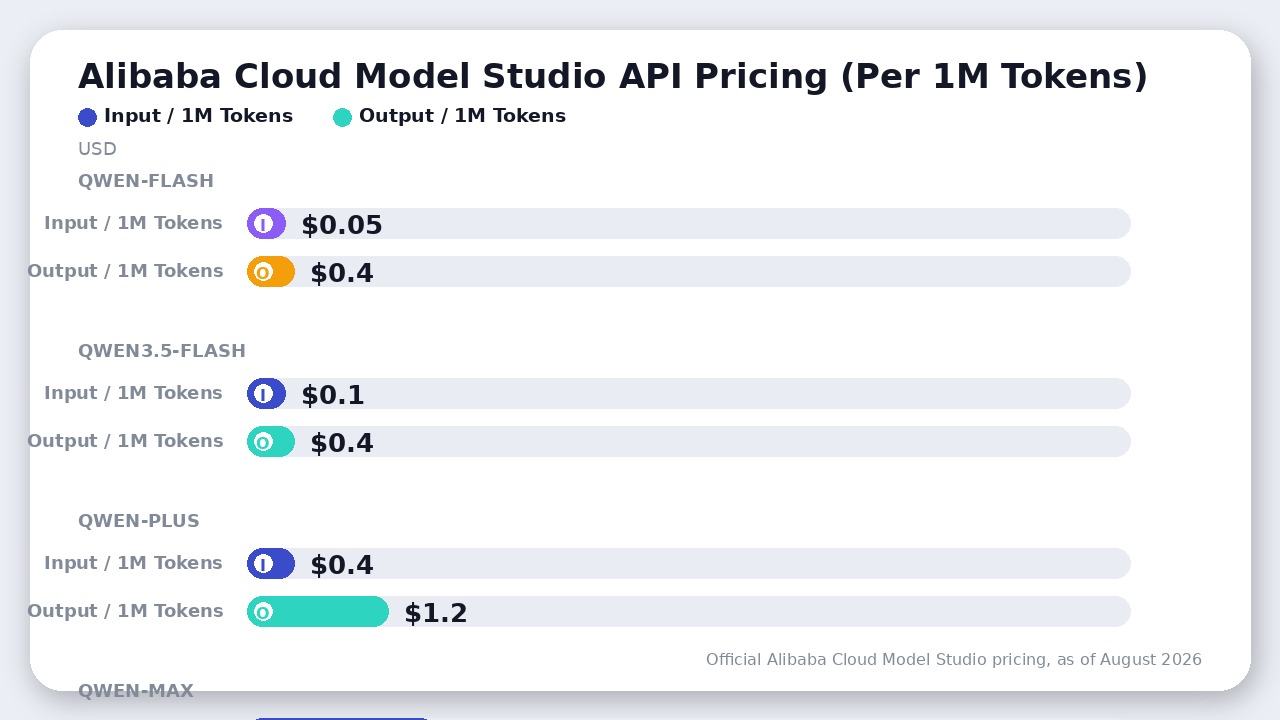
Verified Token Rate Card (As of August 2026)
| Model Tier | Context Window | Input Price / 1M Tokens | Output Price / 1M Tokens | Best Use Case |
|---|---|---|---|---|
| Qwen-Flash | 1,000,000 | $0.05 | $0.40 | High-throughput classification, routing, high-volume extraction |
| Qwen3.5-Flash | 1,000,000 | $0.10 | $0.40 | Agentic tool-calling pipelines and low-latency summarization |
| Qwen-Plus | 1,000,000 | $0.40 | $1.20 | General business logic, writing, structured data transformation |
| Qwen-Max | 32,768 | $1.60 | $6.40 | Complex reasoning, document analysis, multi-turn coding |
| Qwen3.7-Max | 1,000,000 | $2.50 | $7.50 | Frontier agentic workflows, autonomous reasoning, complex software development |
(Note: As of August 2026, Qwen3.7-Max also features an active promotional rate of $1.25 in / $3.75 out per 1M tokens on Model Studio).
Built-In Cost Optimization Features
- Free Trial Quota: Every newly activated international Model Studio account receives 1,000,000 free tokens per model tier, valid for 90 days from registration.
- Context Caching: Repeated prompt prefixes (such as large system instructions or static codebases) receive an implicit and explicit context caching discount. Cache hits are billed at 10% of standard input rates.
- Batch Inference: Non-real-time asynchronous batch calls receive a flat 50% discount on both input and output token rates.
Where Qwen Wins and Where It Falls Short
To understand whether Qwen belongs in your production stack alongside tools compared in our DeepSeek vs Qwen analysis, you must examine its concrete trade-offs.
Where Qwen Genuinely Wins
- Unmatched Multilingual Competency: Because Qwen was pretrained on extensive web-scale corpora across 119 languages and dialects, its translation fidelity, cultural nuance, and syntactic precision in Asian and European language pairs consistently outperform US-centric foundation models.
- True Weight Portability: Unlike closed APIs where pricing and model availability change at vendor discretion, Qwen’s commitment to Apache 2.0 open-weight releases gives engineering teams a permanent fallback: if API costs increase, you can spin up the exact same weights in your own private cluster.
- Hybrid Inference Efficiency: Qwen’s dual-mode reasoning architecture allows applications to toggle dynamically between deep “thinking traces” (extended chain-of-thought) for complex logic and rapid non-thinking output for simple interactions, preventing unnecessary token waste.
Where Qwen Falls Short
- Documentation Fragmentation: Alibaba maintains separate portals for domestic Chinese users (DashScope / Aliyun) and international users (Model Studio / Alibaba Cloud International). SDK documentation and code snippets frequently mix endpoint base URLs, causing initial configuration confusion for Western engineers.
- Tiered Pricing on Massive Prompts: While base rates are highly aggressive, certain long-context requests exceeding 256,000 tokens transition into tiered rate brackets where per-token pricing increases.
- Enterprise Procurement Hesitation: Despite standard cloud security certifications and Frankfurt data centers, enterprise legal teams with strict geopolitical mandates may still require lengthy compliance reviews before approving direct Alibaba Cloud API contracts, making third-party hosted deployments (like AWS Bedrock) necessary.
The Verdict
Qwen is the most viable and architecturally flexible Chinese foundation model for Western engineering teams. If you need cutting-edge multilingual reasoning, high-efficiency coding agents, or an escape hatch from Western proprietary API price floors, Qwen delivers frontier-class intelligence at a fraction of standard hyperscaler rates.
- For compliance-constrained enterprise teams: Self-host the Qwen 32B or 72B Apache 2.0 open weights on your own VPC, or invoke the managed API specifically through the Frankfurt or Virginia Model Studio endpoints to lock in complete data residency.
- For startup builders and agent developers: Leverage Qwen-Flash ($0.05/M) and Qwen-Plus ($0.40/M) on Model Studio’s OpenAI-compatible API to dramatically reduce operational unit economics while maintaining high-end agent tool-calling performance.
Frequently asked questions
Does Alibaba use prompts sent to Qwen to train its AI models?
On the commercial Alibaba Cloud Model Studio API, Alibaba Cloud’s official privacy terms explicitly state that customer prompt and completion data is never used to train or fine-tune models [1.1.4]. However, free consumer interactions on the public web chat at qwen.ai may be collected for service improvements unless users explicitly opt out according to consumer terms.
Can Western developers use Qwen without a Chinese phone number?
Yes. Western developers can register on Alibaba Cloud Model Studio International using a standard email and international credit cards (Visa, Mastercard, American Express) without a Chinese phone number or mainland identity verification. Qwen models can also be called directly via OpenRouter, AWS Bedrock, Google Cloud Vertex AI, and Hugging Face.
Where is customer data stored when calling the Qwen API?
When using Alibaba Cloud Model Studio International, developers can choose specific regional endpoints in Frankfurt (Germany), Virginia (United States), or Singapore. Data processed through these international regions remains confined to those infrastructure zones and is governed under Alibaba Cloud (Singapore) Private Limited rather than mainland Chinese entities.
Are Qwen models open source or proprietary?
Qwen uses a dual release strategy. Base and instruction-tuned dense models from 0.5B to 72B parameters, along with specialized coding and vision variants, are released as open weights under the Apache 2.0 license. The largest frontier architectures, such as Qwen-Max and Qwen3.7-Max, remain proprietary and accessible exclusively via hosted APIs.

Leave a Reply