

Baidu Ernie (文心一言 / Wenxin Yiyan) is Baidu’s flagship LLM ecosystem, offering free consumer chat and developer APIs via the Qianfan platform starting at $0.28 to $0.59 per 1M input tokens. However, all hosted API and web traffic terminates in mainland China under PRC cybersecurity laws, making it suitable for Chinese-market applications but legally restricted for sensitive Western enterprise data.
Baidu Ernie (文心一言 / Wenxin Yiyan), developed by Chinese search giant Baidu, was China’s first high-profile commercial answer to ChatGPT and Google Gemini. While early Western coverage dismissed it as a regional reaction, the underlying foundation model family—branded as ERNIE (Enhanced Representation through Knowledge Integration)—has grown into a technical heavyweight. Powered by Baidu’s proprietary PaddlePaddle deep-learning framework and integrated with Baidu’s search index and knowledge graphs, ERNIE represents one of the most capable multimodal systems for East Asian languages.
Yet for international developers, product managers, and enterprise buyers, evaluating Ernie Bot is rarely a question of benchmark scores alone. The real decision hinges on three practical questions: Where does your data live? Can your team actually sign up and pay? And how do token economics compare to global competitors like DeepSeek and Qwen?
Here is the transparent, unfiltered breakdown of Baidu Ernie’s pricing, data governance, and international accessibility.
1. Where Does My Data Go? (Data Residency & Privacy)
If you send prompts or document payloads to Baidu’s hosted services, your data is processed within the People’s Republic of China. Understanding how that data is governed requires separating consumer usage from enterprise API traffic.
Server Jurisdiction & Regulatory Architecture
Baidu hosts its official Ernie web interfaces (ernie.baidu.com and the Wenxiaoyan app) and its Qianfan Model-as-a-Service (qianfan.baidubce.com) on data centers located within mainland China (primarily Beijing, Baoding, and Guangzhou).
All infrastructure is governed by PRC law, specifically:
* The Cybersecurity Law (CSL) and Data Security Law (DSL), which impose strict data classification and security assessment protocols.
* The Personal Information Protection Law (PIPL), regulating user consent and data handling.
* The Interim Measures for the Management of Generative AI Services, enforced by the Cyberspace Administration of China (CAC). Under CAC rules, generative AI service providers must implement content moderation filters aligned with Chinese core values and retain interaction logs to assist with regulatory compliance.
Model Training on User Prompts
- Consumer Chatbot (
ernie.baidu.com): Baidu’s consumer terms explicitly permit the platform to log, aggregate, and process user inputs, conversational turns, and feedback to refine model accuracy, train future iterations, and conduct automated safety filtering. If you paste proprietary source code or confidential client data into the free web UI, you should assume it is subject to internal analysis. - Baidu AI Cloud Qianfan API: Under commercial enterprise agreements on the Qianfan platform, customer payload data sent through paid model endpoints is partitioned from public model training datasets. However, unlike Western providers (such as Anthropic or Azure OpenAI) that offer zero-data-retention (ZDR) agreements and SOC 2 Type II certifications with Western geographic fencing, Baidu retains diagnostic and safety audit logs inside the PRC to satisfy mandatory statutory compliance requirements.
The Open-Weights Alternative
In mid-2025, Baidu adjusted its closed-ecosystem strategy by open-sourcing multiple parameter variants of the ERNIE 4.5 family (ranging from compact edge models to larger MoE architectures) under the permissive Apache 2.0 license.
For engineering teams subject to strict European GDPR or US HIPAA compliance rules, downloading these open weights and running inference on your own AWS, GCP, or on-premise hardware completely eliminates data transmission to China. Note, however, that Baidu’s newest 5.x flagship iterations—including ERNIE 5.0 and ERNIE 5.1—remain proprietary, hosted-only models.
2. Can You Actually Use It Outside China?
Accessing Baidu’s ecosystem from outside China is technically feasible, but onboarding friction differs sharply depending on whether you want the consumer chat surface or the developer API.
The Consumer Interface (ernie.baidu.com)
Baidu does not actively geoblock international IP addresses; you can load the homepage from North America or Europe without a VPN. However, creating a functional user account requires a Baidu Passport (passport.baidu.com). While the registration dropdown accepts selected international country codes (+1 for the US, +44 for the UK, etc.), SMS one-time password (OTP) delivery to overseas carriers is notoriously inconsistent, often resulting in silent carrier timeouts. Users with an active mainland Chinese phone number or an existing WeChat account linked to verified Chinese credentials experience immediate verification.
Developer API Access (Baidu Qianfan)
For software developers, the primary route is Baidu AI Cloud Qianfan (console.bce.baidu.com/qianfan).
Key developer onboarding considerations:
1. SDK Compatibility: The Qianfan API exposes an OpenAI-compatible endpoint (/v2/chat/completions), allowing teams using the standard openai-python or LangChain libraries to swap base_url to Qianfan’s gateway with minimal refactoring.
2. Network Latency: Because inference servers reside in mainland China, API round-trip latency (TTFT – Time to First Token) from Western Europe or the Americas averages 400ms to 900ms higher than localized endpoints. Interactive UI applications targeting Western users require caching layers or edge routing to mask this physical transit delay.
3. Billing and Payment Rails: Baidu AI Cloud primarily bills in Chinese Yuan (CNY) through domestic payment gateways: Alipay, WeChat Pay, and UnionPay. International Visa and Mastercard credit cards cannot be charged directly on self-service accounts without going through Baidu Cloud’s enterprise cross-border procurement process or using third-party model aggregators like OpenRouter.
3. What Does It Cost in USD?
China’s domestic foundation model market experienced severe price wars throughout 2024 and 2025, driven by aggressive discounting from Doubao (ByteDance) and DeepSeek. In response, Baidu radically restructured both its consumer and enterprise pricing.
Consumer Pricing
- Free Tier (Current): Free of charge.
- Historical Context: Baidu originally charged ¥59.90/month (~$8.18 USD) for its ERNIE 4.0 “Professional” subscription. To retain market share against free competitors, Baidu dropped all subscription fees, opening advanced ERNIE 4.0 and 4.5 web capabilities to all registered users at no cost.
Developer API Token Pricing (as of August 2026)
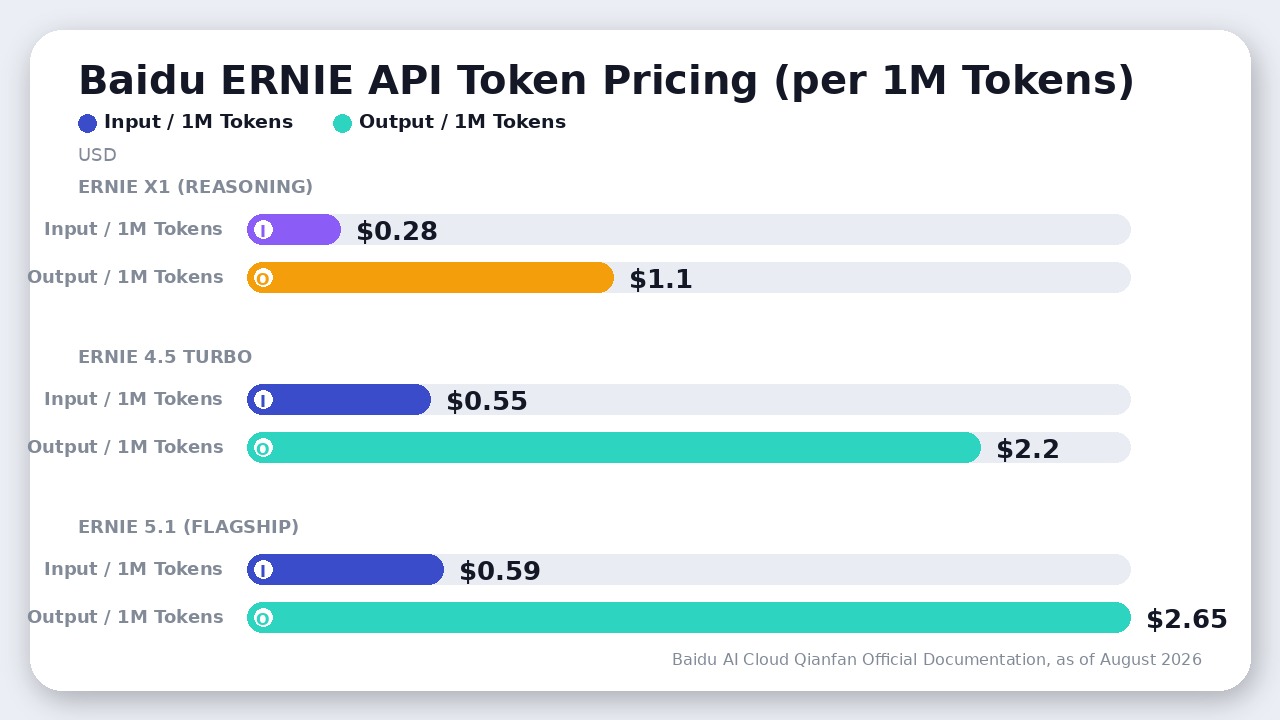
Through the Baidu Qianfan platform, API token pricing is transparently structured per million tokens. The table below reflects official rates published by Baidu AI Cloud:
| Model | Type / Parameter Tier | Input Price (USD / 1M tokens) | Output Price (USD / 1M tokens) | Context Window |
|---|---|---|---|---|
| ERNIE 5.1 | Flagship MoE / Search-Reasoning | $0.59 | $2.65 | 128k |
| ERNIE 4.5 Turbo | Multimodal Flagship | $0.55 | $2.20 | 128k |
| ERNIE X1 | Deep Reasoning / Agentic | $0.28 | $1.10 | 64k |
| ERNIE 4.0 Turbo | General Enterprise | $0.12 | $0.12 | 128k |
| ERNIE Speed / Lite | Lightweight Distillation | $0.00 (Free) | $0.00 (Free) | 8k–16k |
(Source: Official Baidu AI Cloud Qianfan pricing documentation, August 2026. Exchange calculated from official CNY rates at standard benchmark pricing).
At $0.59 per million input tokens for ERNIE 5.1, Baidu is pricing its flagship intelligence at roughly a fraction of Western frontier models like Claude 3.5 Sonnet or GPT-4o, while maintaining high accuracy in specialized reasoning benchmarks.
4. Where Baidu Ernie Genuinely Wins
Baidu Ernie is not merely a generic chatbot; it possesses architectural strengths tied to Baidu’s broader search and enterprise ecosystem:
- Deep Chinese Idiomatic and Cultural Understanding: While Western models handle standard Mandarin translation well, ERNIE excels in nuanced classical Chinese (Wenyanwen), local business jargon, Chinese legal contracts, and regional administrative idioms where OpenAI and Anthropic models frequently produce awkward literal phrasings.
- Baidu Search Index & Knowledge Graph Integration: Much like Google Gemini draws on Google Search, ERNIE integrates directly with the Baidu Search index and Baidu Baike (China’s largest online encyclopedia). For real-time mainland market data, consumer trends, and regulatory announcements within China, ERNIE’s retrieval-augmented generation (RAG) pipeline is unmatched in recency and depth.
- Knowledge Enhancement Architecture: ERNIE utilizes a “dual-engine” architecture combining structured entity knowledge with massive unsupervised pre-training. This design measurably reduces hallucination rates when querying factual data regarding Chinese corporate structures, geographic entities, and historical records.
5. Where It Falls Short
Despite its technical competence, Western teams must consider clear operational drawbacks:
- Regulatory Content Boundaries: Like all models hosted within the PRC, ERNIE enforces strict CAC-mandated filtering. Queries touching on sensitive Chinese political history, contemporary leadership, or cross-strait relations trigger hard refusal templates or abrupt session resets. If your workload requires unrestricted geopolitical analysis, ERNIE cannot be used.
- Hosted-Only Strategy for Newest Models: While Zhipu AI and Alibaba’s Qwen release nearly their entire model lineages as open weights, Baidu keeps its cutting-edge models (ERNIE 5.0 and 5.1) locked behind closed APIs.
- Enterprise Procurement Obstacles: Signing a formal enterprise SLA requires dealing with Baidu Cloud’s domestic legal entities, requiring cross-border currency structuring or Chinese corporate tax IDs.
The Verdict
Baidu Ernie is the premier LLM choice if your software operates inside mainland China or processes Chinese-language business data, but it is an operational mismatch for Western enterprise workloads with strict compliance boundaries.
- Choose Baidu Ernie (Qianfan API) if: You are building customer-facing applications for users in China, localizing complex eCommerce catalogs for the Chinese market, or need real-time search-augmented RAG backed by the Baidu search index.
- Choose an Alternative if: Your data governance policies prohibit processing payloads on servers within mainland China, or your organization requires self-hosted, unrestricted frontier weights—in which case open-weight alternatives like Qwen 2.5 or self-hosted DeepSeek-R1 are significantly better fits.
Frequently asked questions
Can I use Baidu Ernie outside China?
Yes, but with practical barriers. The web interface at ernie.baidu.com is globally reachable without a VPN, but account registration requires a mobile phone verification code where international numbers often fail. For developers, accessing the Qianfan API directly requires either an international Baidu Cloud verification pass or an API gateway like OpenRouter that routes requests to Baidu endpoints.
Does Baidu train its models on user prompt data?
On the consumer web interface and mobile app, Baidu’s terms of service state that conversation logs and prompt data may be retained and analyzed to improve models and ensure content safety compliance. On the enterprise Qianfan API platform, commercial terms state that enterprise customer inputs and outputs are not used for general foundation model pre-training, though audit logs are retained for regulatory compliance under Chinese law.
How much does the Baidu Ernie API cost in USD?
As of August 2026, Baidu Qianfan charges $0.59 per 1M input tokens and $2.65 per 1M output tokens for ERNIE 5.1. The reasoning-optimized model ERNIE X1 costs $0.28 per 1M input and $1.10 per 1M output tokens, while the lightweight ERNIE Speed model is offered for free on basic developer tiers.
Can I self-host Baidu Ernie to keep my data local?
You can self-host select ERNIE 4.5 open-weight models that Baidu released under the Apache 2.0 license, which prevents any prompt data from leaving your private cloud or on-premise infrastructure. However, Baidu’s newest flagship models, including ERNIE 5.0 and ERNIE 5.1, are closed-source and exclusively available through Baidu’s hosted Qianfan API.

Leave a Reply