

PostHog wins this PostHog vs Mixpanel matchup for most modern product-led software teams, but the reason isn’t just that it offers more features for less money—it is a fundamental divergence in architecture. Choosing between PostHog and Mixpanel is a decision between buying an all-in-one developer platform or a hyper-focused pure analytics engine.
While vendor comparison roundups list feature checkboxes side-by-side, they consistently dodge the operational realities that actually break your budget: Mixpanel’s free tier hard lockout, PostHog’s autocapture bill explosion, and the architectural friction of stitching third-party session replays to conversion funnels.
The 30-Second Answer
- Pick PostHog if: You are a developer-led, engineering, or product-led growth (PLG) team that wants product analytics, session replay, feature flags, A/B experiments, error tracking, and surveys natively wired into a single SDK. You prefer transparent step-down usage rates and the ability to click directly from a drop-off point in a conversion funnel to the exact user recording.
- Pick Mixpanel if: You are a non-technical product manager, growth marketer, or executive team that requires an ultra-fast query UI with zero SQL knowledge. You prioritize rigorous manual event schema governance and want to prevent engineers from wading through raw DOM click noise.
PostHog vs Mixpanel: Feature & Quota Breakdown
Pricing and tier data verified from official vendor documentation as of August 2026.
| Comparison Dimension | PostHog (Cloud) | Mixpanel |
|---|---|---|
| Core Architecture | Unified dev platform (Analytics + Replays + Flags + Surveys + Errors) | Pure-play product analytics platform |
| Free Tier Allowance | 1M analytics events, 5k session replays, 1M feature flags/mo | 1M events/mo, 10k session replays/mo, unlimited seats |
| Free Cap Behavior | Continues tracking; billed at usage-based rates once card added | Hard report viewing lockout when 1M cap is reached |
| Post-Free Event Rate | $0.05 per 1,000 events (1M–2M); drops to $0.0343 per 1,000 (2M–15M) | $0.28 per 1,000 events on Growth plan (flat rate) |
| Default Event Ingestion | Autocapture (DOM clicks, pageviews, inputs) + custom SDK calls | Manual explicit tracking calls (or optional autocapture) |
| Session Replay Integration | Built-in natively; linked directly to funnels and cohorts | Included (10k free on Free; 20k on Growth), capped add-on |
| Feature Flags & A/B Testing | Built-in natively (1M free requests/mo) | Paid add-on / third-party integration required |
| Data Control & Open Source | Open-source core; Cloud or self-hosted options | Proprietary cloud SaaS |
The Pricing Mechanics: Step-Down Volume vs. The “Dashboard Blackout”
Both platforms market a “1 million free monthly events” headline, but their billing mechanics once you scale—or breach that limit—could not be more different (pricing accurate as of August 2026).
Mixpanel’s free plan grants 1 million events per month, 10,000 session replays, and unlimited seat licenses. However, Mixpanel enforces a strict enforcement mechanism on its free tier: if your application spikes and crosses 1,000,000 events before month-end, Mixpanel locks your team out of viewing reports. Your dashboards go dark until the next calendar billing cycle unless you upgrade to the Growth plan.
When you upgrade to Mixpanel Growth, as of August 2026, event pricing starts at $0 base and meters at a flat rate of $0.28 per 1,000 events (or $0.00028/event) for volume exceeding the 1M free baseline.
PostHog approaches pricing through modular, usage-based step-down curves across every product line. On PostHog Cloud (as of August 2026), the free tier resets monthly and includes 1,000,000 product analytics events, 5,000 web session recordings, 1,000,000 feature flag requests, 100,000 error tracking exceptions, and 1,500 survey responses.
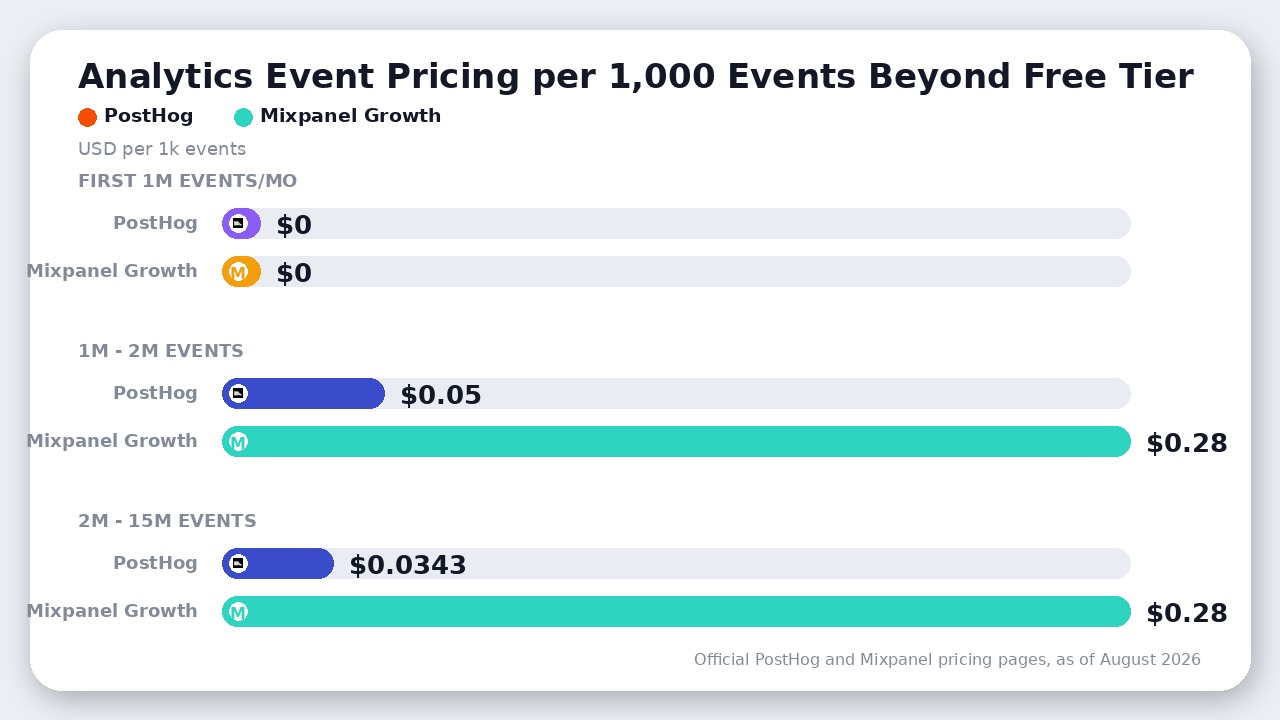
Once you exceed the 1M event threshold on PostHog, event costs step down as your volume grows (as of August 2026):
* 1M to 2M events: $0.000050 per event ($0.05 per 1,000 events)
* 2M to 15M events: $0.0000343 per event ($0.0343 per 1,000 events)
* 15M to 50M events: $0.0000295 per event ($0.0295 per 1,000 events)
As demonstrated in the data, scaling from 1 million to 5 million events costs roughly $1,120 per month on Mixpanel Growth (4 million paid events at $0.28 per 1,000), whereas PostHog’s analytics event charge for the same 4 million paid events comes out to $152.90 per month ($50 for 1M–2M plus $102.90 for 2M–5M, as of August 2026).
Autocapture vs. Manual Governance: The Hidden Bill Surprise
The largest trap in comparing PostHog vs Mixpanel lies in how they ingest user interaction data.
PostHog enables autocapture by default. The moment you insert the posthog-js snippet, it automatically logs every DOM button click, form submission, input change, and page view.
The Autocapture Pricing Trap: Because PostHog records raw user interactions automatically, an application with 20,000 monthly active users might generate 5x to 15x more raw events in PostHog than it would in Mixpanel under a disciplined manual event schema. If left unconfigured, autocapture noise can burn through PostHog’s 1M free tier in days. To prevent surprise bills, engineering teams must configure PostHog’s event rates, set billing limits in the dashboard, or explicitly filter out high-frequency DOM elements.
Mixpanel historically built its reputation on strict manual tracking. Engineers manually instrument discrete server and client calls (e.g., mixpanel.track('Order Completed')). While this requires upfront developer effort to write and maintain tracking code, it keeps event schemas clean, structured, and predictable. Mixpanel has added autocapture capabilities, but its workflows still prioritize curated event taxonomy.
If your team values zero-code setup and wants to analyze historical user actions retroactively without deploying new tracking code, PostHog’s autocapture is an enormous superpower. If your team insists on strict data governance where every event represents a verified business outcome, Mixpanel’s paradigm is cleaner out of the box.
Unified Suite vs. Pure Analytics Engine
Where PostHog completely alters the decision equation is platform breadth.
If you choose Mixpanel for product analytics, you get best-in-class conversion funnels, retention matrices, and user flows. However, when a product manager sees a 40% drop-off in a sign-up funnel, Mixpanel can only show that users dropped off. To figure out why, you either need to rely on Mixpanel’s capped session replay add-on (20,000 replays/mo on Growth) or purchase, install, and pay for a separate tool like LogRocket or Hotjar. Furthermore, running A/B tests or toggling feature flags requires integrating another third-party platform.
PostHog builds these tools directly into the same database and SDK. When analyzing a conversion drop-off in a PostHog funnel, you click directly on the dropped-off cohort and launch a filtered list of session replays showing the exact DOM interactions of those specific users. You can verify if a button was broken, launch a feature flag fix, roll out a survey to affected users, and track exception logs—all inside one browser tab.
For teams looking at the broader analytics ecosystem, you can also read our PostHog vs Amplitude breakdown to evaluate how PostHog compares against legacy enterprise analytics giants.
Where Mixpanel Actually Wins
Despite PostHog’s engineering momentum, Mixpanel maintains clear operational advantages for specific organization types:
- Query UI Speed and Accessibility for Non-Technical PMs: Mixpanel’s user interface remains the fastest, most intuitive UI in the analytics category. Building complex multi-step funnels, applying breakdown formulas, and generating retention cohorts requires zero SQL knowledge and zero technical setup. Non-technical marketers and product managers can answer complex questions in seconds without pinging engineering.
- Data Governance & Clean Taxonomy: Because Mixpanel discourages unformatted event dumps, large teams with dozens of contributors avoid unpredictable event clutter that often plagues unmonitored PostHog instances.
- No Risk of Unintentional Autocapture Overages: Mixpanel’s flat event pricing on Growth makes budgeting straightforward for teams with strict event taxonomy, whereas PostHog requires active management of billing caps.
Frequently Asked Questions
Is PostHog really free?
Yes. PostHog’s free tier is permanent and resets every month (as of August 2026). It includes 1 million analytics events, 5,000 web session recordings, 1 million feature flag requests, 100,000 error tracking exceptions, and 1,500 survey responses with no credit card required. You only pay if your monthly volume exceeds these limits after adding payment details.
Does Mixpanel include session replay?
Yes. Mixpanel includes session replay on all plans (as of August 2026), providing 10,000 free session replays per month on the Free plan and 20,000 on the Growth plan. However, advanced volume and retention controls for replays are treated as paid add-ons compared to PostHog’s native, unified session replay infrastructure.
Is PostHog hard to set up compared to Mixpanel?
PostHog is actually faster to install initially because its snippet autocaptures web interactions immediately without writing manual tracking calls. However, configuring advanced data pipelines, self-hosting, or writing custom SQL queries inside PostHog requires higher technical comfort than Mixpanel’s pure visual reporting interface.
The Verdict
For 90% of modern software teams—especially startups, developer-led companies, and product-led growth (PLG) SaaS—PostHog is the decisive winner.
Unifying product analytics, session replay, feature flags, A/B testing, and error tracking into a single SDK eliminates tool fragmentation. Combine that with a pricing structure that scales at $0.05 (or lower) per 1,000 events compared to Mixpanel’s $0.28 per 1,000 events (as of August 2026), and PostHog delivers vastly superior ROI.
Choose Mixpanel only if your product team consists primarily of non-technical product managers and growth marketers who refuse to write tracking schemas, do not need unified feature flags or developer tooling, and demand the absolute fastest zero-SQL funnel UI on the market.
Final Recommendation
PostHog wins this matchup for product-led startups and developer-led engineering teams because it unifies product analytics, native session replay, feature flags, and error tracking under one SDK at significantly lower per-event scaling costs (as of August 2026). Mixpanel remains superior only for non-technical product managers who want an ultra-fast, zero-SQL query interface and strict manual data governance.

Leave a Reply