

When comparing Clay vs Apollo.io, many sales teams ask the wrong question. They treat them as head-to-head competitors in the “lead generation” category.
In reality, they represent two completely different philosophies of outbound sales. Apollo is an all-in-one execution engine built around a single, massive database. Clay is a data orchestration layer designed to query, enrich, and clean data across 150+ different providers.
If you want a predictable, simple outbound flow that your sales reps can manage themselves, Apollo wins. But if your target market is niche, your data needs are complex, and you have the technical bandwidth to engineer a multi-source pipeline, Clay is exceptionally well-suited to unlock high-match-rate outbound.
The 30-Second Answer
- Pick Apollo.io if: You are a solo founder, a small sales team, or a standard SDR org. You want to find leads, build multi-step email sequences, and make cold calls from a single dashboard with a predictable per-seat cost.
- Pick Clay if: You have a dedicated RevOps operator, your target accounts are hard to find in standard databases, and you want to build custom AI-driven personalization workflows using data from dozens of different providers.
Clay vs Apollo: The Core Philosophy Clash
To understand why these tools are rarely direct competitors, look at where their data comes from.
Apollo.io is a verticalized, all-in-one platform. Its primary moat is its proprietary database of over 275 million contacts. You log in, apply search filters, export a list of leads, and immediately push them into Apollo’s built-in email sequences or use its native dialer. It is a closed ecosystem. The problem? Because Apollo relies on its own static database, data decay is inevitable. Users on G2 and Reddit consistently report email bounce rates of 5% to 10% on Apollo-sourced lists.
Clay, by contrast, is a horizontal GTM engineering platform. Clay does not own a contact database. Instead, it is a highly programmable spreadsheet that connects to 150+ external data providers (including Apollo, Cognism, Hunter, and Lusha) via API.
Rather than relying on one database, you build waterfall enrichment workflows in Clay. For example, you can program a table to:
1. Search for a prospect’s email using Provider A.
2. If Provider A returns nothing, automatically query Provider B.
3. If Provider B fails, query Provider C.
4. Use Claygent (Clay’s AI research agent) to scrape the prospect’s LinkedIn profile and verify their actual job function.
By chaining these providers together, Clay users routinely achieve email match rates of 75% to 85%, reducing bounce rates to under 2%. However, Clay does not handle outbound execution. It has a very basic email sequencer, but for real multi-step cold outreach, you must export Clay’s clean data into a dedicated cold email platform like Instantly or Smartlead.
| Feature | Apollo.io | Clay |
|---|---|---|
| Core Approach | All-in-one sales execution platform | Data orchestration & GTM engineering layer |
| Primary Database | 275M+ proprietary contacts | None (aggregates 150+ providers via API) |
| Pricing Model | Per-seat subscription + credit caps | Platform fee (unlimited seats) + dual credits |
| Email Accuracy | ~73% (single-database risk) | 75%–85% (via multi-provider waterfalls) |
| Native Sequences | Yes (multichannel sequences, dialer) | Extremely basic (requires external sequencer) |
| CRM Integration | All paid plans | Growth plan ($495/mo as of July 2026) and above only |
| Learning Curve | Low (1–2 hours) | Steep (2–4 weeks, RevOps operator recommended) |
The Pricing Traps They Don’t Want You to Calculate
Both platforms use credit systems, but they hide vastly different financial bottlenecks. If you only look at the headline sticker prices, you will get caught in a costly pricing trap.
Clay’s Dual-Currency “Platform Tax”
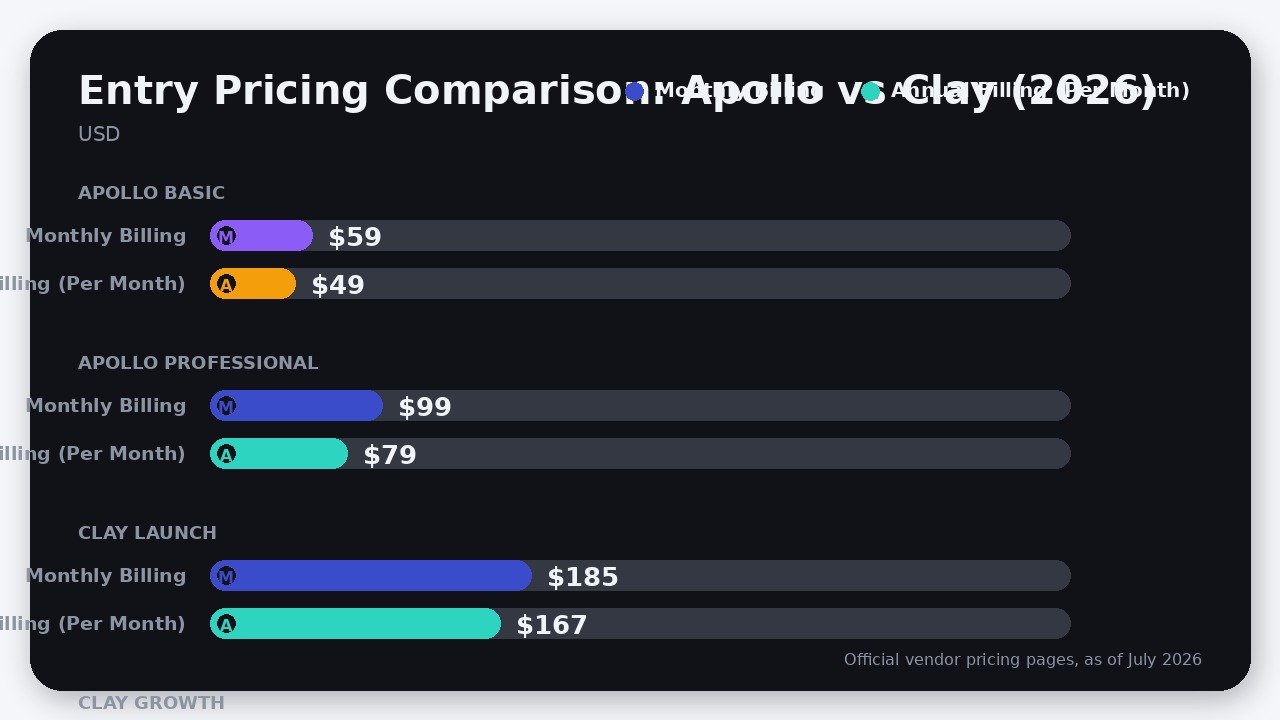
On March 11, 2026, Clay executed a massive pricing overhaul. As of July 2026, Clay’s legacy tiers are collapsed into two self-serve plans: Launch ($185/month, or $167/month billed annually) and Growth ($495/month, or $446/month billed annually).
With this update, Clay split its billing into two separate currencies:
1. Data Credits: Spent to buy actual data from Clay’s marketplace providers (e.g., finding an email).
2. Actions: Spent on platform operations (e.g., running a formula, executing an AI column, or syncing a row to your CRM).
The Trap: Under the old pricing model, if you connected your own API keys (BYO keys) for external tools, running those enrichments in Clay was essentially free. Now, even if you use your own API keys, Clay charges you 1 Action per step. Furthermore, as of July 2026, Salesforce and HubSpot bidirectional CRM syncs are strictly locked behind the $495/month Growth plan. If you are on the Launch plan, you cannot automate your CRM pipeline without manually exporting CSVs.
The Silver Lining: Clay no longer charges Data Credits or Actions for failed lookups. If your waterfall queries three providers and finds nothing, your credit balance remains untouched. However, “failed” is defined narrowly—if a provider returns a generic, unverified email, it still counts as a match and you are billed.
Apollo’s 100-Mobile-Credit Wall
As of July 2026, Apollo’s pricing appears highly predictable:
– Basic: $49/user/month billed annually ($59 month-to-month)
– Professional: $79/user/month billed annually ($99 month-to-month)
– Organization: $119/user/month billed annually ($149 month-to-month, 3-seat minimum)
The Trap: While Apollo advertises “unlimited” email sends and sequences, its data access is heavily metered by credits that reset monthly with zero rollover. Even more importantly, mobile phone numbers are strictly rationed. Even on the Professional plan (priced at $79/user/month as of July 2026), your reps are capped at just 100 mobile number reveals per month. If your team relies on cold calling, you will hit this hard limit in your first week, forcing you to buy expensive overage credits or upgrade to the Organization tier.
The Hybrid Hack: How to Run Both
Because these tools serve different parts of the outbound stack, many successful GTM teams in 2026 do not choose between Clay vs Apollo—they run them together.
If you buy data directly through Clay’s marketplace, you pay a retail markup on every lookup. But Clay allows you to input your own external API keys.
By subscribing to Apollo Basic ($49/user/month as of July 2026), you get access to Apollo’s API. You can then connect your Apollo API key directly to Clay’s Growth plan ($495/month as of July 2026).
This workflow allows you to:
1. Use Apollo as a cheap, high-volume data source to pull your initial list of target accounts and contacts.
2. Pipe those contacts into Clay using your own Apollo API key, bypassing Clay’s marketplace Data Credit costs.
3. Use Clay’s advanced waterfall logic and Claygent AI only to enrich the high-value leads that Apollo missed or couldn’t verify.
4. Push the final, ultra-clean list directly into a dedicated cold email sender or your CRM.
This hybrid setup gives you the massive database access of Apollo with the precision and deliverability protection of Clay’s waterfall engine.
Where Apollo Actually Wins
Despite Clay’s superior data accuracy, Apollo remains a leading option for speed-to-value and ease of use.
Clay is notoriously complex. It is essentially a development environment disguised as a spreadsheet. Building advanced tables, formatting JSON outputs, configuring API calls, and troubleshooting failed webhooks takes weeks of training. If your team doesn’t have a dedicated RevOps operator or a “GTM Engineer,” Clay can quickly become an expensive, unmanaged mess of wasted credits.
Apollo requires almost zero technical setup. A solo founder or a junior SDR can log in, build a list, write a three-step email sequence, and launch a campaign in under an hour. It also includes features Clay completely lacks, such as a native dialer, call recording, A/B testing, and email warmup tools. If your outbound strategy relies on high-volume, multichannel activity managed entirely by your sales reps, Apollo is a highly practical choice.
The Verdict
Our verdict is conditional on your team’s technical resources and outbound strategy:
Choose Apollo.io if you are a startup, a small agency, or a standard sales team that needs an all-in-one, predictable execution stack. It is the fastest and most cost-effective way to go from zero to sending outbound campaigns.
Choose Clay if you are a mid-market company, a high-growth SaaS team, or a data-driven outbound agency with a dedicated RevOps resource. If your primary revenue bottleneck is dirty data, low email deliverability, or highly specific targeting that standard databases can’t solve, Clay’s waterfall orchestration is worth every penny of its premium price.
And if you want an exceptionally powerful approach to modern outbound, don’t pick: run Apollo Basic as a data source inside Clay Growth to build a high-performance, cost-optimized pipeline.
Final Recommendation
Clay is the clear winner for modern, hyper-personalized GTM teams that need deep waterfall enrichment, while Apollo remains the best all-in-one choice for traditional SDR teams prioritizing simplicity.

Leave a Reply