

Doubao AI is ByteDance’s flagship conversational and multimodal model family. Outside mainland China, international developers access Doubao via BytePlus ModelArk in USD ($0.10 to $0.50 per million input tokens) or global third-party gateways. Because Doubao is closed-weight, self-hosting is impossible: your prompts process either in mainland China (via Volcano Engine) or Singapore (via BytePlus).
Doubao AI is ByteDance’s flagship conversational and multimodal model family. Outside mainland China, international developers access Doubao via BytePlus ModelArk in USD ($0.10 to $0.50 per million input tokens) or global third-party gateways. Because Doubao is closed-weight, self-hosting is impossible: your prompts process either in mainland China (via Volcano Engine) or Singapore (via BytePlus).
If you have tracked the explosion of Chinese foundation models, you know that names like DeepSeek and Alibaba’s Qwen dominate Western headlines because of their open-weight releases. But inside China’s consumer and enterprise software markets, Doubao (native name: 豆包) is the undisputed volume leader. Powered by ByteDance—the parent company of TikTok and Douyin—Doubao boasts over 150 million monthly active users on its consumer app and processes hundreds of billions of daily tokens across enterprise workloads.
For Western developers, marketers, and engineering leaders, Doubao presents a very specific set of questions. Is it accessible outside China? What does it actually cost when billed in US Dollars? And most crucially: where does your prompt data travel, and does ByteDance train on it?
Here is the complete, unfiltered breakdown of Doubao’s architecture, overseas access routes, USD pricing, and compliance boundaries as of August 2026.
1. Where Does My Data Go? (The Data Residency Trap)
When evaluating any tool originating from China, data residency is not a side note—it dictates whether procurement will sign off. With Doubao, your legal and architectural risk depends entirely on which door you enter.
ByteDance operates two distinct infrastructure stacks for AI:
- The Mainland China Infrastructure (Volcano Engine / 火山引擎): If you register through
volcengine.comor converse directly ondoubao.com, your data resides on servers in mainland China (primarily Beijing and Shanghai data centers). This traffic falls squarely under the jurisdiction of the People’s Republic of China (PRC), including the Data Security Law and the Personal Information Protection Law (PIPL). Under the consumer terms of service ondoubao.com, user interactions may be logged and utilized for safety monitoring and model alignment. - The International Enterprise Infrastructure (BytePlus ModelArk): To serve global enterprise clients, ByteDance routes international developer accounts through BytePlus Pte. Ltd., an entity headquartered and registered in Singapore. API calls to BytePlus endpoints (
*.bytepluses.com) process requests across data centers in Singapore, Southeast Asia, and regional cloud nodes outside mainland China’s regulatory borders. Enterprise contracts on BytePlus provide data-processing agreements (DPAs) with zero-retention policies for API inputs and outputs.
The Open-Weight Reality: No Self-Hosting
It is critical to contrast Doubao against open-weight ecosystems. When teams deploy models like those covered in our DeepSeek vs Qwen analysis, they have the option to spin up an on-premises GPU cluster or a private AWS VPC, guaranteeing that zero bytes leave their corporate perimeter.
Doubao does not offer open weights. All foundation models—from the Doubao-Seed reasoning models to the Seedance video models—are closed-weight proprietary systems. You cannot download model checkpoints to run on your own hardware. Every single token must pass through ByteDance’s managed API endpoints or a commercial aggregator.
If your compliance framework strictly forbids sending unencrypted corporate payloads to external cloud providers or specifically prohibits entities associated with ByteDance, Doubao is an immediate non-starter.
2. Can You Actually Use It Outside China?
Access to Doubao differs sharply between consumer interfaces and developer APIs.
Consumer Web and Mobile Apps
If you visit doubao.com or download the Doubao app from the iOS App Store or Google Play, you will hit an immediate wall: onboarding requires SMS verification via a mainland Chinese (+86) mobile phone number or an authenticated domestic account (such as Douyin or WeChat). Overseas phone numbers are generally rejected on the domestic consumer client.
For international consumers wanting ByteDance’s conversational AI assistant on mobile, ByteDance operates Dola (formerly branded as Cici), developed under its Singapore subsidiary Spring (SG) Pte. Ltd. However, Dola frequently routes behind-the-scenes workloads through alternative commercial engines rather than strictly mirroring China’s domestic Doubao model pipeline.
Developer and API Access
For developers integrating Doubao models into production applications, access is straightforward and fully functional worldwide:
- BytePlus ModelArk (First-Party International): You can register with an international email address and pay using standard international credit cards (Visa, Mastercard) without needing a Chinese business license or +86 phone number. BytePlus provides an OpenAI-compatible REST API, allowing you to drop Doubao models directly into LangChain, LlamaIndex, or custom SDKs by modifying the base URL and API key.
- Third-Party Model Aggregators: Global routing platforms (including OpenRouter, APIMart, and Ofox) proxy Doubao-Seed and Seedance models, billing in USD with standard credit cards or crypto balances.
- IDE Integration: ByteDance also powers developer tooling directly. For example, in our breakdown of Trae vs Cursor, ByteDance’s AI IDE incorporates native Claude and Doubao capabilities for software engineering workflows.
3. What Does Doubao Cost in USD?
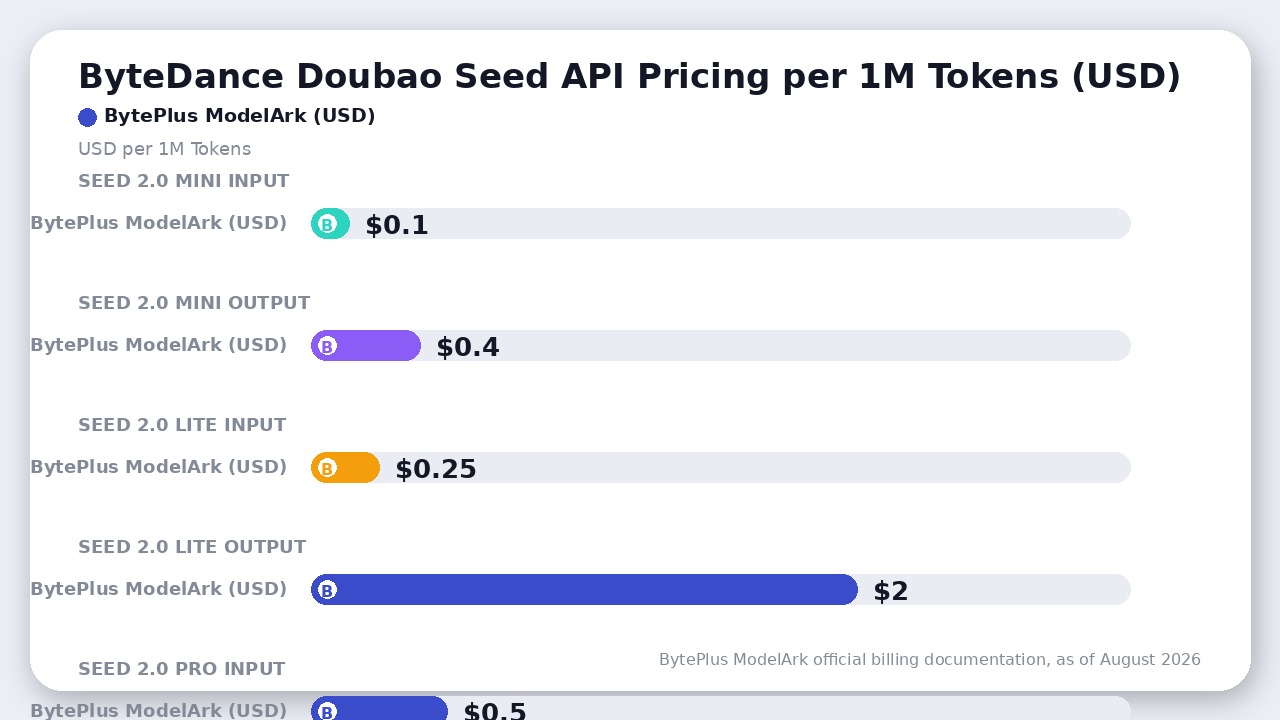
ByteDance has consistently used aggressive pricing as a market weapon, triggering widespread price wars across the Asian AI landscape. Below is the verified USD pricing for Doubao’s core language and reasoning models hosted via BytePlus ModelArk as of August 2026.
Doubao Seed 2.0 Text & Reasoning API Pricing
On BytePlus ModelArk, Doubao text models are billed per million tokens under pay-as-you-go tiers:
| Model Tier | Context Window | Prompt Length Condition | Input Price (per 1M tokens) | Output Price (per 1M tokens) | Cache Hit Input (per 1M tokens) |
|---|---|---|---|---|---|
| Doubao Seed 2.0 Mini | 256K | 0 to 128K tokens | $0.10 | $0.40 | $0.02 |
| Doubao Seed 2.0 Mini (Long) | 256K | 128K to 256K tokens | $0.20 | $0.80 | $0.04 |
| Doubao Seed 2.0 Lite | 256K | 0 to 128K tokens | $0.25 | $2.00 | $0.05 |
| Doubao Seed 2.0 Lite (Long) | 256K | 128K to 256K tokens | $0.50 | $4.00 | $0.10 |
| Doubao Seed 2.0 Pro | 256K | 0 to 128K tokens | $0.50 | $3.00 | $0.10 |
| Doubao Seed 2.0 Pro (Long) | 256K | 128K to 256K tokens | $1.00 | $6.00 | $0.20 |
Pricing verified against official BytePlus ModelArk documentation as of August 2026.
For bleeding-edge engineering workloads, ByteDance’s newer Doubao Seed 2.1 Pro and Turbo models (announced at the Volcano Engine FORCE conference) are billed on international routing tiers at approximately $0.88 to $0.90 per 1M input tokens and $4.42 to $4.50 per 1M output tokens for Pro, with Turbo priced at exactly half.
Multimodal Video Pricing: Seedance 2.0 and 2.5
Beyond language models, ByteDance has positioned its Seedance (often branded under Dreamina or Jimeng) video models directly against Western platforms like Runway Gen-3 and OpenAI’s Sora.
On BytePlus ModelArk, Seedance API video inference is priced based on resolution and token duration:
* Seedance 2.0 (480p): Approximately $0.07 to $0.10 per second (~$0.35 to $0.51 per 5-second generation).
* Seedance 2.0 / 2.5 (720p): Approximately $0.15 to $0.23 per second (~$0.76 to $1.16 per 5-second generation).
* Seedance 2.0 Mini: Budget variant capped at 480p/720p running at roughly 30% to 50% discount compared to full cinematic tiers.
Compared to Western hosted video generation—where equivalent 5-second 720p renders frequently cost $1.50 to $3.00—Doubao’s Seedance represents an enormous per-clip cost reduction for programmatic social media pipelines.
4. What Doubao Actually Excels At (and Where It Fails)
Like other frontier Chinese labs we have profiled (such as in our guide to Kimi AI), ByteDance’s models are optimized for high concurrency, ultra-cheap inference, and deep native Chinese linguistic capability.
Where Doubao Wins
- Linguistic Parity in Chinese Dialects & Slang: Because Doubao is trained on the massive multimodal corpora generated across ByteDance’s consumer ecosystem (Douyin, Toutiao, Lemon8), its mastery of contemporary Chinese culture, idioms, cross-border e-commerce phrasing, and localization is virtually unmatched.
- Agentic Screen & App Navigation: ByteDance’s research arm has heavily focused on UI grounding (such as the UI-TARS framework). Doubao exhibits remarkably high benchmark performance when parsing complex screenshots, clicking interface buttons, and automating browser forms.
- Token Unit Economics: At $0.10/M tokens on Seed 2.0 Mini, it undercuts almost every Western proprietary frontier model by 80% to 90%, making high-volume content synthesis or repetitive data cleaning highly margin-positive.
Where Doubao Falls Short
- No Sovereign / Air-Gapped Deployments: The complete lack of open weights prevents teams from deploying Doubao inside isolated government or HIPAA-compliant enclaves.
- Complex Western Domain Nuance: While English reasoning on Seed 2.0 Pro is robust for coding and math, its comprehension of complex Western legal jargon, US tax codes, or niche European compliance policies lags behind Claude 3.5 Sonnet or GPT-4o.
- Bifurcated Documentation: Documentation is split across Chinese-language Volcano Engine portals and English-language BytePlus docs. Parameter names, model identifiers, and rate-limit allocations often shift between the two consoles without unified release notes.
5. The Verdict
ByteDance’s Doubao is neither an all-encompassing replacement for Western frontier models nor a black box you must avoid. It is a highly specialized, low-cost execution engine with distinct boundaries.
- Choose Doubao via BytePlus if: You are building automated cross-border e-commerce pipelines, generating programmatic video clips at scale via Seedance, building bilingual Chinese/English software agents, or routing high-volume background tasks where paying Western frontier token rates destroys your unit economics.
- Skip Doubao if: Your application requires fully sovereign on-premises hosting (where you should opt for open-weight Qwen or DeepSeek), your security team rejects foreign corporate umbrellas regardless of Singapore cloud routing, or your core workload is nuanced English-language creative drafting.
Frequently asked questions
Can I use Doubao AI outside mainland China?
Yes, but your access route depends on whether you need the consumer app or the developer API. The consumer web interface at doubao.com requires a +86 mainland Chinese phone number. International users wanting the consumer chatbot can use ByteDance’s global equivalent, Dola [1.1.9]. Developers and enterprises can access Doubao foundation models (Seed and Seedance) through BytePlus ModelArk using international credit cards and standard email authentication.
Where is user data processed and stored when using Doubao AI?
Data routing depends strictly on the billing portal. If you interact with doubao.com or the domestic Volcano Engine API, your data resides in mainland Chinese data centers under PRC jurisdiction. If you use BytePlus ModelArk, your commercial agreement is with BytePlus Pte. Ltd. in Singapore, and workloads are processed across Southeast Asian infrastructure outside mainland China’s direct perimeter.
Can I download and self-host Doubao AI open weights?
No. Doubao AI models (including Doubao Seed 2.0/2.1, Seedance 2.0/2.5, and Seedream) are strictly proprietary and closed-weight. Unlike open-weight alternatives such as Qwen 2.5 or DeepSeek-V3, ByteDance does not release full model weights for on-premises deployment. To use Doubao, you must call ByteDance-hosted cloud endpoints.
How much does the Doubao API cost in US Dollars?
Through BytePlus ModelArk as of August 2026, Doubao Seed 2.0 Mini costs $0.10 per million input tokens and $0.40 per million output tokens. Seed 2.0 Lite costs $0.25 input and $2.00 output per million tokens. Seed 2.0 Pro costs $0.50 input and $3.00 output per million tokens for prompts up to 128K context. Prompt cache hits receive up to an 80% discount.

Leave a Reply