

Kling AI (快手可灵) is available internationally without a Chinese phone number, accepting global credit cards in USD starting at $10 per month (discounted to $6.99 for first-month subscribers as of August 2026). Consumer web data is processed via Singapore-incorporated Kling AI Pte. Ltd. but runs on Kuaishou infrastructure with default training rights, while official API endpoints contractually prohibit model training on customer data.
Kling AI (native name: 快手可灵) is available internationally without a Chinese phone number, accepting global credit cards in USD starting at $10 per month (discounted to $6.99 for first-month subscribers as of August 2026). Consumer web data is processed via Singapore-incorporated Kling AI Pte. Ltd. but runs on Kuaishou infrastructure with default training rights, while official API endpoints guarantee zero data training.
When Kling AI burst onto the generative video scene from Chinese tech giant Kuaishou Technology, it disrupted Western incumbents like Runway, Luma, and Pika virtually overnight. Creators praised its complex physics simulation, realistic facial micro-expressions, multi-character consistency, and 1080p/4K rendering pipelines.
Yet for international developers, agencies, and enterprise IT teams, deploying a Chinese-developed foundation model introduces critical operational questions: Where does prompt data go? Can corporate credit cards pay for it? And what are the hidden traps in its credit economy?
Here is the objective breakdown of Kling AI’s access posture, pricing tiers, data privacy terms, and developer API architecture.
1. Where Does Your Data Go? (Data Residency & Privacy)
For enterprise legal teams and privacy-conscious creators, data governance is the primary gating factor when evaluating Chinese AI platforms. Kling AI’s legal and infrastructure setup operates under a dual framework:
The Legal Corporate Shell
International users accessing the global portal at kling.ai do not contract directly with Beijing Kuaishou Technology Co., Ltd. Instead, the Terms of Service and Privacy Policy specify that international accounts contract with Kling AI Pte. Ltd., located at 1 Raffles Place #36-01, Singapore 048616.
This corporate structure places contractual disputes and personal data handling under Singapore law (Personal Data Protection Act – PDPA) rather than mainland Chinese jurisdiction.
Consumer Web Tier vs. API Training Policies
There is a major privacy divide between how Kling AI treats its consumer web application versus its developer API:
- Consumer Web Platform (
kling.ai): Under the standard Terms of Service (updated April 2026), Kling AI collects user inputs, prompt text, uploaded reference images, and generated videos. The platform reserves a worldwide, perpetual, royalty-free license to use public content and submissions for platform improvement, marketing, and model retraining. If you upload sensitive internal IP or proprietary footage to the web UI, you have granted the vendor rights to process and learn from that data. - Developer API (
kling.ai/document-api): The official Kling AI Privacy Policy of API Service contains an explicit training exclusion: “We promise that your and your end-users’ personal information will not be used for any other purposes beyond those stated in this privacy policy (including, for example, model training)”. API calls are routed for execution, input media is cached transiently for processing, and outputs are retained up to 30 days before automated deletion.
Infrastructure & Model Serving
While billing and account data sit within Singapore-managed cloud infrastructure, model inference clusters remain heavily concentrated on Kuaishou’s internal GPU infrastructure in Asia. If your organization has strict compliance requirements mandating US-only or EU-only data processing (such as strict HIPAA, FedRAMP, or localized GDPR processing without cross-border transfers), hosted Kling AI cannot provide dedicated Western-only enclave guarantees unless accessed through specialized third-party enterprise proxy gateways.
2. Can You Actually Use It? (Access, Geo-Blocks & Payment)
Unlike mainland Chinese platforms that mandate a mainland +86 phone number or domestic payment methods, Kling AI was built from the start for global distribution.
International Account Registration
- Domain: Global users should navigate directly to
kling.ai. (Do not sign up on Kuaishou’s mainland portal,klingai.kuaishou.com, which enforces domestic identity verification). - Authentication: Registration supports standard international email addresses (Gmail, Outlook, custom corporate domains) and direct Google SSO / Apple ID authentication. No Chinese phone number is required.
- Geographic Availability: Kling AI is accessible across North America, Europe, Latin America, Southeast Asia, and APAC without requiring a VPN.
International Payment Methods
International billing operates in United States Dollars (USD):
* Payment Gateways: Kling AI utilizes Stripe to process international transactions.
* Accepted Cards: Visa, Mastercard, American Express, and major international debit cards work without foreign transaction blocks.
* Corporate Invoicing: Stripe generates downloadable PDF VAT/tax invoices within the billing dashboard.
3. What Does Kling AI Cost in USD? (Plans, Limits & Credit Math)
Kling AI operates on a hybrid credit subscription model. You do not buy unlimited generations; you pay for a monthly pool of credits that deplete based on video resolution, duration, motion complexity, and model mode.
All pricing below is verified against official Kling AI documentation as of August 2026:
Monthly Subscription Tiers
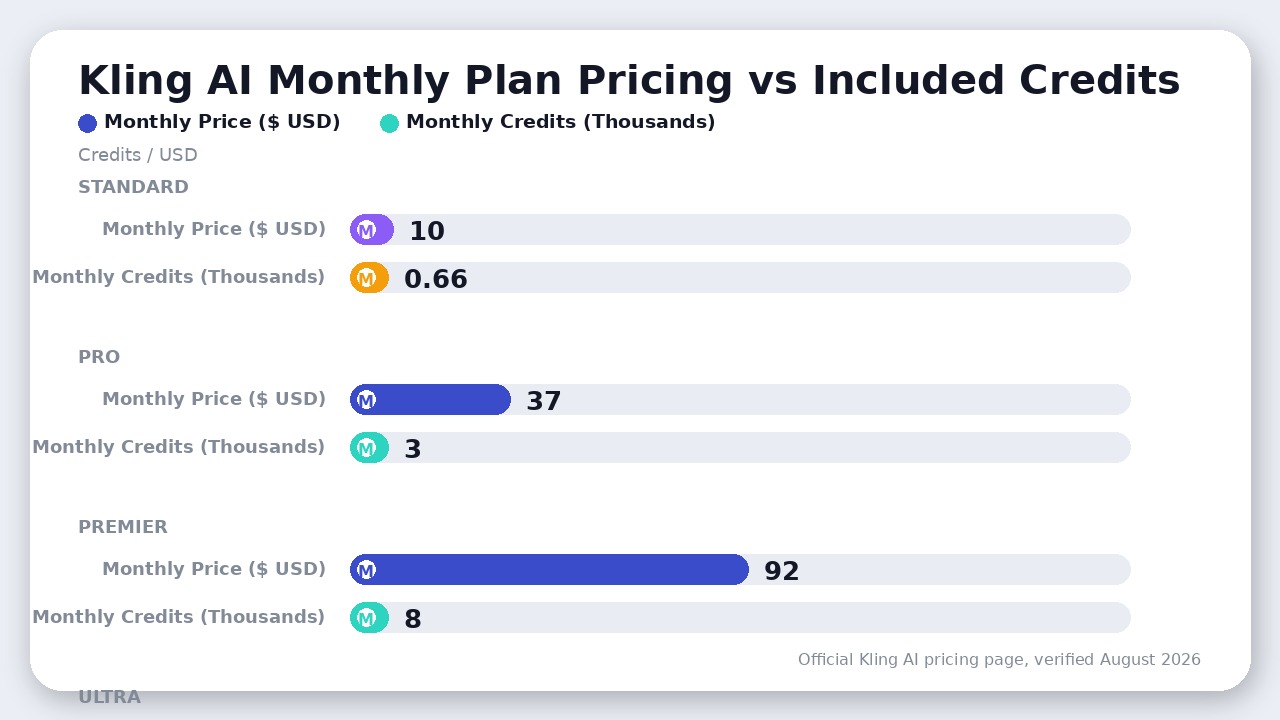
| Plan Tier | List Price (USD) | Promotional / 1st Month | Included Monthly Credits | Max Resolution | Watermark Status | Commercial Usage |
|---|---|---|---|---|---|---|
| Free Tier | $0 | $0 | 66 daily (resets 24h) | 720p | Kling Watermark | Non-commercial only |
| Standard | $10.00 / mo | $6.99 / mo | 660 credits / mo | 1080p | No Watermark | Full Commercial |
| Pro | $37.00 / mo | $25.99 / mo | 3,000 credits / mo | 1080p | No Watermark | Full Commercial |
| Premier | $92.00 / mo | $64.99 / mo | 8,000 credits / mo | 1080p / 4K beta | No Watermark | Full Commercial |
| Ultra | $180.00 / mo | $127.99 / mo | 26,000 credits / mo | Native 4K | No Watermark | Full Commercial |
Annual Billing Discount: Standard through Premier plans offer annual billing with an effective ~34% discount ($79.20/year for Standard, $293.04/year for Pro, and $728.64/year for Premier as of August 2026).
The Pricing Trap: The No-Rollover Policy
There is one crucial billing catch: monthly subscription credits do not roll over. If you subscribe to the Premier tier (8,000 credits) and only consume 3,000 credits during your 30-day billing cycle, the remaining 5,000 credits expire upon renewal.
Conversely, standalone top-up credits purchased outside a recurring subscription ($1 USD = 66 credits) remain valid for two full years. If your generation volume fluctuates drastically between marketing campaigns, purchasing credit packs or downgrading to Standard with on-demand top-ups prevents credit forfeiture.
What Does a Single Video Actually Burn?
Understanding credit consumption is essential to calculate your real unit cost as of August 2026:
* Standard Legacy Mode (720p / 5s): ~10 credits (~$0.15 effective cost at list price).
* Professional Mode (1080p / 5s): ~35 to 40 credits (~$0.53 to $0.61 effective cost).
* Kling 3.0 with Native Audio (1080p / 10s at 12 credits/s): ~120 credits (~$1.82 effective cost).
* Native 4K Master Export (Ultra tier, 30 credits/s for 5s): ~150 credits (~$2.27 effective cost).
When stacked against Western generative video tools (such as Runway Gen-3 Alpha at $0.25–$0.50 per second on base plans), Kling AI’s raw per-second generation cost sits roughly 50% to 60% lower for equivalent frame stability. Readers comparing dedicated tool stacks can view our complete breakdown in the Kling AI vs Runway analysis.
4. Where Kling AI Genuinely Wins
Kling AI leads the industry across several specific creative domains:
- Physics & Complex Anatomical Motion: Kling handles dynamic human movement—dancing, athletic actions, martial arts, fluid liquid simulations, and complex fabric folding—with substantially fewer limb warping artifacts than early-generation diffusion models.
- Multi-Shot Narrative Consistency: The Element AI Multi-Shot feature allows creators to lock character faces, outfits, and lighting setups across sequential connected shots without character drift.
- Native Audio Synchronization: Kling 3.0 Omni introduces co-generated background acoustics, ambient sound effects, and lip-synchronized voice tracks directly from text prompts, eliminating the need to stitch audio in secondary tools for rapid prototyping.
- Motion Control & Camera Trajectories: The platform offers granular spatial sliders—pan, tilt, zoom, roll, and brush-based regional motion masking—giving cinematographers precise shot blocking control.
5. Where Kling AI Genuinely Fails
Despite its technical strengths, Kling AI presents concrete hurdles for production pipelines:
- Generation Queue Latency on Budget Plans: While Ultra and Premier tiers receive priority execution, Standard and Free tier queues can take anywhere from 10 minutes to several hours during peak Asian business hours.
- Aggressive Content Moderation: Kling AI’s prompt filtration system is notably conservative. Prompts referencing political figures, sensitive historical themes, or mildly provocative artistic styling will trigger prompt rejections with no refund of wasted processing time.
- Customer Support Response Times: International customer support operates asynchronously. Community reports on Trustpilot and Discord highlight delayed ticket resolutions regarding billing disputes and subscription cancellations.
- Free Tier Commercial Restrictions: Unlike open-weight alternatives (such as FLUX for images, detailed in our Midjourney vs FLUX review) or Chinese foundational LLMs like DeepSeek, Kling AI’s free model output cannot be used commercially and forces a non-removable watermark in the bottom corner.
6. Developer API & Programmatic Workflows
For engineering teams building autonomous video pipelines, automated marketing campaigns, or social media automation workflows, Kling AI exposes an OpenAI-compatible REST API.
API Architecture & Model IDs
- Base Endpoints: Standard HTTPS POST routes accepting structured JSON payloads for
text2video,image2video, andvideo_extend. - Billing Units: API access is billed per second of completed inference based on prepaid resource units ($0.14 list price per unit as of August 2026). For example,
Kling 3.0 Turbowith native audio lists at $0.112 per second (720p) and $0.14 per second (1080p). - Third-Party Model Gateways: If your legal team forbids creating a direct account with a Singapore/Chinese billing entity, Kling models are also accessible via Western model aggregators (such as Fal.ai), which bill through domestic US entities and absorb regional payment routing.
The Verdict
Kling AI is one of the most capable generative video engines in production today, but whether you should adopt it depends strictly on your compliance framework and production volume:
- Pick Kling AI if: You are an indie creator, marketing agency, game studio, or solo filmmaker seeking industry-leading motion fidelity, character consistency, and 1080p/4K generation at roughly half the per-second cost of Western suites.
- Avoid Kling AI (or use Western API proxies) if: You are an enterprise operating under strict US/EU sovereign data hosting requirements, or your team requires dedicated 24/7 SLA enterprise support and rollover subscription billing.
For alternative low-cost creative tools emerging from Asian research labs, explore our analysis of MiniMax’s video platform in Hailuo AI: Pricing, Data Residency, and Access.
Frequently asked questions
Can I use Kling AI outside China without a VPN?
Yes. Kling AI operates a dedicated international platform at kling.ai managed by Singapore entity Kling AI Pte. Ltd. It is accessible globally without a VPN, supports Google single sign-on, and accepts standard international credit cards via Stripe as of August 2026.
Does Kling AI own my generated videos?
Paid Kling AI subscribers own their output and receive commercial usage rights with watermark removal. However, free-tier users are restricted to non-commercial use, and Kling AI retains a license to use and train on public web inputs. Kling AI API submissions are explicitly exempt from model training.
How much does a single video cost on Kling AI?
As of August 2026, at standard top-up rates ($1 USD = 66 credits), a standard 5-second 720p video consumes roughly 10 to 30 credits ($0.15 to $0.45). High-definition 1080p clips or Kling 3.0 renders with native audio consume 40 to 120 credits ($0.61 to $1.82) per clip depending on model mode and duration.
Do Kling AI subscription credits roll over to the next month?
No. Kling AI monthly subscription credits expire at the end of each billing cycle with zero rollover. Only separately purchased top-up credit packs remain valid for two years from the date of purchase.

Leave a Reply