

Zhipu AI (智谱AI, branded globally as Z.ai) provides commercial LLM APIs and open-weight models including the GLM-5 and GLM-4 families. International developers can access Zhipu AI through z.ai without a Chinese phone number, paying in USD via international credit cards or PayPal. Proprietary cloud API endpoints process data in mainland or regional nodes with stated no-training protections, while open-weight MIT-licensed releases allow complete self-hosted data isolation.
Zhipu AI (智谱AI, branded globally as Z.ai) provides commercial LLM APIs and open-weight models including the GLM-5 and GLM-4 families. International developers can access Zhipu AI through z.ai without a Chinese phone number, paying in USD via international credit cards or PayPal. Proprietary cloud API endpoints process data in mainland or regional nodes with stated no-training protections, while open-weight MIT-licensed releases allow complete self-hosted data isolation.
Among the top tier of foundational AI laboratories founded in China—frequently grouped alongside Moonshot AI, MiniMax, and Baichuan—Zhipu AI holds a distinct profile. Spun out of Tsinghua University’s Knowledge Engineering Group in 2019, Beijing Zhipu Huazhang Technology became the first foundation-model company in the world to complete an IPO on the Hong Kong Stock Exchange (HKEX: 02513.HK).
For Western developers, technical leads, and engineering teams, Zhipu AI offers an aggressive combination of high benchmark capability, OpenAI-compatible APIs, generous free tiers, and open weights. However, navigating its split portal infrastructure, geopolitical context, and privacy posture requires clear facts rather than marketing slogans.
The 30-Second Answer: Who Should Use Zhipu AI?
- Deploy Zhipu AI if you need near-frontier coding and agentic reasoning at a fraction of Western proprietary prices (roughly $1.00 per million input tokens for GLM-5 vs $2.50 to $5.00 on major Western peers), want a perpetual $0.00 token baseline for high-volume automation (GLM-4.7-Flash), or require MIT-licensed open weights for fully sovereign on-premises hosting.
- Look elsewhere if your corporate compliance policy strictly prohibits vendors on the US Commerce Department’s Entity List, or if your application demands native US/EU cloud data residency agreements backed by Western enterprise SLAs.
What Is Zhipu AI (智谱AI)?
Zhipu AI (北京智谱华章科技有限公司) is the developer behind the General Language Model (GLM) architecture. While consumer users in China interact with its conversational assistant, Zhipu Qingyan (智谱清言), technical teams primarily interact with Zhipu’s developer ecosystem across two layers:
- The Commercial Cloud API (
Z.ai/BigModel): Hosted endpoints delivering proprietary reasoning models, multimodal vision models (GLM-4.6V), image generation (CogView-4), and video generation (CogVideoX). - The Open-Source Weight Catalog: Freely downloadable model weights released on platforms like Hugging Face and ModelScope under permissive licenses (including MIT and Apache 2.0 depending on the model variant).
Unlike pure closed-source platforms, Zhipu AI builds its commercial strategy around a dual-track model: enterprise cloud subscriptions alongside accessible open weights that run on inference engines like vLLM and SGLang. Similar to how builders evaluate options between DeepSeek vs Qwen, Zhipu represents a powerhouse in open-source parameter efficiency.
Can You Actually Use Zhipu AI Outside China?
One of the most persistent misconceptions about Chinese AI labs is that access requires a mainland China mobile number (+86) or domestic identity verification. For Zhipu AI, accessibility depends entirely on which platform portal you enter.
The Two Portals: Z.ai vs Open.BigModel.cn
- The International Portal (
z.ai): Built specifically for global users. Registration requires only a standard email address (Google, GitHub, or corporate email). SMS verification does not require a Chinese phone number. Billing is handled entirely in US Dollars (USD) via standard international Visa, Mastercard, and PayPal. - The Mainland Platform (
open.bigmodel.cn): Built for domestic Chinese business entities. It mandates a +86 mobile phone number, bills in Chinese Yuan (CNY), and processes payments via Alipay and WeChat Pay.
For international developers integrating GLM models into autonomous coding agents such as Claude Code vs Cursor or Cline, the international z.ai portal provides OpenAI-compatible REST endpoints (https://api.z.ai/v1) that drop directly into standard SDKs by swapping the base_url and API key.
Where Does Your Data Go? Data Residency and Privacy
When evaluating any AI tool originating in Asia—whether reviewing models like Kimi AI or video generators like Kling AI—data residency is the primary enterprise hurdle.
Hosted Cloud API Residency
- Jurisdiction: API requests made through
open.bigmodel.cnare routed through and stored within data centers located in mainland China. The internationalz.aiendpoint routes traffic through regional nodes; however, underlying core model inference clusters remain subject to Chinese corporate data compliance frameworks. - Training on Submissions: According to Zhipu AI’s published commercial developer terms on
z.ai, API payload data (prompts and completions) is stored temporarily for operational integrity and abuse prevention. Zhipu AI contractually states that paid developer API submissions are not used to train base foundation models without explicit user consent. - Regulatory Constraints: In January 2025, Zhipu AI was added to the US Commerce Department’s Entity List. While this designation restricts US companies from exporting specific sensitive hardware and proprietary technologies to Zhipu AI, it does not make calling an inference API illegal for most global developers. However, US defense contractors, federal agencies, and heavily regulated enterprises frequently maintain internal policies forbidding data egress to Entity List firms.
The Zero-Data-Egress Path: Open Weights
For organizations with strict compliance mandates (such as HIPAA, SOC 2 Type II, or GDPR data localization rules), Zhipu AI offers a clean legal architecture: self-hosting.
Because Zhipu open-sources the weights for many of its most powerful architectures (such as GLM-4-9B, CogVideoX, and GLM open checkpoints) under permissive MIT and open-access licenses, engineering teams can pull the model weights directly from Hugging Face and deploy them on private AWS, Google Cloud, or on-premises GPU infrastructure. In this architecture, zero bytes of data ever leave your private virtual cloud.
What Does Zhipu AI Cost in USD?
Zhipu AI operates on two transparent pricing tracks: pay-as-you-go per-million-token API billing and flat-rate monthly coding subscriptions.
Pay-As-You-Go API Rates (As of August 2026)
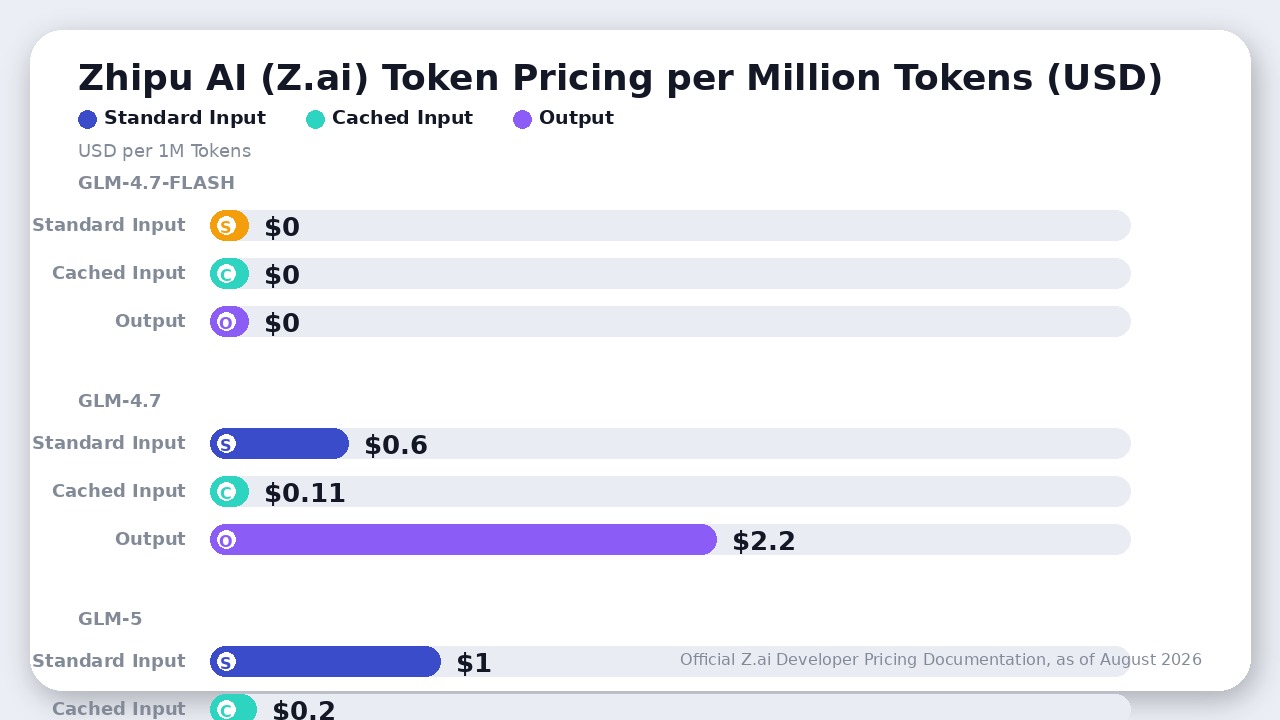
All rates below are verified in USD from the official Z.ai developer pricing documentation as of August 2026:
- GLM-5 (Flagship Reasoning): $1.00 per 1M input tokens | $0.20 per 1M cached input tokens | $3.20 per 1M output tokens.
- GLM-5-Turbo: $1.20 per 1M input tokens | $0.24 per 1M cached input tokens | $4.00 per 1M output tokens.
- GLM-4.7 (Balanced Production): $0.60 per 1M input tokens | $0.11 per 1M cached input tokens | $2.20 per 1M output tokens.
- GLM-4.7-Flash / GLM-4.5-Flash: $0.00 / Free for standard inference calls.
- GLM-4.6V (Multimodal Vision): $0.30 per 1M input tokens | $0.05 cached input | $0.90 per 1M output tokens.
- GLM-OCR: $0.03 per 1M tokens.
- CogView-4 (Image Generation): $0.01 per image.
- CogVideoX-3 (Video Generation): $0.20 per generated video.
The Free Flash Tier
One of Zhipu AI’s sharpest market advantages is its permanent free Flash tier. Models like GLM-4.7-Flash and GLM-4.6V-Flash carry zero per-token charges on the developer API. For baseline data extraction, document classification, translation, and high-frequency background polling, this eliminates token burn entirely.
GLM Coding Plans (Flat-Rate Pricing)
To capture developers running continuous autonomous coding loops inside IDEs like Cursor and tools like Trae, Zhipu introduced structured monthly prompt-based plans:
- Lite Plan: $18/month (approx. 80 prompts per 5 hours / 400 prompts per week).
- Pro Plan: $72/month (5x Lite capacity; approx. 400 prompts per 5 hours / 2,000 prompts per week).
- Max Plan: $160/month (20x Lite capacity; approx. 1,600 prompts per 5 hours / 8,000 prompts per week).
These coding subscriptions provide predictable monthly expenses for heavy agentic coding sessions where standard per-token billing would quickly compound.
Technical Strengths: Where Zhipu AI Genuinely Wins
- Unmatched Price-to-Performance Ratio: At $1.00 per million input tokens, flagship GLM-5 provides deep reasoning and multi-step tool orchestration at roughly one-third the cost of Western flagship models like Claude 3.5 Sonnet or GPT-4o.
- Context Caching Economics: Zhipu’s context cache read pricing cuts token costs by up to 80% ($0.20/1M on GLM-5; $0.11/1M on GLM-4.7). For large Retrieval-Augmented Generation (RAG) codebases and massive system prompts, caching transforms unit economics.
- Native Bilingual & Tool Calling Capabilities: Because the architecture was trained extensively on both rich Chinese corpora and global English technical documentation, GLM models exhibit superior bilingual code generation, function execution, and structured JSON output handling.
- Open Weights Availability: Unlike proprietary-only providers, Zhipu’s commitment to releasing open weights under the MIT license gives developers a permanent migration escape hatch.
Where Zhipu AI Falls Short
- Enterprise Procurement Obstacles: For Western publicly traded companies, procurement teams may flag Zhipu AI’s Entity List presence and mainland corporate registration during standard vendor security reviews.
- Latency on Global Endpoints: While API response times on
z.aiare competitive for batch and coding workflows, developers serving interactive end-users in North America or Europe may observe slightly higher Time-to-First-Token (TTFT) compared to domestic US infrastructure providers like AWS Bedrock or OpenAI. - Ecosystem Tooling Defaults: Western AI developer frameworks frequently default to OpenAI or Anthropic configuration blocks. While Zhipu’s API is OpenAI-compatible, configuring custom tool calling or MCP servers requires manual endpoint pointing.
The Verdict
Zhipu AI has evolved from an academic spin-out into one of the most commercially disruptive AI infrastructure providers globally.
- For solo developers, bootstrapped startups, and automation builders, Zhipu AI’s international
z.aiportal is an outstanding resource. It offers friction-free USD payments, a genuine $0.00 free tier on Flash models, and frontier-level GLM-5 coding intelligence at disruptive pricing. - For regulated Western enterprises and defense-adjacent teams, the hosted API may fail vendor compliance audits due to data residency and Entity List restrictions. For these teams, the winning play is downloading Zhipu’s open weights to host internally on sovereign cloud clusters.
Frequently asked questions
Can I use Zhipu AI outside China without a Chinese phone number?
Yes. While Zhipu AI’s domestic platform (bigmodel.cn) requires a mainland +86 phone number, international developers can use Zhipu AI’s global portal at z.ai. The international portal supports standard email registration, accepts international credit cards and PayPal, and provides OpenAI-compatible API endpoints without regional SMS verification.
Does Zhipu AI train on developer API data?
According to Zhipu AI’s developer terms for commercial API endpoints on z.ai, user prompts and completions are retained only for security and abuse monitoring and are not used to train foundation models without explicit consent. However, teams handling regulated data who cannot route through overseas servers should deploy Zhipu AI’s open-weight GLM models on private infrastructure.
How much does Zhipu AI’s GLM API cost in USD?
As of August 2026, Zhipu AI charges $1.00 per million input tokens, $0.20 for cached input, and $3.20 per million output tokens for its flagship GLM-5. Balanced models like GLM-4.7 cost $0.60 input and $2.20 output, while GLM-4.7-Flash and GLM-4.5-Flash remain free of charge.
What is the difference between BigModel and Z.ai?
BigModel (open.bigmodel.cn) is Zhipu AI’s mainland China developer platform billed in Chinese Yuan (CNY) requiring domestic identity verification. Z.ai is Zhipu AI’s international developer portal billed in US Dollars (USD), designed for global developers with international billing rails and English documentation.

Leave a Reply