

DeepSeek wins for pure mathematical reasoning, deep chain-of-thought logic, and raw API cost efficiency ($0.14 to $0.435 per million input tokens as of August 2026). Qwen wins if you need a flexible model family ranging from 0.5B on-device models to 1M-token multimodal vision agents, seamless 100+ language support, or an Apache 2.0 license with enterprise patent protection.
DeepSeek wins for pure mathematical reasoning, deep chain-of-thought logic, and raw API cost efficiency ($0.14 to $0.435 per million input tokens as of August 2026). Qwen wins if you need a flexible model family ranging from 0.5B on-device models to 1M-token multimodal vision agents, seamless 100+ language support, or an Apache 2.0 license with enterprise patent protection.
For engineering leaders and AI architects, the debate between DeepSeek and Alibaba’s Qwen is no longer an academic exercise. These two model families represent the vanguard of open-weight artificial intelligence, routinely matching closed Western models while slashing infrastructure costs by an order of magnitude.
Yet, treating them as interchangeable open-source commodities is a multi-thousand-dollar architecture mistake. DeepSeek is a specialized, mathematically rigorous reasoning engine engineered around aggressive inference compression. Qwen is an expansive, general-purpose ecosystem designed to run on everything from a developer’s MacBook Air to enterprise multi-cloud pipelines.
Here is how to pick between them without falling into common deployment traps.
The 30-Second Answer
- Choose DeepSeek if: Your core workload revolves around deterministic code synthesis, heavy symbolic math, complex autonomous reasoning, or API-based document pipelines where disk-caching can bring your input costs down to pennies per million tokens. You are consuming models over an API or you have dedicated enterprise server racks (8x 80GB GPUs) ready to run large Mixture-of-Experts (MoE) weights.
- Choose Qwen if: You want to run models locally on consumer or workstation hardware (using standalone 7B, 14B, or 32B dense checkpoints), require native vision-language processing (Qwen-VL), serve users in non-English/non-Chinese markets, or require an explicit Apache 2.0 patent grant for commercial compliance.
DeepSeek vs Qwen: Feature and Architecture Comparison
| Dimension | DeepSeek (V3 / R1 / V4) | Alibaba Qwen (Qwen 2.5 / Qwen 3 / Qwen 3.8 Max) |
|---|---|---|
| Primary Architecture | Massive Mixture-of-Experts (MoE) with Multi-Head Latent Attention (MLA) | Hybrid: Dense checkpoints (0.5B to 72B) + MoE configurations |
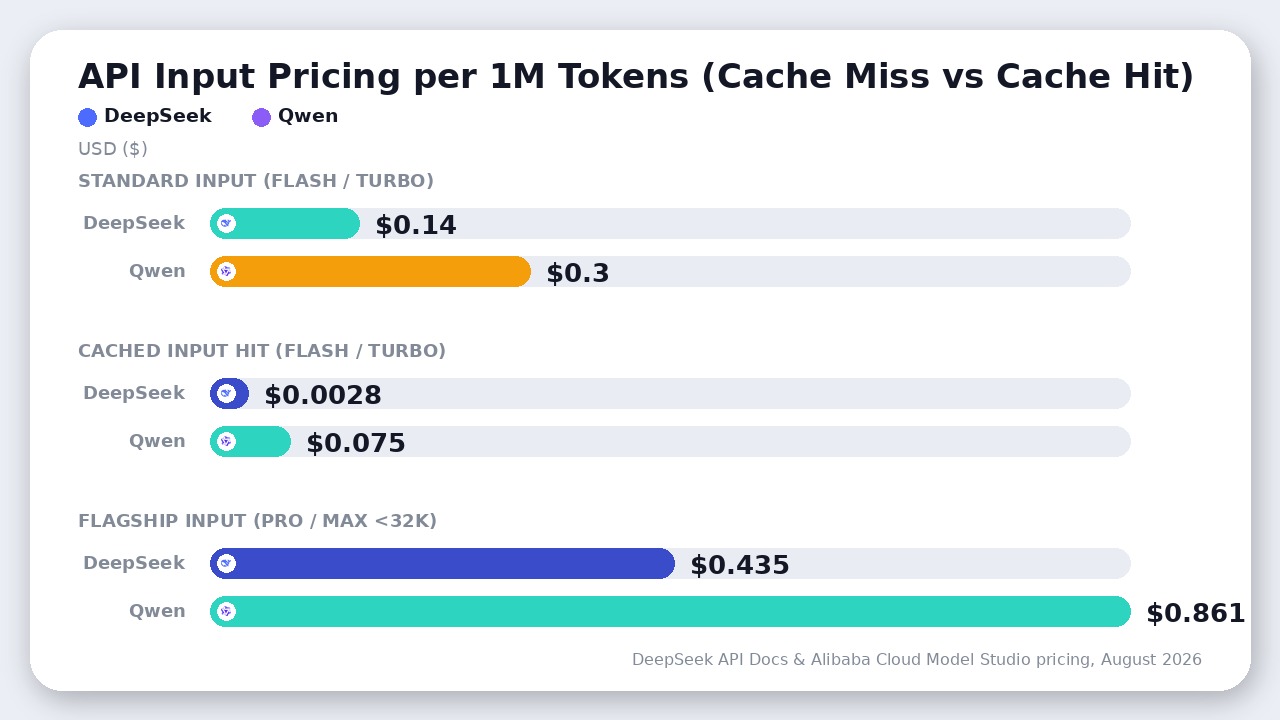
| Entry API Pricing (as of August 2026) | $0.14 / 1M input, $0.28 / 1M output (Flash) | $0.30 / 1M input, $0.60 / 1M output (Turbo/Flash) |
| Flagship API Pricing (as of August 2026) | $0.435 / 1M input, $0.87 / 1M output (Pro) | $0.861–$2.151 / 1M input, $3.441–$8.602 / 1M output (Max, tiered) |
| Context Cache Hit Rate (as of August 2026) | $0.0028 to $0.003625 / 1M tokens | 75% discount off base rate (~$0.075 to $0.215 / 1M) |
| Local Hardware Fit | Hard: Full base models require 8x H100s; relies on Qwen/Llama distills for edge | Easy: Native dense models (0.5B, 1.5B, 3B, 7B, 14B, 32B) run on laptops & single GPUs |
| Multimodal Capabilities | Text and code focused; separate experimental VL checkpoints | Native Vision & Audio: Integrated Qwen-VL and Qwen-Audio series |
| Language Breadth | English, Chinese, code, and basic multilingual translation | 100+ languages and regional dialects |
| Open License | MIT License | Apache 2.0 (for most open weights) |
| Data as of | August 2026 (Official API Documentation) | August 2026 (Alibaba Cloud Model Studio) |
The Differences That Actually Matter
1. The Token Economics and the Tiered Pricing Trap
At the API level, both providers disrupted Western pricing, but their billing mechanics diverge sharply once your production prompts grow.
As of August 2026, DeepSeek uses a flat, predictable fee structure across its official API endpoints. DeepSeek V4 Flash costs $0.14 per million input tokens (cache miss) and $0.28 per million output tokens, while the flagship V4 Pro tier costs $0.435 per million input and $0.87 per million output. More importantly, DeepSeek’s context caching architecture offers aggressive unit economics: when a prompt hits disk cache, the input price drops to $0.0028 per million tokens on Flash and $0.003625 on Pro. For agentic coding workflows—such as using Claude Code or Cursor with custom API routing—the cache hit rate regularly exceeds 80%, rendering inference virtually free.
Alibaba Cloud Model Studio structures Qwen pricing differently. While Qwen-Turbo and Qwen-Flash remain cheap, flagship models like Qwen-Max implement a tiered pricing penalty based on input context length (as of August 2026):
– 0 to 32K input tokens: $0.861 / 1M input, $3.441 / 1M output
– 32K to 128K input tokens: $1.434 / 1M input, $5.735 / 1M output
– 128K to 252K input tokens: $2.151 / 1M input, $8.602 / 1M output
If you send a 100K token repository dump to Qwen-Max, all 100K tokens are billed at the higher $1.434 rate rather than the base tier. If you are tracing requests with tools like Langfuse or LangSmith, you will see that long-context agent loops on Qwen-Max cost 3x to 5x more than equivalent workloads routed to DeepSeek Pro.
2. Local Self-Hosting: Full MoE Clusters vs. Granular Dense Weights
If your compliance or security policy mandates self-hosting on private VPCs or bare metal, the architectural differences between these two labs become decisive.
DeepSeek’s state-of-the-art models (such as DeepSeek-V3, R1, and V4) are built on massive Mixture-of-Experts architectures spanning 671B to 685B total parameters. While they only activate roughly 37B parameters per token—giving them rapid inference speed—the entire weight matrix must remain in GPU memory. To run unquantized or FP8 DeepSeek base models in production, you need an absolute minimum of 8x 80GB H100 or A100 GPUs. To bridge this for solo developers, DeepSeek provides distilled models, but those smaller checkpoints are fine-tuned versions of Qwen and Llama architectures.
Alibaba, by contrast, built Qwen as a vertically integrated ladder of native models:
1. Edge & Laptop Tiers (0.5B, 1.5B, 3B, 7B): Run with zero friction inside Ollama, llama.cpp, or on Apple Silicon unified memory.
2. Workstation Tier (14B, 32B): Qwen-Coder-32B delivers near-frontier code generation and fits easily onto a single consumer RTX 4090 (with 4-bit quantization) or a dual-GPU setup.
3. Data Center MoE Tier (72B, 235B, 397B): For enterprise clusters needing frontier reasoning under Apache 2.0.
If you want to spin up private coding assistants across an engineering team using IDEs like Cursor or Claude Code without renting cloud GPU farms, Qwen’s 14B and 32B checkpoints provide the cleanest local developer experience available today.
3. Reasoning Depth vs. Multilingual & Multimodal Versatility
On algorithmic depth, DeepSeek holds the crown. DeepSeek pioneered reinforcement learning methodologies that force explicit, multi-step chain-of-thought verification. On benchmarks such as MATH-500, AIME, and scientific code reasoning (SciCode), DeepSeek consistently outscores equivalent-tier models. Its responses prioritize step-by-step logic, edge-case assertions, and executable unit tests.
[Deterministic Problem / Algorithm / Math]
       │
       ├──> DeepSeek: Multi-Head Latent Attention + Pure RL Chain-of-Thought
       │    └── Output: Verifiable, structured, step-by-step logic
       │
[Multilingual Translation / Document Vision / Mobile Agent UI]
       │
       └──> Qwen: Qwen-VL + 18T Token Pretraining (100+ Languages)
            └── Output: Native document OCR, visual bounding boxes, natural prose
Qwen, however, dominates whenever the problem leaves pure English/Chinese symbolic logic:
– Multilingual Support: Qwen is pre-trained on more than 18 trillion tokens across 100+ languages. It translates, summarizes, and classifies European, Southeast Asian, and Middle Eastern languages with far fewer syntactic hallucinations than DeepSeek.
– Multimodal Perception (Qwen-VL): Qwen features native vision processing capable of interpreting complex UI screenshots, reading scanned PDF diagrams, extracting tabular data, and grounding spatial coordinates for GUI agent workflows. DeepSeek remains predominantly a text-and-code engine.
4. Legal Compliance and Open Source Licensing
For enterprise legal teams, license terminology matters as much as benchmark scores.
DeepSeek models are distributed under the MIT License. MIT is simple and highly permissive, allowing unrestricted commercial use, modification, and model distillation. However, MIT lacks an express patent grant.
Alibaba ships most open-weight Qwen models under the Apache 2.0 License. Apache 2.0 includes an explicit contributor patent license and patent retaliation clause. For multinational corporations with defensive patent portfolios, enterprise compliance officers routinely approve Apache 2.0 models while subjecting MIT AI checkpoints to extended scrutiny.
Where Qwen Actually Wins
It is tempting to declare DeepSeek the automatic choice based on its viral benchmark scores and aggressive token pricing. That ignores three scenarios where Qwen is undeniably superior:
- Edge and On-Premise Sizing: If you cannot afford to host 600B+ MoE architectures in a private cloud, Qwen’s native 7B, 14B, and 32B dense models are unbeatable. DeepSeek does not build native small dense models; its smaller releases are merely distills layered on top of Qwen’s base architecture.
- Vision and Document AI Pipelines: DeepSeek cannot natively parse receipts, user interface screenshots, or technical architecture blueprints. Qwen-VL handles multimodal document extraction with industry-leading precision.
- Global Localization: If you are building customer-facing support bots, content generation tools, or legal summarizers for Japanese, Arabic, Spanish, Vietnamese, or German markets, Qwen generates noticeably more natural, culturally nuanced prose.
The Verdict
DeepSeek is our overall winner for API-first developers, algorithmic coding, and high-volume reasoning. Its aggressive cache pricing ($0.0028/1M hit tokens as of August 2026) and relentless reinforcement-learning logic make it the most cost-effective reasoning engine in modern software development. If your workload lives in code, math, or complex agent execution over an API, DeepSeek provides unbeatable unit economics.
Buy Alibaba’s Qwen instead if:
* You need to self-host high-quality models on single workstation GPUs or laptops using native 7B, 14B, or 32B dense checkpoints.
* Your application requires multimodal capabilities to read images, documents, or UI interfaces (via Qwen-VL).
* You process multi-turn conversations across languages other than English and Chinese.
* Your corporate legal department strictly mandates Apache 2.0 patent protection.
Frequently asked questions
Is DeepSeek or Qwen better for local coding assistance?
For local developer machines running Ollama or vLLM, Qwen is usually superior because Alibaba provides dedicated, highly optimized dense weights like Qwen-Coder-7B and Qwen-Coder-32B that fit on standard consumer GPUs. Full DeepSeek base models (like V3 and V4) are massive Mixture-of-Experts architectures requiring enterprise server clusters, though DeepSeek’s distilled Qwen models bridge this gap.
How does DeepSeek API pricing compare to Alibaba Cloud Qwen?
As of August 2026, DeepSeek provides flatter, lower entry pricing, charging $0.14 per million input tokens on Flash and $0.435 on Pro, with disk-cache hits dropping to $0.0028 per million tokens. Alibaba Cloud Qwen charges tiered rates for Qwen-Max that scale up with prompt length (from $0.861/1M tokens below 32K input up to $2.151/1M above 128K input).
Which model offers better multilingual translation?
Qwen is significantly stronger for multilingual workloads outside of English and Chinese. Trained on over 18 trillion tokens across more than 100 languages and dialects, Qwen handles Southeast Asian, European, and Middle Eastern languages with higher grammatical fidelity than DeepSeek, which concentrates its training weights primarily on English, Chinese, and code.
What is the difference in licensing between DeepSeek and Qwen?
DeepSeek releases its flagship model weights and codebases under the permissive MIT license, which allows commercial modification and distillation without restrictions. Alibaba releases most Qwen open-weight models under the Apache 2.0 license, which includes an explicit patent retaliation grant that many enterprise legal and compliance teams prefer over MIT.
Final Recommendation
DeepSeek takes the overall win for API-driven reasoning, symbolic problem-solving, and cost disruption, while Qwen remains the superior platform for local edge deployment, multimodal vision tasks, and broad multilingual coverage.

Leave a Reply