


Plausible wins for most websites in 2026 because it delivers full conversion funnels, custom properties, and open-source self-hosting at a lower entry price ($9/month vs. Fathom’s $15/month). However, Fathom wins decisively for agencies and creators managing multiple properties, because its base tier includes 50 websites without feature gating, whereas Plausible limits entry tiers to 1 site and gates funnels behind its $19/month Business plan.
Plausible wins this matchup for most website owners in 2026, but the reason is not just about raw pageview tracking. While both platforms strip away the bloat and cookie compliance nightmares of Google Analytics 4 (GA4), Plausible provides deeper marketing utility with conversion funnels, custom event properties, and a free open-source self-hosting option at an entry price of $9/month. However, if you manage a portfolio of client sites or side projects, Fathom flips the verdict immediately by offering 50 sites out of the box on its base tier.
Here is how to settle the Plausible vs Fathom debate for your specific tech stack.
The 30-Second Answer
- Choose Plausible if: You run a single business or SaaS marketing site, need multi-step conversion funnels to track signup flows, want to inspect or self-host your analytics stack on your own servers, or want a $9/month entry point for low-traffic sites.
- Choose Fathom if: You are an agency, freelancer, or serial builder running multiple websites (up to 50 on the entry plan), want built-in uptime monitoring, prefer zero feature tiering where every paid account gets every tool capability, or want automated EU data isolation without configuring custom reverse proxies.
Plausible vs Fathom: Core Comparison
| Dimension | Plausible Analytics | Fathom Analytics | Winner |
|---|---|---|---|
| Entry Price (as of August 2026) | $9/month (10,000 pageviews/events) | $15/month (100,000 pageviews/events) | Plausible (low volume) |
| Sites on Base Plan | 1 site (Starter) | 50 sites (Starter) | Fathom |
| Feature Gating | Tiered (Starter, Growth, Business) | None (all features on all tiers) | Fathom |
| Conversion Funnels | Yes (Business plan at $19/mo+) | No (Single event goals only) | Plausible |
| Self-Hosting | Yes (Free Community Edition, AGPL-3.0) | No (Proprietary SaaS only) | Plausible |
| Uptime Monitoring | No | Yes (Included on all plans) | Fathom |
| Script Size | < 1.3 KB | < 1.5 KB | Tie |
| Cookie Banner Needed | No (Cookieless by design) | No (Cookieless by design) | Tie |
| Data Retention | Up to 5 years (by plan) | Unlimited (Forever) | Fathom |
| API Access | Business plan ($19/mo+) | Included on all plans (with tiered limits) | Fathom |
Pricing and plan specifications verified against vendor pricing documentation as of August 2026.
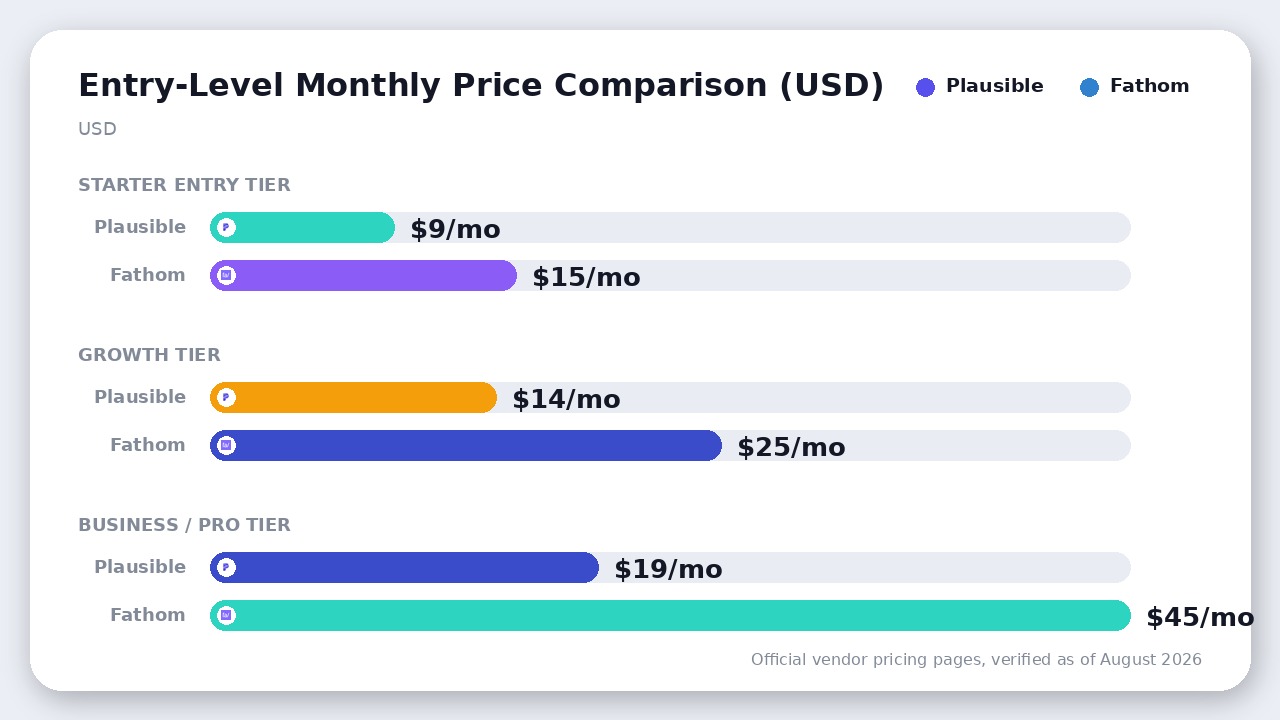
Pricing Architecture: The Multi-Site Trap vs. The Feature Gate
The most substantial difference between Plausible and Fathom lies not in how they count pageviews, but in how they package their product tiers. SaaS comparison articles routinely miss this distinction: Plausible prices by features and site caps, while Fathom prices strictly by traffic volume.
Plausible’s Model: Cheap Entry, Strict Feature Tiers
Plausible structures its cloud offering into three distinct tiers at every traffic band:
1. Starter ($9/month for 10k pageviews): Covers 1 site and 1 team member. It includes standard pageviews, referral sources, and basic custom event goals, but excludes dashboard sharing, funnels, and the Stats API.
2. Growth ($14/month for 10k pageviews): Expands limits to 3 sites and 3 team members, adding shared links and embedded dashboards.
3. Business ($19/month for 10k pageviews): Expands to 10 sites and 10 team members. Crucially, this is the only tier that unlocks conversion funnels, user journeys, custom properties, the Stats API, and the Looker Studio connector.
If you manage 4 websites, Plausible forces you directly onto the Business plan ($19/month minimum), even if your aggregate traffic across all four sites is only 5,000 views a month. If you manage 11 sites, you are forced into custom Enterprise pricing.
Fathom’s Model: Flat Feature Access, Generous Site Allowances
Fathom eliminates feature tiering entirely. When you pay for Fathom, every account receives:
– Unlimited data retention
– Built-in website uptime monitoring
– Shared client dashboards and email reports
– API access (starting with a base rate limit of 500 hourly requests, expandable via API add-on plans)
– 50 websites included on the $15/month Starter plan (which also includes 100,000 monthly pageviews)

If you run 8 side projects that get 2,000 visits each (16,000 total views), Fathom costs you $15/month total. On Plausible, that same 8-site portfolio requires the $19/month Business plan. If you scale past 50 sites on Fathom, you simply buy packs of 50 additional sites for $10/month.
The Pricing Verdict: Plausible is cheaper for a single standalone site ($9 vs. $15). Fathom is cheaper and substantially more flexible the moment you manage 4 or more distinct web properties.
Marketing Capabilities: Funnels vs. Simple Aggregation
If your website generates revenue, traffic numbers alone are rarely enough. You need to know where visitors drop out of a purchase funnel or onboarding flow. While both tools are primarily traffic monitors rather than deep behavioral product analytics suites like PostHog vs Mixpanel or PostHog vs Amplitude, Plausible offers far more actionable marketing depth.
Plausible Conversion Funnels & Custom Properties
On its Business tier, Plausible provides native multi-step conversion funnels. You can define a linear user journey (e.g., /pricing → Click Sign Up → /register → Completed Onboarding) and see exact percentage drop-offs at each step.
Furthermore, Plausible supports custom event properties. You can attach dynamic metadata to button clicks—such as tracking which pricing plan was clicked (plan: 'growth'), author names on blog posts, or error codes on 404 pages. Combined with Plausible’s ability to filter the entire dashboard by clicking on any referrer or UTM campaign, diagnosing conversion problems takes seconds.
Fathom’s Goal Model: Flat Event Tracking
Fathom tracks custom events and allows you to attach an optional monetary value (e.g., tracking a $49 sale event). However, Fathom does not have multi-step conversion funnels. You can see how many total users triggered Event A and how many triggered Event B, but you cannot visualize the step-by-step pipeline drop-off in a single continuous view. If your marketing strategy relies on funnel optimization, Fathom forces you to calculate drop-off ratios manually in a spreadsheet.
Data Sovereignty: Open-Source AGPL vs. Managed EU Isolation
Privacy-conscious teams migrate away from Google Analytics primarily to avoid regulatory exposure under GDPR and PECR. Both tools solve this, but through fundamentally different technical philosophies.
Plausible: The Open-Source Standard
Plausible is fully open-source under the AGPL-3.0 license. The cloud service is incorporated and hosted entirely in Estonia on EU-owned server infrastructure (Hetzner in Germany), ensuring no data is ever subject to the US CLOUD Act.
For enterprise teams, engineering organizations, or security-sensitive applications, Plausible’s Community Edition allows you to run the exact analytics engine inside your own VPC via Docker Compose. You own 100% of the database, pay zero licensing fees, and never send traffic metadata to a third party.
Fathom: Proprietary SaaS with Built-In Edge Routing
Fathom is a closed-source Canadian company (Conva Ventures Inc.). While it is not open-source, Fathom built an advanced privacy architecture called EU Isolation. Fathom automatically detects visitor geography: EU visitor traffic is processed entirely on EU-based infrastructure (AWS Germany) and anonymized before any high-level aggregated data is saved.
Fathom also excels at avoiding ad-blocker suppression. Both tools allow you to configure custom domain CNAME records to serve scripts from your own subdomain, but Fathom’s routing handles automated SSL issuance and multi-region bypass out of the box with zero maintenance required.
Where Fathom Actually Wins
To make this verdict completely transparent, there are specific environments where Fathom is undeniably the better product:
- Web Agencies and Freelancers: If you build and manage client websites, Plausible’s 10-site Business cap will quickly frustrate you. Fathom gives you 50 sites right away, custom domains for each, and shareable client links without forcing you into an enterprise negotiation.
- Zero-Maintenance Upgrades: Fathom includes integrated uptime monitoring. If your site goes down, Fathom alerts you via email, SMS, or Telegram, saving you from paying for a separate service like UptimeRobot or Better Stack.
- Uncapped Feature Access: You will never hit a wall in Fathom where a feature is locked behind an upgrade prompt. Whether you pay $15/month or $100/month, you get the exact same powerful engine.
The Verdict
For 80% of standalone websites, startups, and SaaS products, Plausible is the winner. It provides a lower starting cost ($9/month), critical marketing tools (funnels and custom properties), and an open-source codebase that guarantees data sovereignty. It is the most complete direct replacement for GA4 on the market.
Switch the verdict to Fathom if your primary requirement is managing multiple domains (4 or more sites) under a single flat subscription, or if you want bundled uptime monitoring and refuse to deal with feature-gated pricing plans.
Frequently asked questions
Do Plausible and Fathom require cookie consent banners under GDPR?
Neither Plausible nor Fathom requires a cookie banner under GDPR, PECR, or CCPA. Both platforms operate entirely cookieless, never write to local browser storage, and generate daily rotating cryptographic hashes to track unique visitors anonymously without collecting personally identifiable information (PII).
Can I self-host Plausible or Fathom for free?
Plausible offers a fully functional, open-source Community Edition licensed under AGPL-3.0 that you can self-host for free on your own server. Fathom discontinued its open-source version years ago and operates exclusively as a paid, proprietary cloud SaaS.
How do Plausible and Fathom handle traffic spikes and overages?
Neither tool cuts off tracking during occasional traffic spikes. Both Plausible and Fathom apply a fair-use policy: if your monthly traffic exceeds your purchased tier for two consecutive billing cycles, the vendor notifies you to upgrade. Data collection continues uninterrupted in the background.
Which tool is better for marketing conversion funnels?
Plausible is superior for conversion funnels, offering multi-step goal paths and user journey drop-off tracking on its Business plan ($19/month). Fathom tracks individual event goals and monetary conversion values, but does not support multi-step funnel analysis.
Final Recommendation
Plausible takes the win for most teams thanks to its conversion funnels, custom properties, and open-source self-hosting, though Fathom remains the superior choice for agencies running multiple sites on a flat budget.

Leave a Reply