

If you ask a product manager and a software engineer to choose an analytics platform, they will immediately lock horns. The PM will point to Amplitude‘s unmatched behavioral cohorting and conversion drivers. The engineer will counter with PostHog‘s developer-friendly API, native session replay, and the fact that they can query raw tables using SQL.
Historically, this argument was settled by billing: Amplitude charged by Monthly Tracked Users (MTUs), while PostHog charged strictly by event volume. But a massive, under-the-radar pricing shift has completely rewritten the playbook. As of July 2026, Amplitude’s self-serve Plus plan has fully adopted a volume-based pricing model, matching PostHog’s billing unit.
With both platforms now matching on metrics, the choice is no longer about “how you charge,” but how your team actually builds and analyzes. Here is the unfiltered reality of how they stack up when you peel back the marketing pages.
The 30-Second Answer
- Pick PostHog if: You are an engineering-led team that wants a single “builder’s stack”. PostHog bundles product analytics, session replay, feature flags, A/B testing, surveys, and error tracking under one roof. It is the ultimate tool for fast-moving startups that want to deploy first, autocapture everything, and clean up their data taxonomy later.
- Pick Amplitude if: You are a product-led team with dedicated analysts who need to run complex behavioral queries. Amplitude’s cohort builder, funnel conversion drivers, and causal analysis are best-in-class. Choose Amplitude if you require strict data governance to keep your tracking plan clean across multiple cross-functional teams.
PostHog vs Amplitude: The Core Dimensions
| Dimension | PostHog (Cloud) | Amplitude (Plus/Starter) | Winner |
|---|---|---|---|
| Free Tier Limit | 1M events/mo + 5K replays + 1M flags | 2M events/mo + 10K replays + unlimited flags | Amplitude (on raw volume & replays) |
| Billing Metric | Raw product usage per product | Event volume (Plus plan) | Tie |
| Setup & Tracking | Autocapture + Custom SDKs | Autocapture + Custom SDKs | Tie |
| Analytical Depth | Good (standard funnels, paths, SQL) | Best-in-class (Cohorts, Conversion Drivers) | Amplitude |
| Built-in Features | Replay, Flags, Surveys, Error Tracking, Warehouse | Replay, Flags, Web Experimentation, Guides & Surveys | PostHog |
| Data Governance | Light (Schema tracking, basic properties) | Advanced (Data, Schema, Taxonomy templates) | Amplitude |
Pricing and feature details verified against official documentation as of July 2026.
The 2026 Pricing Shift: Event Volume vs. MTU
For years, Amplitude’s MTU-based pricing model was a massive selling point for products with highly active “power users” who generated millions of events. If your users were busy, Amplitude was highly predictable. If you had millions of low-activity web visitors, Mixpanel or PostHog’s event-based model was cheaper.
Today, Amplitude Plus has shifted to event-volume pricing. The self-serve Plus plan starts at $0/month (as of July 2026) with your first 2 million events free. Once you exceed that free allowance, paid pricing scales dynamically based on your monthly event volume up to a 70 million event ceiling (with a base paid tier starting at $49/month).
This makes a direct, head-to-head financial comparison finally possible. Let’s look at a realistic scenario: a growth-stage team sending 10 million events per month (pricing verified as of July 2026):
- PostHog Cloud (Analytics Only, assuming 100% anonymous events): Billed at tiered rates. The first 1M events are free. The next 1M events cost $0.00005/event ($50). The remaining 8M events cost $0.0000343/event ($274.40). Total: $324.40/month (~$3,893/year). (Note: If these were 100% identified events, PostHog’s identified add-on of $0.000198/event for the second million and $0.0000697/event thereafter would add $755.60/month, bringing the total to $1,080/month or ~$12,960/year).
- PostHog Cloud (Analytics – Anonymous + 10K Replays): If you add 10,000 session replays per month, PostHog charges $0.0050/recording for the 5,000 replays above the free tier. This adds $25/month. Total: $349.40/month (~$4,193/year).
- Amplitude Plus (Bundled): According to Amplitude’s official self-serve calculator, 10M events per month on the Plus plan costs $576/month (~$6,912/year) on an annual prepay contract.
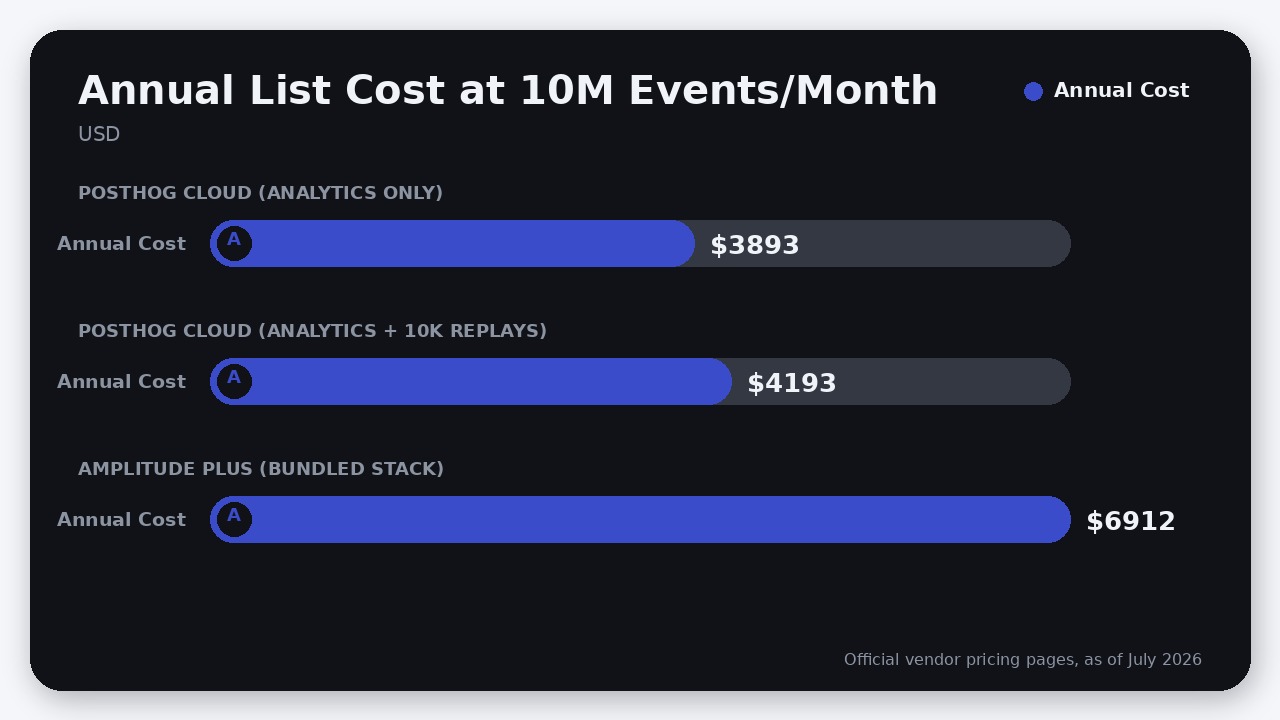
At first glance, PostHog is significantly cheaper for raw analytics. However, Amplitude Plus bundles its core features. That $576/month covers not just analytics, but also 10,000 session replays per month, unlimited feature flags, and web experimentation. If you were to scale up feature flag usage and session replays on PostHog, the price gap shrinks dramatically.
The Hidden Pricing Traps
Neither vendor is entirely innocent of burying limits in their documentation. If you don’t configure your tracking properly, you will run into these walls.
PostHog’s “Session Replay Tax”
While PostHog’s free tier of 5,000 recordings is incredibly generous, scaling replays on the pay-as-you-go tier is highly expensive. At $0.0050 per recording, capturing every single visitor on a high-traffic site will cause your bill to explode.
PostHog handles this by letting you set strict billing limits in your dashboard and configuring sampling rates in your initialization code. If you don’t set these, a sudden traffic spike could leave you with a painful bill.
Amplitude’s “MTU Guardrail” and the “Enterprise Cliff”
While Amplitude Plus bills on event volume, it has retained a sneaky metric called the MTU Guardrail. To prevent teams from abusing the system, Amplitude applies a guardrail of up to 1,000 events per Monthly Tracked User.
For example, if you purchase a tier representing 10,000 MTUs, you are capped at 10 million events (10,000 × 1,000). If your event count grows faster than your user base (meaning your active users generate more than 1,000 events each on average), Amplitude converts each additional 1,000 events into an extra MTU and charges you at your plan’s per-unit rate.
More importantly, Amplitude Plus hard-caps at 70 million events per month. The moment you cross that line, you are pushed out of self-serve and forced onto the custom-priced Growth or Enterprise plans. According to procurement data compiled by Vendr, the median annual contract for Amplitude’s custom tiers sits at $64,724/year. If you are a rapidly scaling startup, that is a massive financial cliff to climb.
The Startup Hack: If your company has raised less than $10M and has fewer than 20 employees, do not sign up for Plus. Apply for the Amplitude Startup Scholarship. It grants you a full year of the premium Growth plan (including advanced cohorting and experimentation) completely free, saving you up to $40,000.
Feature Breadth vs. Analytical Depth
To settle the argument between your PM and your engineer, you have to look at what these tools are actually built to do.
Where PostHog Wins: The Developer Ecosystem
PostHog is not just an analytics tool; it is a developer platform. It includes native capabilities that Amplitude simply does not offer:
- HogQL (Raw SQL Access): PostHog runs on ClickHouse. If a pre-built chart cannot answer your question, you can write raw SQL queries directly inside the PostHog dashboard to join tables and extract custom datasets.
- Native Error Tracking: PostHog captures frontend exceptions and links them directly to session replays. When a user encounters a bug, an engineer can watch the exact recording of the failure and inspect the console logs in one tab.
- Data Warehouse Syncing: PostHog can act as a lightweight data warehouse, allowing you to sync external data sources (like Stripe, HubSpot, or Zendesk) natively without paying for a separate ETL tool like Fivetran.
Where Amplitude Wins: Behavioral Rigor
Amplitude remains the undisputed gold standard for analytical depth. While PostHog can show you what happened, Amplitude is built to explain why:
- Advanced Cohorting: Amplitude allows you to build highly complex behavioral cohorts (e.g., “Users who did Action A within 3 days of Action B, but did not do Action C”) and sync them in real-time to ad networks or email platforms. PostHog’s cohorting is functional but significantly slower and more basic.
- Conversion Drivers: Amplitude’s machine learning models can automatically analyze a funnel and tell you exactly which user actions are most highly correlated with conversion or drop-off.
- Data Governance (Schema): As product teams grow, event taxonomies inevitably become messy. Amplitude’s “Data” suite provides advanced schema enforcement, letting you merge duplicate events, block unapproved properties, and categorize data so non-technical teammates don’t get lost.
Where Amplitude Actually Wins
If your organization has multiple product managers, growth marketers, and business analysts who need to self-serve answers, PostHog will eventually fail you.
PostHog’s “autocapture” feature is fantastic for early-stage tracking because it collects every click, hover, and pageview automatically. But in a mature organization, autocapture creates an unmanageable mountain of unstructured data. Without strict schema enforcement, your event names will diverge, dashboards will break, and your non-technical team members will lose trust in the data.
Amplitude forces a disciplined, taxonomy-first approach. It is a highly polished, structured environment where a non-technical PM can build a complex funnel or retention curve in minutes without asking an engineer to write a single line of SQL.
The Verdict
This matchup is not a tie. The choice comes down to who holds the keys to your product decisions:
- Choose PostHog if you are an engineering-heavy startup or scale-up. If your developers are the ones building experiments, debugging errors, and managing feature flags, PostHog is the superior choice. It eliminates the need to pay for separate tools like LaunchDarkly (flags), Sentry (errors), and Hotjar (replays). You get a unified developer platform with highly transparent, pay-as-you-go pricing.
- Choose Amplitude if you are a growth-focused SaaS with a dedicated product management team. If your primary goal is optimizing conversion funnels, building complex user cohorts, and running high-velocity A/B tests managed by non-engineers, Amplitude is worth the premium. Start on the Free tier, leverage the Startup Scholarship if you qualify, and enjoy the most powerful behavioral analytics engine on the market.
FAQ
Can I self-host PostHog in 2026?
Yes, but with a major caveat. PostHog sunsetted its officially supported self-hosted Kubernetes deployment and transitioned its open-source self-hosted focus purely to its single-instance Docker Compose “Hobby” deployment. While you can still run this Hobby version on your own infrastructure, it lacks high-availability features, and you must manage your own ClickHouse cluster, which introduces significant DevOps overhead. For production scale, PostHog strongly recommends using PostHog Cloud.
Does Amplitude offer error tracking?
No. Unlike PostHog, which natively monitors frontend exceptions and links them to session recordings, Amplitude focuses strictly on behavioral analytics. If you use Amplitude, you will still need a dedicated tool like Sentry or Bugsnag for error monitoring.
Is Amplitude’s session replay as good as PostHog’s?
Amplitude’s Session Replay is fully integrated into its charts, allowing you to watch recordings directly from a funnel drop-off point. However, Amplitude’s Free plan actually includes up to 10,000 session replays per month, which is double PostHog’s free limit of 5,000 recordings. That said, PostHog offers deeper developer-level console inspection and network logs within its replays.

Leave a Reply