

ChatGPT wins for coding, interactive editing via Canvas, and complex agentic workflows, while Google Gemini wins for long-document analysis, video understanding, and users embedded in Google Workspace. If you already pay $9.99 monthly for 2TB of Google One storage, Gemini Advanced effectively cuts your AI software cost in half.
ChatGPT wins for coding, interactive editing via Canvas, and complex agentic workflows, while Google Gemini wins for long-document analysis, video understanding, and users embedded in Google Workspace. If you already pay $9.99 monthly for 2TB of Google One storage, Gemini Advanced effectively cuts your AI software cost in half.
Choosing between Google Gemini and ChatGPT is no longer a question of which model can write a polite introductory email. Both platforms easily handle standard text drafting, translation, and general research. The real decision comes down to your operating environment: whether you need an autonomous execution partner that writes and iterates on complex code inside a dedicated workspace, or a context engine that plugs straight into your Google Drive, parses 500-page technical PDFs in one breath, and lives inside your Gmail inbox.
Here is how both platforms compare across real-world workflows in 2026, where the pricing traps hide, and which tool deserves your monthly subscription.
The 30-Second Answer
- Pick ChatGPT if your primary AI workflows involve writing software, refactoring code repositories, structuring agentic workflows, generating interactive artifacts, or collaborating in a dedicated visual workspace like Canvas.
- Pick Google Gemini if you live inside Google Workspace (Docs, Gmail, Drive, Sheets), regularly need to process hour-long video recordings or book-length PDF manuals without manual chunking, or want 2TB of Google One cloud storage bundled into your $19.99 monthly fee.
| Dimension | Google Gemini (Google AI Pro) | ChatGPT (ChatGPT Plus) |
|---|---|---|
| Entry Paid Price (as of August 2026) | $19.99/mo (Google One AI Premium) | $20.00/mo (No annual discount) |
| Bundled Cloud Storage | 2TB Google One storage included | None |
| Context Window | 1,000,000+ tokens (native multimodal) | 128,000 tokens (standard chats) |
| Flagship Reasoning Models | Gemini 2.5 Pro / Gemini 3 Pro | GPT-5.6 Sol / GPT-5.5 / o-series |
| Native Workspace Integration | Direct reading/writing in Gmail, Docs, Sheets, Drive | Requires manual uploads or third-party webhooks |
| Interactive Editing UI | Basic side panels & split views | Canvas (inline code/text editing & version diffs) |
| Video & Audio Analysis | Native timestamped video & audio file ingestion | Limited audio processing, video via keyframe sampling |
| Ecosystem & Custom Bots | Gems (Workspace-focused) | Custom GPTs Marketplace & Actions API |
Source: Official Google AI and OpenAI plan specifications, retrieved August 2026.
1. Pricing Math and the Google One Storage Offset
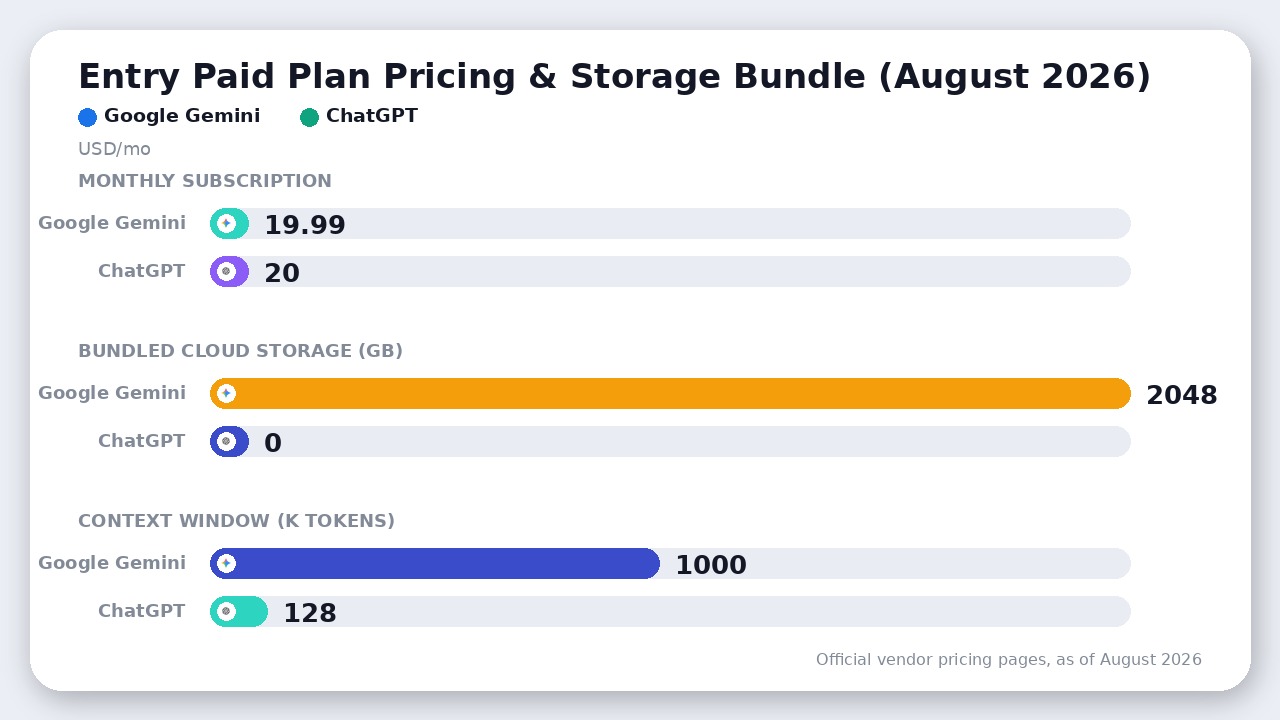
At first glance, both platforms appear to cost roughly the same as of August 2026: ChatGPT Plus is $20.00/month, and Gemini Advanced (sold under Google’s unified Google AI Pro tier) is $19.99/month. However, the economic reality changes completely once you look at what comes in the box.
OpenAI sells ChatGPT Plus as a pure AI software subscription. You get priority server access, elevated rate limits for flagship reasoning models like GPT-5.6 Sol, Canvas, and Deep Research capabilities. There is no cloud storage, no bundled third-party services, and zero discount for paying annually. If you cancel ChatGPT Plus, your AI access reverts to free rate limits immediately.
Google approaches the subscription as an ecosystem bundle. A Google AI Pro subscription ($19.99/month as of August 2026) includes 2TB of Google One cloud storage. Because a standalone 2TB Google One storage plan costs $9.99/month on its own, anyone already paying Google for backup storage or Google Photos is effectively paying just $10.00/month for Gemini’s premium AI engine. In addition, the plan unlocks NotebookLM Plus audio generation features and integrations across family accounts.
Effective AI Cost Comparison (For Users Needing 2TB Storage):
┌────────────────────────────────────────────────────────┐
│ ChatGPT Plus ($20) + Standalone Google One ($9.99)    │ = $29.99/mo
├────────────────────────────────────────────────────────┤
│ Google AI Pro (Gemini Advanced + 2TB Included)         │ = $19.99/mo
└────────────────────────────────────────────────────────┘
If you do not use Google Drive or cloud storage, the price comparison is a dead heat. But for freelancers, small business owners, and media creators who already pay for cloud backups, Google provides undeniable hardware-and-infrastructure leverage that OpenAI cannot match.
2. Context Window and Multimodal Ingestion: 1M vs. 128K
Where Gemini fundamentally separates itself is how much raw data it can swallow in a single prompt.
Gemini 2.5 Pro processes an active context window of 1,000,000 tokens (roughly 750,000 words or 1,500 pages of text). More importantly, Gemini was architected from the ground up as a native multimodal model. You can drag and drop a 45-minute MP4 video recording, an hour of unedited podcast audio, or an entire 400-page financial prospectus into Gemini. You can then ask: “At what timestamp did the CFO mention inventory impairment, and what was the exact reasoning given?” Gemini will locate the specific moment, quote the transcript, and cross-reference it with accompanying on-screen charts.
ChatGPT Plus, while exceptionally smart, operates on a 128,000-token context window for standard interactions. When you upload a massive PDF or a lengthy repository dump to ChatGPT, the system relies on Retrieval-Augmented Generation (RAG) to search, chunk, and summarize relevant passages rather than holding the entire document in active memory. For focused queries, RAG works fine; for complex synthesis across 20 different sections of a dense legal contract, RAG frequently drops context or hallucinates connecting details that Gemini retains with absolute clarity.
3. Coding, Technical Reasoning, and the Canvas Advantage
If Gemini wins on ingestion scale, ChatGPT decisively wins on developer execution and iterative problem-solving.
When writing code, building web applications, or debugging API integrations, ChatGPT’s Canvas interface provides a superior developer experience. Instead of re-generating an entire 300-line script just to change two database queries, Canvas allows you to edit code directly in a side-by-side pane, highlight specific functions for inline refactoring, and review automated version diffs. Combined with OpenAI’s reasoning architecture (the GPT-5.6 and o-series reasoning models), ChatGPT handles multi-step architectural logic, edge-case analysis, and type definitions with noticeably fewer hallucinations than Gemini.
Gemini has closed the benchmark gap with Gemini 2.5 Pro, but its web interface remains largely conversational. While it can generate functional Python, TypeScript, and SQL code, asking Gemini to iterate on an existing codebase frequently results in truncated code blocks, missing imports, or subtle logical drift when handling nested callbacks. Developers who rely on an AI assistant for hours every day will find ChatGPT’s precision and tooling vastly more productive. (For developers looking for deeper IDE integration, see our breakdown of ChatGPT Projects vs Claude Projects and our guide on Perplexity vs ChatGPT).
4. Google Workspace Integration vs. Custom GPT Ecosystem
The two tools also differ sharply in how they connect to the rest of your digital workflow.
The Gemini Workspace Layer
Gemini’s superpower is zero-friction data access across Google apps. With Workspace extensions enabled, you can type @Google Drive or @Gmail directly in Gemini and prompt:
* “Summarize the key action items from the three client emails I received yesterday morning.”
* “Find the Q3 budget spreadsheet in my Drive, calculate the variance between projected and actual ad spend, and draft a summary in Google Docs.”
Gemini performs these tasks natively without forcing you to export files, configure third-party API keys, or upload sensitive documents to an external server. For teams and professionals who run their entire workday inside Google Docs and Gmail, this integration saves dozens of hours of manual copy-pasting every month.
The ChatGPT Custom GPT & Plugin Ecosystem
ChatGPT counters with the broader third-party ecosystem. The Custom GPTs Store hosts thousands of specialized assistants configured for specific SaaS platforms, research databases, and developer tools. Furthermore, ChatGPT’s Actions functionality allows technical teams to connect ChatGPT directly to their own REST APIs, triggering webhooks, reading internal databases, and executing external operations via custom OpenAPI schemas. Gemini’s custom assistant feature (Gems) is improving, but it remains heavily sandboxed within Google’s own ecosystem.
Where Google Gemini Actually Wins
To evaluate Gemini fairly, you have to look beyond standard text generation. There are several specific domains where Google’s model clearly outclasses ChatGPT:
- Native Video Comprehension: Uploading raw MP4 or MOV files directly into the prompt without pre-transcribing them. Gemini’s native visual-temporal processing can analyze physical mechanics in sports clips, transcribe whiteboard drawings across a lecture, or summarize webinar slides accurately.
- Deep Research Grounding: Google’s Deep Research feature leverages Google’s live search index to crawl hundreds of domain sources simultaneously, producing synthesized 15-page academic-grade reports with verified primary source citations.
- Hardware Ecosystem Integration: On Android and Google Pixel devices, Gemini acts as a system-level multimodal assistant, answering questions about what is currently displayed on your screen without manual screenshots.
- NotebookLM Synergy: Google AI Pro subscribers get expanded access to NotebookLM Plus, turning source document repositories into structured study guides, cross-referenced bibliographies, and high-fidelity conversational audio overviews.
Where ChatGPT Actually Wins
Conversely, ChatGPT maintains clear superiority in areas where precision, developer UX, and autonomous task execution matter most:
- Canvas Interactive Workspace: The dedicated side-by-side editor for documents and code lets you highlight, edit, tweak length, and adjust reading levels interactively rather than re-prompting from scratch.
- Complex Instruction Following & Logic: In tasks requiring multi-constraint logic (e.g., “Write an RFC following this exact 8-part template, never use passive voice, and enforce these 4 type constraints”), ChatGPT follows complex negative constraints with greater fidelity than Gemini.
- Advanced Voice Mode: ChatGPT’s low-latency, emotionally expressive Voice Mode remains noticeably more natural, capable of handling mid-sentence interruptions, tone modulation, and real-time pronunciation corrections.
- Developer Tooling & Agentic Tasks: From automated multi-step browser tasks to code-generation integrations in VS Code and command-line interfaces, OpenAI’s toolchain remains the industry standard.
The Verdict
For the vast majority of technical professionals, developers, and power users, ChatGPT is the overall winner. Its reasoning consistency on complex tasks, the interactive Canvas workspace for editing, and its superior coding capabilities make it a significantly more capable cognitive partner for everyday knowledge work.
However, Google Gemini is the undisputed winner for two specific groups:
1. Google Workspace power users who want an AI assistant directly integrated into Gmail, Docs, Drive, and Sheets.
2. Researchers and media analysts who need to drop full-length videos, multi-hour audio files, or 1,000-page document archives into a single 1M-token prompt without hitting context bottlenecks.
If you already pay for 2TB of Google One storage, start with Gemini Advanced (Google AI Pro) at $19.99/month—the bundle savings are unbeatable. If you are paying strictly for raw intelligence, coding precision, and iterative content creation, spend your $20 on ChatGPT Plus.
Frequently asked questions
Is Gemini Advanced worth the $19.99/month upgrade over Gemini Free?
Gemini Advanced (Google AI Pro) is worth the $19.99 monthly price if you regularly analyze large documents exceeding 100 pages, require multi-step Deep Research, or already pay for 2TB of Google One cloud storage. For casual chatting, web lookups, and basic drafting, the free Gemini tier using Flash and limited Pro models is sufficient.
Does Gemini have a larger context window than ChatGPT?
Yes. Google Gemini natively processes up to 1,000,000 tokens (and up to 2,000,000 tokens in developer previews), allowing you to upload complete video files, 1,500-page manuscripts, or massive datasets. In contrast, ChatGPT Plus operates on a 128,000-token context window, requiring chunking or summarization for large files.
Which tool is better for programming and coding tasks?
ChatGPT is noticeably better for coding tasks. Its Canvas interface allows interactive inline code revisions, its reasoning models handle multi-file architectural refactoring with fewer hallucinations, and its CLI and IDE integrations are significantly more mature than Gemini’s code generation tools.
Can Gemini search my private Google Drive and Gmail accounts?
Yes. Google Gemini features native Workspace extensions that allow it to read, search, and synthesize information from your personal or work Google Drive, Docs, Gmail, and Google Sheets directly within the chat interface, eliminating the need to manually export and upload files.
Final Recommendation
ChatGPT takes the overall crown for technical precision, live code iteration via Canvas, and superior reasoning depth, but Google Gemini is the unmatched value choice for anyone living in Google Docs, Gmail, and heavy multi-gigabyte document analysis.

Leave a Reply