

Langfuse wins this matchup for most engineering teams, but not just because it is open source. The real reason comes down to business architecture: LangSmith imposes a per-seat subscription tax that heavily penalizes growing development teams, while Langfuse provides unlimited user seats on all paid plans and lets you self-host the entire production stack for free under an MIT license. However, if your engineering team is already building multi-agent orchestration directly on LangGraph and requires managed agent deployment infrastructure, LangSmith offers native framework depth that no open-source competitor currently matches.
The 30-Second Answer
- Choose Langfuse if: You want a framework-agnostic, OpenTelemetry-native observability engine with zero per-seat charges on paid plans, transparent unit-based pricing, and the ability to self-host 100% of your trace data inside your VPC for data sovereignty and compliance.
- Choose LangSmith if: You are an all-in LangChain or LangGraph shop that wants native execution trees, integrated agent sandboxes, prompt hubs, and managed agent deployment (LangSmith Deployment) inside a single proprietary SaaS ecosystem.
Feature & Spec Comparison
| Dimension | Langfuse | LangSmith |
|---|---|---|
| Core Architecture | Open source (MIT License) | Proprietary closed-source SaaS |
| Self-Hosting | First-class citizen (Free MIT / Docker / Helm) | Enterprise add-on only (Requires sales contract) |
| Free Tier (as of July 2026) | $0/mo (Hobby, 50,000 units/mo, 2 users) | $0/mo (Developer, 5,000 base traces/mo, 1 seat) |
| Base Paid Tier (as of July 2026) | $29/mo (Core, 100k units included) | $39/seat/mo (Plus, 10k base traces/mo per org) |
| Seat Costs (as of July 2026) | $0 / Unlimited users (paid plans) | $39 per user / month |
| Overage Pricing (as of July 2026) | $8.00 per 100,000 units ($0.08 / 1k) | $2.50 per 1,000 base traces ($5.00 / 1k extended) |
| Instrumentation | OpenTelemetry, Native SDKs, LiteLLM | OpenTelemetry, LangChain SDKs, Native SDKs |
| Data Retention | 30 days (Hobby), 90 days (Core), 3 yrs (Pro) | 14 days (Base), 400 days (Extended) |
The Pricing Trap: Seat Taxes vs. Ingested Units
Most comparative roundups treat pricing as a simple feature table bullet point. They miss how dramatically the economic models diverge once an application ships to production.
As of July 2026, Langfuse bills purely on ingested units (where total billable units equal the sum of ingested traces, observation spans, and evaluation scores). Crucially, user seats are completely free and unlimited on every paid plan (the free Hobby plan includes 2 seats). On the $29/month Core plan, you receive 100,000 units per month. Additional units cost $8.00 per 100,000 units (scaling down with higher volume).
As of July 2026, LangSmith combines per-seat subscriptions with trace volume overages. On the Developer plan ($0/mo), you get 1 seat and 5,000 base traces (with 14-day data retention). To collaborate with a team, you must upgrade to the Plus plan at $39 per seat per month. The Plus plan includes 10,000 base traces per month for the organization, but any additional base traces cost $2.50 per 1,000 traces (or $5.00 per 1,000 extended traces with 400-day retention).
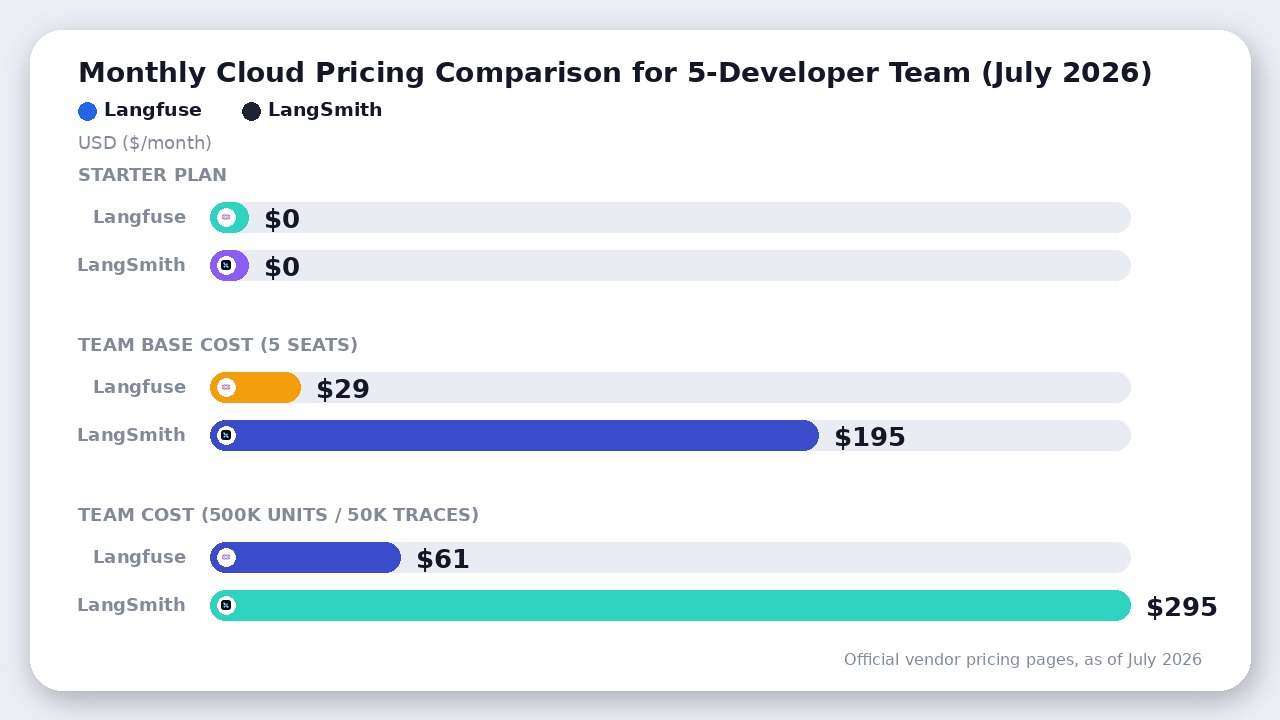
Consider a real-world scenario as of July 2026: an engineering team of 5 developers monitoring a production AI workflow that generates 50,000 execution traces (comprising ~500,000 total billable observations/units) per month.
- Langfuse Core Cost: $29 base plan + 400,000 excess units at $8/100k ($32) = $61 / month total.
- LangSmith Plus Cost: 5 seats x $39 ($195 base) + 40,000 excess base traces at $2.50/1k ($100) = $295 / month total.
For a modest team of five, LangSmith costs nearly 5x as much as Langfuse ($295 vs $61) for the exact same observability volume. As you invite product managers, QA engineers, and domain expert annotators into the platform, LangSmith’s seat tax scales linearly regardless of whether those team members generate a single trace.
Architecture & Data Sovereignty: Open Source vs. Closed SaaS
When building production AI agents, prompt data often contains sensitive user PII, proprietary source code, or strict corporate IP. Where that data resides is a critical architecture consideration.
Langfuse is built from the ground up as an open-source project under the MIT license. Its storage architecture relies on ClickHouse for high-throughput OLAP analytics, PostgreSQL for transactional metadata, Redis for caching, and S3-compatible storage for raw trace payloads. You can spin up the identical backend running Langfuse Cloud inside your own VPC using Docker Compose or official Kubernetes Helm charts for $0 in licensing fees. Your engineering team retains 100% data sovereignty, making HIPAA, GDPR, and SOC2 compliance trivial.
LangSmith is a proprietary SaaS product owned by LangChain Inc. While its client SDKs (Python, TypeScript, Go, Java) are open source, its backend execution engine, storage layer (including its proprietary trace database), and visual web UI are entirely closed source. Self-hosting LangSmith is strictly an Enterprise-only option gated behind sales calls and custom contracts.
For engineering teams deploying software in air-gapped environments or regulated industries (financial services, healthcare, defense), Langfuse’s MIT codebase eliminates vendor lock-in and security review roadblocks completely.
Agent Tracing & Evals: OpenTelemetry vs. LangGraph Ecosystem
Tracing basic LLM prompt-response chains was solved years ago. Modern LLM observability centers on complex agentic workflows: recursive tool invocations, parallel branch reasoning, dynamic sub-graphs, and human-in-the-loop approvals.
Langfuse takes an OpenTelemetry-native and framework-agnostic approach. Whether you build with OpenAI’s native SDK, Vercel AI SDK, LiteLLM, CrewAI, AutoGen, or raw API calls, Langfuse treats traces as standardized OpenTelemetry spans. Its UI renders complete execution trees, token usage breakdowns, latency bottlenecks, and cost attribution per user or feature. For developers building modular stacks—such as a Next.js frontend deployed on Vercel paired with a Python microservice backed by Supabase—Langfuse integrates effortlessly without requiring you to adopt any specific agent orchestration library.
LangSmith was built specifically as the control center for the LangChain and LangGraph ecosystem. When you trace a multi-agent system built on LangGraph, LangSmith captures state transitions, node executions, conditional routing decisions, and intermediary payload streams with zero configuration. Its evaluation tools feature automated online LLM-as-judge evaluators, prompt playground experiments, and seamless dataset generation directly from failed production traces.
Where LangSmith Actually Wins
LangSmith remains a formidable platform, and for specific team workflows, it is the superior solution:
- Deep LangGraph Orchestration & Studio: If your codebase relies on LangGraph for stateful agent orchestration, LangSmith’s visual debugging capabilities are unmatched. You can inspect exact graph state at step 14 of an execution trajectory, re-run specific sub-graphs with modified inputs directly in the UI, and visually debug complex supervisor-worker patterns.
- Managed Agent Infrastructure (LangSmith Deployment): LangSmith has expanded beyond pure observability into an end-to-end agent platform. With LangSmith Deployment, Sandboxes, and Fleet, you can deploy long-running stateful agents as managed MCP (Model Context Protocol) servers without managing serverless runtime infrastructure.
- Domain Expert Annotation Queues: LangSmith offers sophisticated review queues tailored for non-technical domain experts (legal, medical, or support leads) to audit agent trajectories, provide human feedback, and systematically align LLM-as-judge evaluators.
The Verdict
For 85% of AI engineering teams, Langfuse is the definitive winner. It delivers complete agent observability, robust prompt management, online evaluators, and cost tracking with an MIT open-source license, zero seat fees on paid plans, and a fraction of the cloud hosting costs.
Choose Langfuse if you build framework-agnostic AI applications, require full self-hosting in your own cloud, or want to collaborate with your entire team without paying per-seat SaaS tolls.
Choose LangSmith if your architecture is built exclusively on LangGraph, and your primary goal is an integrated, managed SaaS environment covering agent execution, visual state debugging, and managed agent deployment.
Frequently Asked Questions
Is Langfuse completely free to self-host?
Yes. Langfuse is open source under the MIT license. You can deploy all core platform features (tracing, prompt management, evaluators, datasets, cost tracking) on your own infrastructure using Docker Compose or Kubernetes for free without user or trace volume caps.
Do I need to use the LangChain framework to use LangSmith?
No. LangSmith provides native SDKs for Python, TypeScript, Go, and Java, as well as OpenTelemetry integrations. You can trace any LLM application on LangSmith regardless of framework, though its deepest agent debugging features are optimized for LangGraph.
How do Langfuse and LangSmith calculate token costs?
Both platforms maintain automatically updated model price tables for major providers (OpenAI, Anthropic, Google, Cohere) and calculate USD costs at ingestion. Both tools also allow you to define custom model pricing and override token/cost counts directly via API.
Final Recommendation
Langfuse wins for most engineering teams thanks to its open-source MIT license, zero seat fees on paid plans, full self-hosting freedom, and transparent unit-based pricing. Choose LangSmith only if your stack is deeply tied to LangChain and LangGraph.

Leave a Reply