

If your AI application runs high query volume or relies heavily on metadata filtering, Qdrant wins this matchup on both cost and performance. The reason isn’t open-source dogma or language benchmarks—it comes down to a fundamental mismatch in how the two platforms charge for vector retrieval.
Pinecone charges for serverless reads and writes on top of storage. That pricing architecture works brilliantly for bursty, low-traffic prototypes, but it creates a steep pricing penalty the moment your production Retrieval-Augmented Generation (RAG) pipeline handles millions of user queries. Qdrant, by contrast, bills strictly for provisioned hardware resources (vCPU, RAM, and disk) in its cloud tier and costs $0 in software licensing if you self-host its open-source Rust engine.
Unless your team strictly forbids managing infrastructure and runs low-frequency background retrieval, Qdrant is the sharper architectural choice for modern AI engineering stacks.
The 30-Second Decision Framework
- Pick Qdrant if you want predictable monthly infrastructure bills regardless of query throughput, need lightning-fast payload metadata filtering, or want the flexibility to deploy on Qdrant Cloud, Docker, Kubernetes, or air-gapped private VPCs.
- Pick Pinecone if you want a fully managed, zero-ops SaaS vector database with zero infrastructure dials to turn, hosted embedding and reranking models directly inside the API, and turn-key SOC 2 Type II compliance without touching a deployment manifest.
Comparison Overview
Pricing verified against official vendor documentation as of July 2026.
| Dimension | Pinecone | Qdrant |
|---|---|---|
| Core Philosophy | Proprietary, serverless-first managed SaaS | Open-source (Apache 2.0), Rust-native engine |
| Pricing Model | Usage-based (Read Units + Write Units + Storage) + Monthly Minimum | Resource-based (vCPU + RAM + Disk) or $0 Self-Hosted |
| Free Tier | Starter: $0/mo (2 GB storage, 5 serverless indexes, as of July 2026) | Cloud Free: 1 cluster (1 GB RAM, 4 GB disk) / OSS: Unlimited self-hosted |
| Entry Paid Plan | Builder: $20/mo flat commitment / Standard: $50/mo minimum (as of July 2026) | Cloud Standard: Pay-as-you-go (~$0.014/hr, ~$10-$25/mo entry, as of July 2026) |
| Per-Query Billing | Yes ($16/M Read Units on Standard, as of July 2026) | No ($0 per query across all tiers) |
| Metadata Filtering | Namespace and metadata filters | First-class payload indexing (pre-filtering in Rust memory) |
| Self-Hosting / BYOC | BYOC on Enterprise only (No self-host option) | Full self-hosting via Docker/K8s, Hybrid Cloud, Private Cloud |
| Integrated Models | Hosted embeddings and reranking APIs built-in | Vector search engine (requires external embedding/rerank pipeline) |
The Pricing Trap: Per-Query Read Units vs. Resource Metering
When evaluating a vector database comparison for production RAG pipelines, most developers look only at initial storage costs. That is where many teams get caught off-guard.
Pinecone eliminated its legacy pod-based architecture for new accounts in favor of a serverless object-storage model. On paper, this sounds ideal: you pay $0.33/GB-month for vector storage on the Standard plan (as of July 2026). However, Pinecone bills every vector search through Read Units (RUs). On Pinecone’s Standard tier ($50/month minimum commitment, as of July 2026), queries cost $16 per million Read Units (as of July 2026). One Read Unit covers up to 1 GB of index data queried. If your application handles 20 million queries per month against a multi-gigabyte namespace, your monthly Pinecone bill quickly climbs past $400—reaching $412/month when accounting for storage, read units, and write overhead—even if your raw stored vector footprint is relatively small.
Qdrant Cloud operates on a completely different pricing philosophy. Instead of metering individual API requests, Qdrant bills solely for the underlying compute resources (vCPU, RAM, and storage disk). A typical 2-node managed Qdrant cluster handling 10 million 1536-dimensional vectors with scalar quantization runs around $120/month (as of July 2026). Whether that cluster serves 100,000 queries or 50 million queries in a month, the software cost remains identical.
Total Cost Breakdown by Workload Scale (as of July 2026)
- 1M Vectors / Low Queries (500k queries/month):
- Pinecone Serverless (Standard): $52/month ($50/mo minimum spend commitment plus $2.00 storage overhead for ~6.1 GB).
- Qdrant Cloud (Managed): $25/month for an entry 2 GB RAM managed node ($0 per query).
- Qdrant Self-Hosted (VPS): $10/month on a 2 vCPU / 4 GB RAM cloud VPS ($0 license fee).
- 10M Vectors / High Queries (20M queries/month):
- Pinecone Serverless (Standard): $412/month (20M Read Units at $16/M = $320, plus ~61.4 GB vector storage at $0.33/GB = $20.26, plus Write Units & base operational overhead).
- Qdrant Cloud (Managed): $120/month for a 2-node high-availability cluster with scalar quantization ($0 per query).
- Qdrant Self-Hosted (VPS): $40/month on a 4 vCPU / 16 GB RAM cloud VPS ($0 license fee).
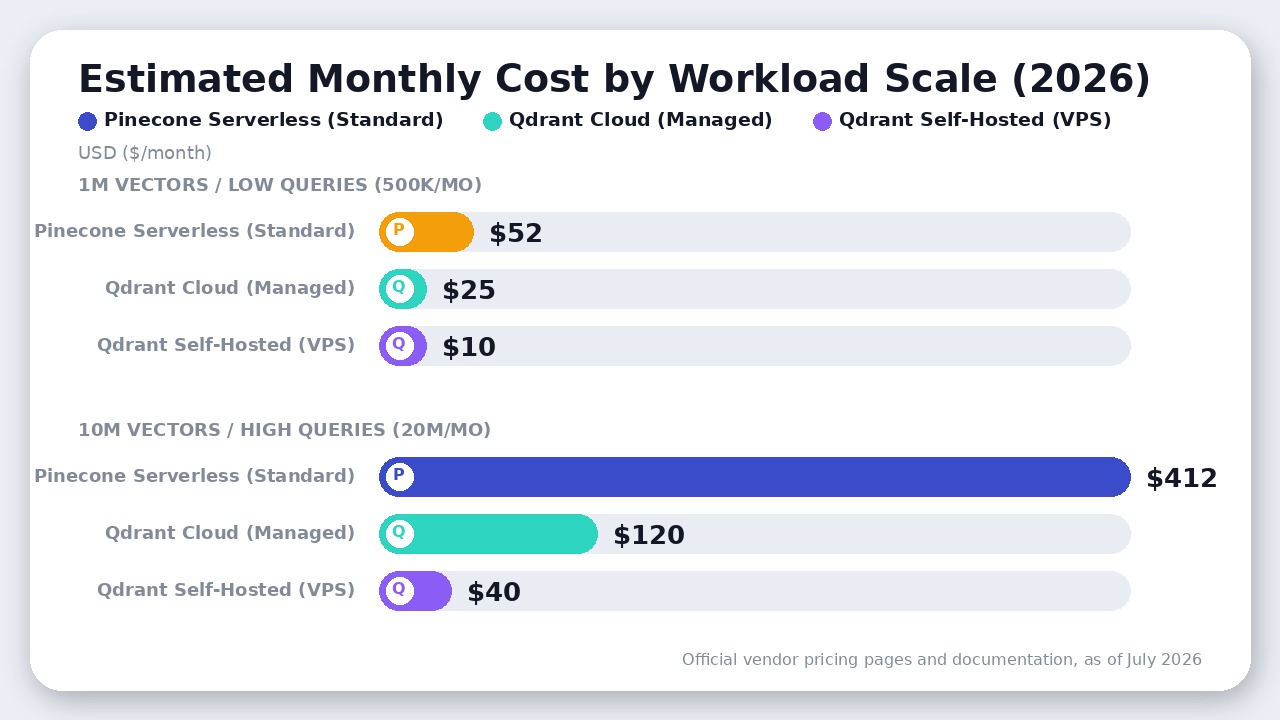
For teams with high Query-to-Ingestion Ratios (QIR)—such as real-time search, customer-facing AI agents, or high-traffic recommendation engines—Qdrant’s resource-based model provides 3x to 5x cost savings compared to Pinecone’s per-query metering.
Payload Metadata Filtering & Latency Under Stress
In real-world RAG architectures, pure vector similarity search is rarely enough. You almost always need to filter retrieval by tenant ID, document access permissions, publication date, or user category. How a database handles metadata filtering heavily dictates p95 query latency.
Pinecone supports metadata filtering, but its underlying serverless architecture separates query compute nodes from persistent object storage. When executing complex, highly restrictive filters across large indexes, query execution can experience latency spikes because the engine must reconcile storage partitions with sparse metadata constraints.
Qdrant was engineered in Rust specifically around payload indexing. In Qdrant, metadata fields (payloads) can be indexed alongside vectors directly in memory. During a query, Qdrant’s payload index evaluates filter conditions before and during the HNSW graph traversal (pre-filtering), rather than filtering results after vector distance calculations (post-filtering). This architecture allows Qdrant to maintain consistent low p95 latencies even under heavy multi-tenant filtering constraints.
Furthermore, Qdrant natively supports scalar, binary, and product quantization (PQ). By quantizing 32-bit floating-point vectors down to 8-bit integers or binary representations, Qdrant reduces RAM footprint by up to 95% while retaining over 97% of search recall. This means you can keep massive vector collections entirely in RAM on lower-cost compute instances.
Developer Experience, Hosted Models, and Integrations
Where Pinecone shines is operational abstraction. Setting up a serverless index on Pinecone takes less than two minutes: pick a cloud provider (AWS, GCP, or Azure), name your index, specify your vector dimensions (e.g., 1536 for OpenAI text-embedding-3-small), and start upserting.
Pinecone has also expanded into an all-in-one AI retrieval platform. It offers integrated hosted embedding and reranking models directly inside its API. You can send raw text strings to Pinecone, and its infrastructure automatically handles vector generation and reranking before returning structured results. This cuts down on pipeline boilerplate code.
Qdrant is a dedicated, high-performance vector search engine. While Qdrant offers rich client SDKs for Python, TypeScript/JavaScript, Go, and Rust, it expects you to manage your own embedding generation and reranking logic. If you are building complex LLM applications, you will pair Qdrant with orchestration frameworks like LangChain or LlamaIndex and trace execution using observability platforms like Langfuse vs LangSmith. For application storage and user metadata, teams frequently complement Qdrant with relational backends like Postgres via managed platforms reviewed in our Supabase vs Firebase guide.
Where Pinecone Actually Wins
To make a credible decision, you have to acknowledge where the losing tool holds genuine advantages. Pinecone remains a compelling choice in three specific scenarios:
- Zero Operational Overhead: If your engineering team does not have dedicated DevOps or platform engineers and refuses to manage cluster sizing, memory configuration, or shard replicas, Pinecone eliminates operational maintenance entirely.
- Low Query Volume with High Burstiness: If you are building internal corporate tools or batch processing pipelines where the database sits idle for hours and receives fewer than 1 million queries per month, Pinecone’s serverless pay-per-read model ($0/mo Starter or $20/mo Builder, as of July 2026) can actually be cheaper than paying for an always-on Qdrant Cloud node.
- Turn-Key Enterprise Readiness: Pinecone Standard ($50/mo minimum commitment, as of July 2026) and Enterprise ($500/mo minimum commitment, as of July 2026) tiers deliver turn-key SOC 2 Type II compliance, HIPAA eligibility, and AWS/GCP Marketplace billing without needing custom infrastructure contracts.
The Verdict
For most production software teams building AI applications in 2026, Qdrant is the superior vector database choice.
Qdrant provides predictable monthly infrastructure costs, superior payload filtering for multi-tenant applications, and complete deployment sovereignty. Whether you start on Qdrant Cloud for managed simplicity or deploy its open-source Docker container directly onto your cloud infrastructure, you avoid the per-query pricing tax that makes Pinecone expensive at scale.
Choose Qdrant if:
- You want flat, predictable infrastructure costs with zero per-query fees.
- Your application relies on complex metadata payload filtering (e.g., multi-tenant SaaS).
- You require open-source code ownership, self-hosting options, or air-gapped private deployments.
Choose Pinecone if:
- Your team requires a completely hands-off SaaS experience with zero infrastructure configuration.
- Your workload has low query traffic where serverless pay-per-use remains under $50/month.
- You want built-in text embedding and reranking models directly inside your vector database API.
Frequently Asked Questions
Is Qdrant completely free to self-host?
Yes. Qdrant’s core vector search engine is released under the Apache 2.0 open-source license. You can download and run Qdrant via Docker or Kubernetes in production without paying any software licensing fees. You only pay for your underlying cloud compute infrastructure.
Does Pinecone still offer pod-based indexes?
As of 2024 and continuing through 2026, Pinecone has deprecated legacy pod-based indexes for new accounts and migrated fully to its serverless architecture backed by object storage.
Can I migrate data from Pinecone to Qdrant easily?
Yes. Both platforms support standard JSON metadata payloads and vector arrays. Because both engines interface cleanly with standard OpenAI, Cohere, and open-source embedding formats, migrating involves exporting vector IDs and payloads via Pinecone’s fetch API and upserting them into a Qdrant collection using Qdrant’s batch Python or TypeScript SDKs.
Final Recommendation
Qdrant wins this matchup for most production AI engineering teams due to its resource-based pricing, Rust-native speed, and zero per-query fees. Pick Pinecone only if your team mandates zero infrastructure maintenance and runs low-frequency query workloads.

Leave a Reply