

Paddle wins this matchup for scaling software businesses, but the reason isn’t the headline price on their homepages. If you land on either site, as of July 2026, you’ll see the exact same standard rate advertised: 5% + $0.50 per transaction (as of July 2026).
The difference lies in what happens when you actually charge a customer. Paddle delivers a genuinely all-inclusive fee schedule that absorbs sales tax, cross-border payments, currency conversions, and subscription management under one flat fee. Lemon Squeezy, under the hood, layers line-item surcharges for international buyers (+1.5%), PayPal transactions (+1.5%), and recurring subscriptions (+0.5%). For a global SaaS billing monthly subscriptions, Lemon Squeezy’s effective cut easily climbs from 5% to over 8% per order.
The Decision Framework: Choose Paddle if you are building a B2B or B2C software business with international users, recurring subscriptions, or wire/invoice requirements. Choose Lemon Squeezy only if you are a solo creator or US indie hacker launching digital downloads, license keys, or a pre-launch micro-SaaS that values 10-minute setup over margin economics.
The 30-Second Answer
- Pick Paddle if: You sell software globally, offer monthly/annual subscriptions, need B2B wire invoicing, and want predictable gross margins without cross-border or PayPal penalties.
- Pick Lemon Squeezy if: You are selling one-off digital assets (ebooks, templates, license keys) primarily to US buyers, need a hosted storefront and built-in email tools out of the box, and want the fastest possible path to accepting payments.
Paddle vs Lemon Squeezy: Direct Comparison
| Feature / Dimension | Paddle | Lemon Squeezy |
|---|---|---|
| Merchant of Record (MoR) | Yes (Absorbs global tax liability) | Yes (Absorbs global tax liability) |
| Standard Headline Fee | 5% + $0.50 / transaction (as of July 2026) | 5% + $0.50 / transaction (as of July 2026) |
| International Transaction Surcharge | $0.00 (Included in base rate) | +1.5% surcharge |
| PayPal Processing Surcharge | $0.00 (Included in base rate) | +1.5% surcharge |
| Subscription Payment Surcharge | $0.00 (Included in base rate) | +0.5% surcharge |
| Abandoned Cart Email Fee | Included | +5% on recovered sales |
| Payout Surcharge (Non-US Bank) | Standard payout options included | 1% via Stripe / 3% via PayPal |
| B2B Invoicing & Wire Transfers | Native wire transfers & net-30 terms | Basic invoice generation |
| Built-in Revenue Analytics | ProfitWell Metrics (Included free) | Native basic analytics |
| Parent Company / Ownership | Independent | Acquired by Stripe (July 2024) |
Source: Official vendor documentation, fee schedules, and platform developer docs as of July 2026.
1. The Pricing Trap: Headline Rates vs. Effective Surcharges
On paper, as of July 2026, both platforms charge 5% + $0.50 per successful charge. This leads many founders to assume their transaction costs will be identical regardless of which platform they pick. In practice, Lemon Squeezy’s fee structure uses line-item additions that compound on every non-standard charge, according to Lemon Squeezy’s official documentation.
Here is how those add-on fees stack according to Lemon Squeezy’s published rates as of July 2026:
* Base Platform Fee: 5% + $0.50
* Subscription Surcharge: +0.5%
* International Card Surcharge (outside US): +1.5%
* PayPal Surcharge: +1.5%
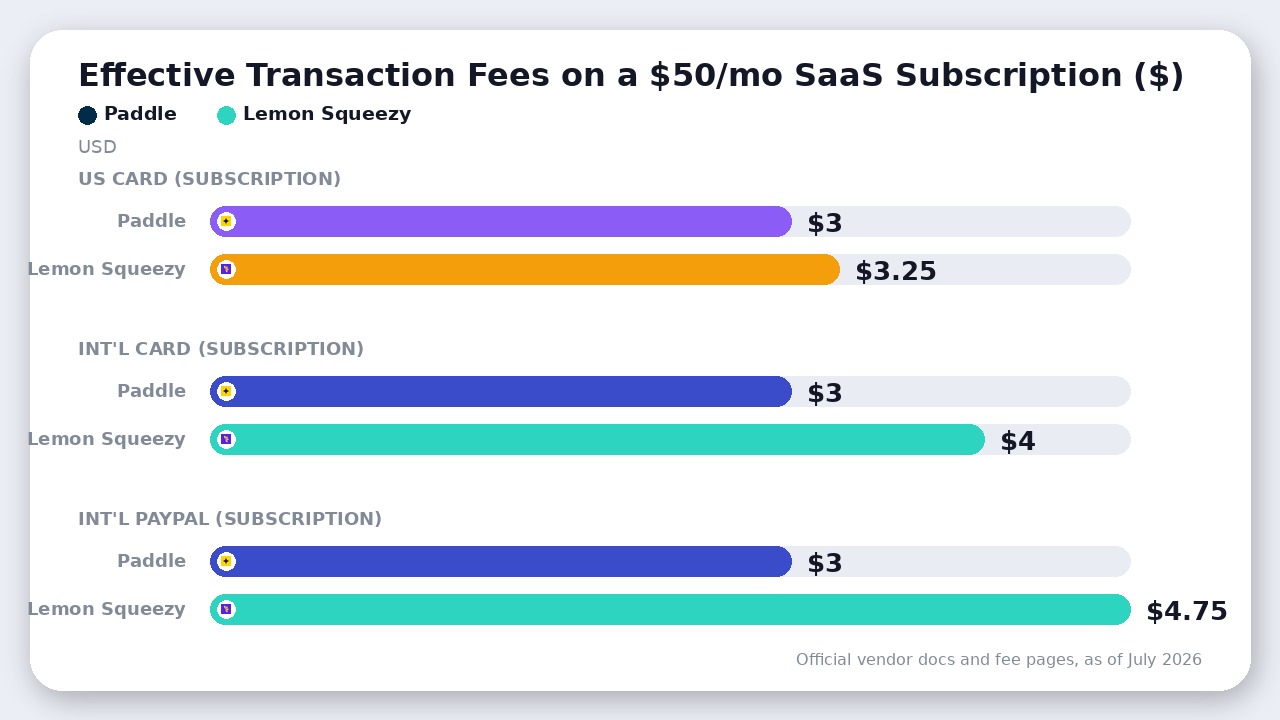
To illustrate the real-world impact, let’s trace a standard $50/month SaaS subscription across three common customer payment scenarios.
Scenario A: US Customer paying via Credit Card ($50/mo subscription)
- Paddle: 5% of $50 ($2.50) + $0.50 = $3.00 (Effective rate: 6.00%)
- Lemon Squeezy: Base 5% ($2.50) + $0.50 + Subscription (+0.5% / $0.25) = $3.25 (Effective rate: 6.50%)
Scenario B: European Customer paying via Credit Card ($50/mo subscription)
- Paddle: 5% of $50 ($2.50) + $0.50 = $3.00 (Effective rate: 6.00%)
- Lemon Squeezy: Base 5% ($2.50) + $0.50 + Subscription ($0.25) + Int’l Card (+1.5% / $0.75) = $4.00 (Effective rate: 8.00%)
Scenario C: European Customer paying via PayPal ($50/mo subscription)
- Paddle: 5% of $50 ($2.50) + $0.50 = $3.00 (Effective rate: 6.00%)
- Lemon Squeezy: Base 5% ($2.50) + $0.50 + Subscription ($0.25) + Int’l Card ($0.75) + PayPal (+1.5% / $0.75) = $4.75 (Effective rate: 9.50%)
If your SaaS targets global developers or international B2B buyers who frequently check out via PayPal or non-US cards, Lemon Squeezy takes nearly 10% of your top-line gross revenue. Paddle’s fee remains strictly capped at 6.00% for that same $50 transaction.
Furthermore, if you live outside the US, Lemon Squeezy charges an additional 1% fee on Stripe payouts or 3% (up to $30) on PayPal payouts to non-US bank accounts. Paddle handles payouts to international bank accounts without these percentage payout penalties.
2. Global Tax Compliance & Merchant of Record Coverage
Both Paddle and Lemon Squeezy act as a Merchant of Record (MoR). Unlike standard payment gateways where you are the legal merchant—requiring you to register for sales tax, VAT, and GST in every state and country where you cross nexus thresholds—an MoR acts as the reseller. Legally, your buyer purchases the software from the MoR, and the MoR remits tax to global authorities on your behalf.
Where they diverge is in operational scale and market maturity:
- Paddle: Built specifically for global B2B and B2C software compliance. Paddle collects and remits tax in over 200 regions, handles reverse-charge VAT rules for B2B transactions seamlessly, and validates EU VAT IDs in real time during checkout.
- Lemon Squeezy: Handles global sales tax and VAT across 150+ regions, but sits on top of Stripe’s infrastructure following Stripe’s acquisition of Lemon Squeezy in mid-2024. While Lemon Squeezy offers tax-inclusive pricing toggles, its B2B tax validation flows are less customizable for enterprise buyer workflows.
If your stack relies on modern infrastructure—whether you host on Render or handle auth with Clerk—Paddle’s checkout engine provides cleaner localization for multi-currency billing out of the box, allowing buyers to pay in their local currency while you settle in USD, EUR, or GBP.
3. Subscription Management, B2B Invoicing, and Ownership
For SaaS companies, acquiring the customer is only step one. Retaining them and collecting recurring revenue determines whether the business survives.
B2B Invoicing & High-Ticket Sales
If your SaaS charges $1,000/year or higher, many B2B customers refuse to put a credit card on file—they require wire transfers, ACH, or net-30 terms.
* Paddle includes native B2B invoicing with automated bank transfer matching. It generates tax-compliant invoices and tracks incoming wire payments directly inside the dashboard.
* Lemon Squeezy focuses primarily on self-serve credit card and PayPal checkouts. While it can issue basic receipt invoices, it lacks native support for complex manual invoicing workflows or bank transfers.
Dunning & Revenue Recovery
Paddle integrates natively with ProfitWell Retain (which Paddle acquired), an automated dunning engine that uses machine learning to retry failed payments and recover churned subscribers. ProfitWell Metrics is also included completely free for Paddle sellers. Lemon Squeezy relies on basic email retry logic, or charges a 5% surcharge on sales recovered via its built-in abandoned cart workflow.
Platform Direction & Ownership
Stripe acquired Lemon Squeezy in July 2024 and launched Stripe Managed Payments (a 3.5% MoR add-on on top of standard Stripe processing). Consequently, Lemon Squeezy is increasingly positioned alongside Stripe’s broader merchant of record capabilities. Paddle remains an independent, focused Merchant of Record platform dedicated exclusively to software billing.
Where Lemon Squeezy Actually Wins
Despite Paddle’s cost advantages at scale, Lemon Squeezy holds clear advantages for specific creator and indie hacker workflows:
- Instant Setup & Creator Storefronts: Setting up Lemon Squeezy takes 15 minutes. It provides hosted product landing pages, file hosting for digital downloads, and built-in lead magnets right out of the box. Paddle requires a business verification approval process and expects you to embed its checkout SDK into your own existing website or application.
- License Key Management: If you sell desktop apps, Figma plugins, or self-hosted software, Lemon Squeezy includes a native license key generator and validation API out of the box. On Paddle, you must generate and validate license keys via external webhooks.
- Built-in Email Marketing & Affiliates: Lemon Squeezy offers built-in email broadcasts, sequence automation, and an affiliate management portal. While affiliate sales carry a 3% surcharge, having an all-in-one stack without paying for a separate email service provider is a major advantage for solo builders launching digital goods.
The Verdict
For any software business charging recurring subscriptions or selling globally, Paddle is the clear winner.
While both platforms market the same 5% + $0.50 headline price (as of July 2026), Paddle’s all-inclusive fee schedule preserves your gross margins. Lemon Squeezy’s stacked surcharges on international cards (+1.5%), PayPal (+1.5%), and subscriptions (+0.5%) turn a $50 global PayPal subscription into a 9.5% transaction penalty. Combined with Paddle’s native B2B invoicing, free ProfitWell analytics, and enterprise dunning, Paddle is built for sustainable SaaS growth.
Conditional Exceptions:
* Choose Lemon Squeezy if you are a US-based creator selling one-off digital downloads or license keys, want hosted storefronts and built-in email tools, and operate primarily in the US market where cross-border fees won’t bite.
* Choose Paddle for everything else—especially B2B SaaS, international products, and multi-tier recurring subscription models.
Final Recommendation
While both platforms market a 5% + $0.50 base rate (as of July 2026), Paddle wins for all scaling SaaS businesses because its fee is truly all-inclusive. Lemon Squeezy stacks surcharges for international cards, PayPal, and subscriptions, driving effective fees up to 9.5%.

Leave a Reply