

Midjourney wins for solo creatives, concept artists, and marketers who want instant, art-directed cinematic visuals out of the box through a polished web UI. FLUX wins decisively for developers, product teams, and technical designers who need precise prompt adherence, legible in-image text, API automation, or the ability to self-host open weights with zero lock-in.
Midjourney wins this matchup if your primary goal is generating stunning, art-directed concept art from short prompts without touching code or configuring pipelines. FLUX, built by Black Forest Labs, wins if you need precise prompt adherence, readable typography inside images, developer-accessible APIs, or open weights you can run locally on your own hardware.
The AI image generation space spent two years locked in a battle over default aesthetics. In 2026, the question is no longer just which tool makes the prettiest picture—it is whether you want a closed consumer platform or an open, composable foundation model you can build into real products.
The 30-Second Answer
- Choose Midjourney if you are a solo designer, content creator, or marketer who wants an all-in-one web and Discord interface that turns casual prompts into polished, cinematic visuals with minimal prompt engineering. You are comfortable paying a flat monthly subscription and do not need to integrate image generation into external applications.
- Choose FLUX if you are a developer, studio pipeline technical director, or agency that demands exact adherence to complex prompts, photorealistic textures, crisp text rendering, or automated backend generation via API. FLUX is also the only choice between the two if your enterprise requires self-hosting or data sovereignty.
Head-to-Head Comparison
| Feature / Dimension | Midjourney | FLUX (Black Forest Labs) |
|---|---|---|
| Core Architecture | Proprietary closed-source model | Transformer-based flow matching; open weights & API |
| Access Methods | Web app (midjourney.com) and Discord |
BFL API, partner APIs (fal.ai, Replicate), ComfyUI, local weights |
| Entry Price | $10/month (Basic Plan as of August 2026) | $0 (Open-weight Schnell) or $0.04/image (FLUX 1.1 Pro API) |
| Official Public API | ❌ No official API | ✅ Fully documented REST API |
| In-Image Text Accuracy | Moderate (improving, but prone to garbling) | High (industry-leading typography precision) |
| Prompt Adherence | Creative interpretation (high bias toward beauty) | Literal & precise spatial/object adherence |
| Private Generations | Locked to $60/mo Pro plan (Stealth Mode) | Included by default (API requests & local runs) |
| Self-Hosting Options | ❌ None | ✅ Apache 2.0 (Schnell), Dev weights |
Pricing and technical parameters verified from official vendor documentation and pricing portals as of August 2026.
1. Prompt Adherence and Text Rendering: Accuracy vs Interpretation
The fundamental difference between the two models lies in how they interpret instructions.
Midjourney operates with a strong aesthetic prior. When you enter a vague prompt like “a cybernetic detective in a rain-slicked alley,” Midjourney’s engine fills in volumetric fog, anamorphic lens flares, balanced color grades, and intricate costume details. It acts like an aggressive art director who takes your basic concept and executes it to look like a blockbuster film still. However, when you give Midjourney a rigid, multi-constraint prompt—such as “a woman in a green coat on the left, holding a blue notebook, standing next to a red mailbox with the words ‘PRESS DAILY’ printed on it”—Midjourney frequently drops objects, mixes colors between subjects, or corrupts the text.
FLUX, engineered by the researchers behind Latent Diffusion and Stable Diffusion at Black Forest Labs, utilizes a 12-billion-parameter rectified flow transformer architecture. It prioritizes prompt fidelity and spatial logic. If you specify four distinct objects in specific locations with particular colors, FLUX honors those constraints with exceptional accuracy.
Furthermore, FLUX has established itself as a benchmark leader for in-image typography. Rendering logos, book covers, street signage, and UI components that require readable English text is reliable on FLUX 1.1 Pro, whereas Midjourney still frequently generates pseudo-lettering or misspells words longer than five characters.
Prompt Adherence Spectrum:

[ FLUX 1.1 Pro ] ─────────────────────────► [ Midjourney V8 ]
Exact spatial layout                         Artistic interpretation
Clean typography                             Cinematic color grading
Literal constraint execution                 High aesthetic default
2. Infrastructure, Integration, and Developer Control
For anyone building software, the comparison ends almost immediately on developer ergonomics.
Midjourney remains a closed consumer product. To generate images, users must interact with the Midjourney web client or Discord bot. Midjourney has no official REST API, and utilizing headless browser scripts or unofficial Discord automation explicitly violates Midjourney’s Terms of Service. If your product roadmap requires generating dynamic banners, user avatars, or e-commerce mockups on the fly, Midjourney cannot legally or technically be integrated into your production backend.
FLUX was built from day one for developers and automated workflows. Black Forest Labs provides direct API access alongside official availability on platforms like fal.ai, Replicate, and Microsoft Azure AI Foundry. A single API call to api.bfl.ml with your payload returns a generated image in 3 to 10 seconds.
For teams with security requirements, data sovereignty mandates, or on-premises GPU infrastructure, FLUX offers open weights:
- FLUX.1 [schnell]: Distilled 4-step model available under an Apache 2.0 license for commercial local use.
- FLUX.1 [dev]: Full-guidance 12B model with non-commercial open weights available for fine-tuning, LoRA training, and research.
- ComfyUI Integration: Deep node-level control over latent noise, conditioning, inpainting, and custom adapters.
If you want to read more about how AI workflows fit into broader app design, check our analysis of Canva vs Adobe Express and UI systems in Figma vs Penpot.
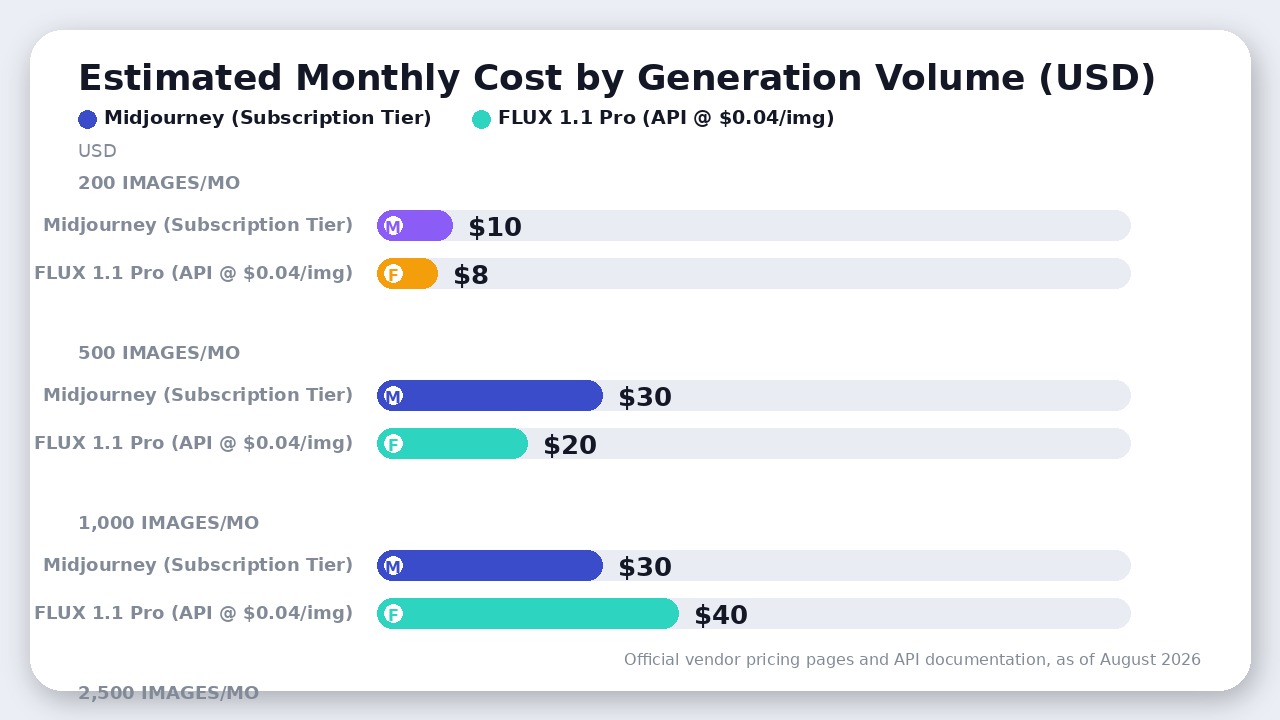
3. Pricing Traps and Unit Economics: Monthly Plans vs Usage-Based Billing
The pricing structures of both tools reflect their target audiences, and choosing the wrong model can inflate your monthly spend.
Midjourney’s Subscription Structure
Midjourney prices its service through fixed monthly tiers based on “Fast GPU Hours” (as of August 2026):
- Basic Plan ($10/mo or $8/mo billed annually): 3.3 Fast GPU hours (~200 standard image generations). No Relax Mode. Once Fast hours are exhausted, you must purchase additional compute at $4/hour.
- Standard Plan ($30/mo or $24/mo billed annually): 15 Fast GPU hours plus unlimited Relax Mode generations. Relax Mode places jobs in a dynamic queue that processes without burning Fast credits.
- Pro Plan ($60/mo or $48/mo billed annually): 30 Fast GPU hours, unlimited Relax Mode, higher concurrent job limits, and Stealth Mode.
- Mega Plan ($120/mo or $96/mo billed annually): 60 Fast GPU hours, unlimited Relax Mode, and highest concurrency.
The Midjourney Privacy Trap: On Midjourney’s Basic ($10/mo) and Standard ($30/mo) plans, every image you generate is automatically published to Midjourney’s public showcase gallery. If you are working on unreleased client projects, proprietary branding, or confidential concepts, you are forced to pay at least $60/month for the Pro plan to activate Stealth Mode.
FLUX Pricing Mechanics
FLUX pricing scales directly with consumption or compute:
- BFL API / Hosted Providers: FLUX 1.1 Pro runs at approximately $0.04 per image. FLUX.1 [dev] via API runs at roughly $0.025 per image, and FLUX.1 [schnell] runs at roughly $0.003–$0.005 per image.
- Self-Hosted Local Execution: $0 marginal software cost using open weights on your own hardware, paying only for electricity or raw cloud GPU compute (such as an RTX 4090 or cloud A10G/H100 instance).
- Privacy by Default: All API generations and local instances are completely private without paying a privacy surcharge.
For low-to-moderate volume users (e.g., generating 300 to 500 images per month), FLUX 1.1 Pro via API costs between $12 and $20 per month—significantly cheaper than Midjourney’s $30 or $60 tiers—while offering total privacy. However, for high-volume manual power users generating thousands of exploratory draft images, Midjourney’s Standard plan ($30/mo) with unlimited Relax Mode offers unmatched value per prompt.
4. Fine-Tuning, LoRAs, and Consistency Control
A critical requirement for professional design teams is brand consistency: maintaining exact character faces, corporate color palettes, or proprietary product silhouettes across hundreds of generations.
Midjourney tackles consistency using internal parameters such as --cref (Character Reference) and --sref (Style Reference), along with the Web Editor’s inpainting brushes. While effective for casual style-matching, these parameters cannot be trained on proprietary datasets. You cannot upload a 50-image dataset of a new hardware product and fine-tune Midjourney’s underlying weights to understand that product from every angle.
FLUX supports the entire open-source training ecosystem. Designers and machine learning engineers can train Low-Rank Adaptations (LoRAs) on FLUX.1 [dev] using tools like Kohya-ss or cloud trainers on Replicate and fal.ai. A 20MB LoRA file allows teams to lock down exact corporate identities, bespoke typography sets, or photorealistic brand mascots with mathematical repeatability.
If you are also evaluating generative video pipelines to pair with your image models, see our breakdown of Kling AI vs Runway.
Where Midjourney Actually Wins
It would be a mistake to dismiss Midjourney as an inferior model simply because it is closed-source. There are key areas where Midjourney remains unmatched:
- Out-of-the-Box Aesthetic Taste: Midjourney has an extraordinary built-in understanding of cinematography, fine art, color theory, and lighting. A two-line prompt in Midjourney frequently produces an image that looks ready for a gallery wall, while FLUX with the same short prompt can look flat, sterile, or like an unedited raw DSLR photo. Directing beauty in FLUX requires detailed prompt modifiers.
- The Web Workspace Experience: The modern
midjourney.comweb canvas is a masterclass in creative ergonomics. Panning, zooming, regional inpainting, style exploration, and organizing image batches are intuitive for non-technical creatives who do not want to manage node graphs or API keys. - Relax Mode for Exploration: If you generate 4,000 concept images a month while brainstorming, Midjourney Standard ($30/mo) provides unlimited generation in Relax Mode. Generating 4,000 images on FLUX 1.1 Pro via API would cost $160.
The Verdict
Choose Midjourney if you are a creator, art director, or solo marketer whose sole priority is aesthetic output and ease of use. If your workflow lives entirely inside an interactive canvas, and you want stunning visuals without having to specify lighting ratios, camera lenses, or geometry in your prompts, Midjourney remains the premier creative companion.
Choose FLUX if you are building production software, need API access, require exact text in your images, or demand absolute data privacy without paying an enterprise tax. For engineering teams, agencies training custom LoRA models, and designers who value literal adherence over algorithmic artistic liberties, FLUX is the undisputed winner in 2026.
Frequently asked questions
Can I run FLUX locally for free?
Yes. Black Forest Labs released FLUX.1 [schnell] under an open Apache 2.0 license and FLUX.1 [dev] under a non-commercial research license. Both can be downloaded from Hugging Face and run locally via ComfyUI or WebUI on consumer GPUs with sufficient VRAM (typically 12GB to 24GB depending on quantization).
Does Midjourney have an official API?
No. As of August 2026, Midjourney has not released an official public API for developers. Using third-party wrappers or scraping Discord automation violates Midjourney’s Terms of Service. If you need programmatic image generation inside a SaaS app or workflow, FLUX via API is the compliant choice.
Which tool renders text in images better?
FLUX handles text rendering with significantly higher accuracy than Midjourney. While Midjourney V6 and V7 improved short-word handling, FLUX consistently renders multi-word phrases, logos, street signs, and UI labels without garbled characters or spelling hallucinations.
Is Midjourney’s free trial still available?
No. Midjourney does not offer a permanent free tier or trial. Access requires a paid subscription starting with the Basic Plan at $10 per month (or $8 per month billed annually as of August 2026).
Final Recommendation
FLUX wins the overall matchup for modern production workflows due to superior prompt adherence, accurate typography, open weights, and direct API flexibility. Midjourney remains the premier choice solely for standalone creatives prioritizing effortless editorial styling and curated aesthetics over technical control.

Leave a Reply