

Kimi AI is Moonshot AI’s flagship reasoning and long-context assistant. Western teams can access it globally via web, mobile, and an OpenAI-compatible API with standard international cards. However, hosted consumer data is routed through Singapore and Chinese infrastructure where submissions are used for model training by default without an in-app toggle, making self-hosted open weights or API-level routing necessary for regulated workloads.
Kimi AI is Moonshot AI’s flagship reasoning and long-context assistant. Western teams can access it globally via web, mobile, and an OpenAI-compatible API with standard international cards. However, hosted consumer data is routed through Singapore and Chinese infrastructure where submissions are used for model training by default without an in-app toggle, making self-hosted open weights or API-level routing necessary for regulated workloads.
Founded in Beijing by Tsinghua alumni and backed by Alibaba, Kimi AI (developed by Moonshot AI, natively known as 月之暗面) has emerged as one of the most prominent Chinese AI labs. Its Kimi assistant was among the first consumer chat systems to popularize massive context processing, scaling to 1 million tokens and beyond. With recent releases like Kimi K3 challenging established Western frontier models on complex coding and multi-step reasoning benchmarks, engineering teams outside China are paying attention.
Yet for international developers and enterprise buyers, evaluating Kimi is rarely just a question of benchmark scores. The decisive questions center on three concrete operational hurdles: where the data actually travels, whether overseas accounts and payment methods function reliably, and what the true dollar cost looks like.
Here is what you need to know before piping production prompts into Kimi AI.
Where Does Your Data Go? Data Residency and Privacy Terms
When using any Chinese-origin model, data sovereignty is the primary compliance question. With Kimi, the legal structure and the physical routing require careful distinction.
Corporate Entity vs. Infrastructure Footprint
Moonshot AI structures its consumer service and global developer portal through Moonshot AI PTE. LTD., an entity incorporated in Singapore. However, the core engineering teams, operational headquarters, and primary server clusters belong to Beijing Moonshot Technology Co., Ltd. in mainland China.
Moonshot’s international privacy policy states that user data may be transferred to and maintained on servers located outside the user’s home country, including infrastructure in Singapore and mainland China. For enterprise risk officers, this dual-jurisdiction structure means that hosted traffic passing through Moonshot’s proprietary cloud cannot claim absolute separation from China’s regulatory perimeter—specifically Article 7 of China’s National Intelligence Law and the Data Security Law, which mandate institutional assistance with state requests. Similar jurisdictional trade-offs apply across Chinese AI providers, as explored in our profiles of Hailuo AI and the broader DeepSeek vs Qwen ecosystem.
Model Training on User Submissions
According to Moonshot AI’s consumer Terms of Service and Privacy Policy, user content—including prompts, uploaded PDFs, tabular files, and generated responses—is processed to maintain and improve the platform, including training and optimizing future models.
Unlike Western counterparts such as ChatGPT or Claude, which provide immediate in-product settings toggles to disable training on consumer chats, Kimi does not offer a self-service training opt-out button in its web dashboard. Moonshot’s terms state that users wishing to opt out of training cycles must manually email membership@moonshot.ai. Furthermore, opt-outs apply prospectively and do not mandate the deletion of data already incorporated into completed model runs.
If you are handling proprietary source code, internal financial statements, or patient health information (PHI), using the unconfigured consumer web interface represents an unacceptable compliance risk.
Can You Actually Use Kimi AI Outside China?
A persistent myth is that Chinese AI tools require a mainland Chinese phone number (+86) or an active mainland VPN. For Kimi AI, this is false.
Account Registration and Verification
Accessing Kimi from North America, Europe, or the Asia-Pacific region is frictionless:
– Web and Mobile Platforms: The official web client at kimi.ai (and kimi.com) accepts registrations using standard email addresses or international telephone numbers (+1 for the US/Canada, +44 for the UK, etc.) without geographic IP blocking.
– Developer OpenPlatform: Signing up for API access at platform.kimi.ai supports standard developer credentials.
Payment and Foreign Cards
While the Chinese domestic portal prices in Renminbi (CNY) and routes through WeChat Pay and Alipay, the international service natively supports US Dollar (USD) transactions. International Visa, Mastercard, and American Express cards process normally through Moonshot’s global payment gateway without requiring foreign exchange workarounds or domestic Chinese payment instruments.
Network Latency
Because Moonshot’s API gateway operates through global edge routing alongside its Singapore entity, basic API calls maintain stable throughput. However, during peak East Asian business hours, reasoning-heavy requests on flagship models can experience variable queue delays on free-tier consumer endpoints.
Kimi AI Pricing Breakdown in USD
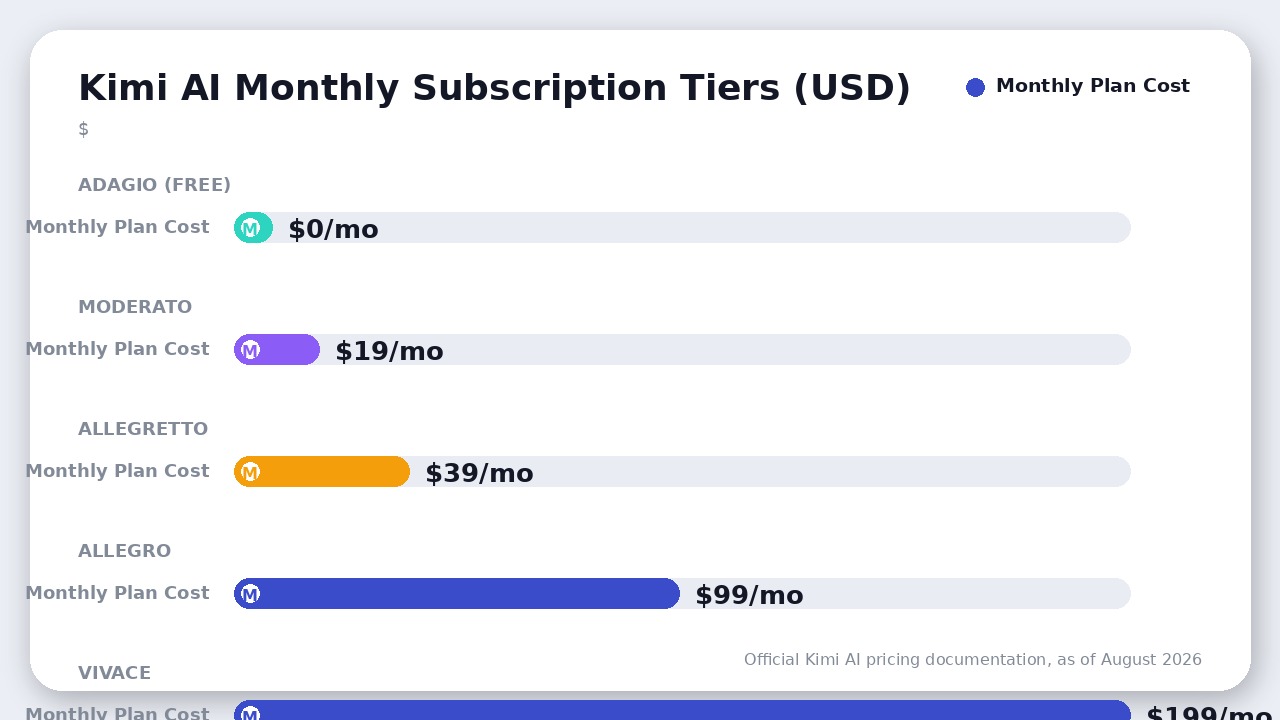
Kimi AI separates its pricing into two distinct tracks: Consumer Web Memberships and OpenPlatform Pay-As-You-Go API Tokens. Paying for a consumer membership does not grant API credits, and depositing API funds does not unlock consumer membership perks.
1. Consumer Web Memberships (As of August 2026)
Moonshot structures its consumer tiers around musical tempo names, scaling context windows and automated agent allocations:
| Plan | Monthly Price (USD) | Annual Billing Rate | Context Limit | Key Inclusions |
|---|---|---|---|---|
| Adagio (Free) | $0 | $0 | 256K tokens | Kimi K3 access, Deep Research, 200 Pro Data requests/mo |
| Moderato | $19/mo | ~$15/mo | 256K tokens | Kimi K3 + K2.7, Kimi Slides, 2,000 Pro requests/mo, priority queue |
| Allegretto | $39/mo | ~$31/mo | 1M tokens | 1M context, Kimi Claw cloud agent, Agent Swarm (50 uses/4 agents) |
| Allegro | $99/mo | ~$79/mo | 1M tokens | Agent Swarm (120 uses/6 agents), priority Claw scheduling |
| Vivace | $199/mo | ~$159/mo | 1M tokens | Agent Swarm (240 uses/8 agents), 24,000 Pro requests/mo, dedicated capacity |
Source: Official Moonshot AI consumer pricing as of August 2026.
For standard knowledge work, the Free Adagio tier provides sufficient headroom to test reasoning quality. The primary reason to step up to Allegretto ($39/mo) is unlocking full 1-million-token context processing and Moonshot’s autonomous “Kimi Claw” background agent execution.
2. Developer API Token Rates (As of August 2026)
Developers connecting through https://api.moonshot.ai/v1 (which adheres strictly to OpenAI SDK syntax) pay per million tokens. Moonshot enforces automatic prefix caching, significantly reducing input costs when passing large system prompts or static document context.
| Model | Context Window | Fresh Input / 1M Tokens | Cached Input / 1M Tokens | Output / 1M Tokens |
|---|---|---|---|---|
| Kimi K3 (Flagship Reasoning) | 1,048,576 tokens | $3.00 | $0.30 | $15.00 |
| Kimi K2.7 Code (Coding Specialist) | 262,144 tokens | $0.95 | $0.19 | $4.00 |
| Kimi K2.6 (Multimodal / General) | 262,144 tokens | $0.95 | $0.16 | $4.00 |
Source: Moonshot AI OpenPlatform documentation as of August 2026. API accounts require a $1.00 USD minimum initial top-up.
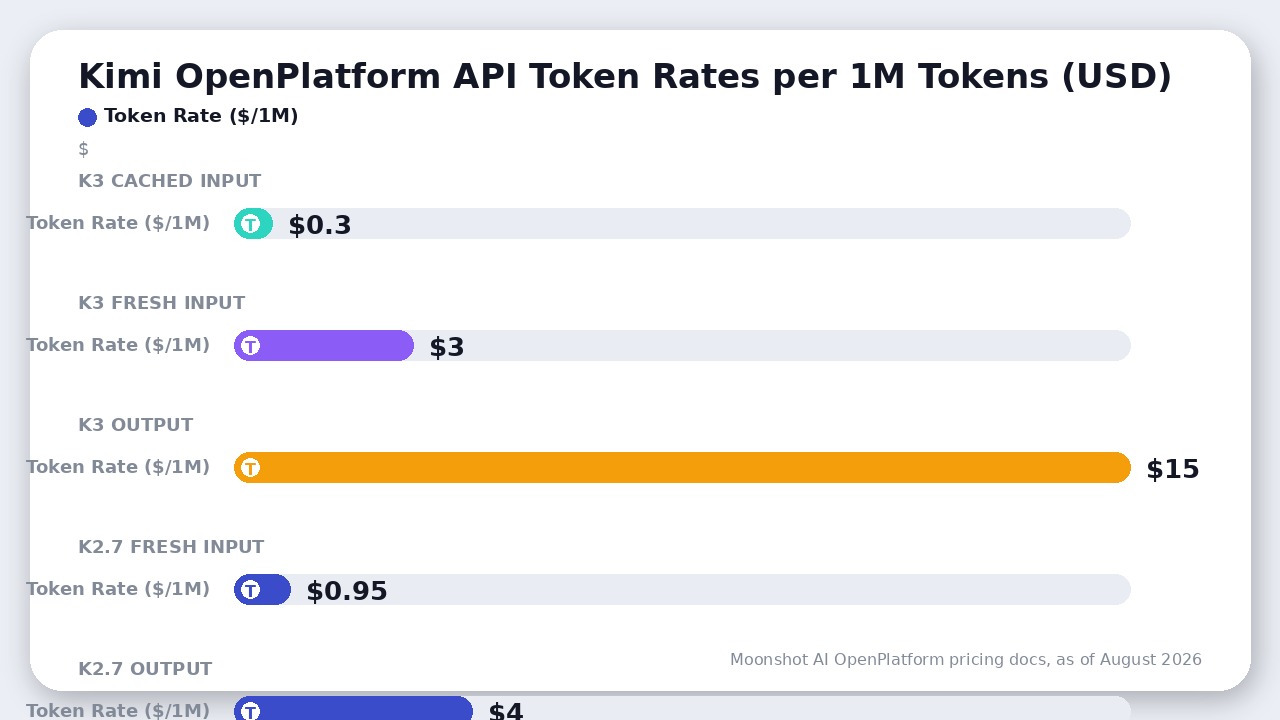
At $3.00 per million input tokens and $15.00 per million output tokens, Kimi K3 is not competing in the ultra-budget commodity tier alongside open-source distillation models; it is priced directly against frontier-class reasoning engines. However, its $0.30/1M cached input rate makes long-document reasoning loops and code-refactoring pipelines substantially cheaper than running un-cached Western frontier models.
Where Kimi AI Genuinely Wins
- Uncompromised Million-Token Retrieval: While many models degrade in accuracy beyond 100k tokens, Kimi’s attention architecture maintains sharp needle-in-a-haystack retrieval across full 1-million-token contexts. Dropping complete code repositories, legal archives, or annual financial reports into K3 produces detailed, context-aware analysis without hallucinating references.
- Kimi Claw and Autonomous Workflows: Unlocked on the $39/month Allegretto tier, Kimi Claw operates as an always-on cloud agent capable of persistent memory, scheduled tasks, and autonomous tool calling without requiring local runtime infrastructure.
- OpenAI SDK Drop-In Compatibility: Migrating backend services to Kimi requires changing only two lines of code—the
base_urltohttps://api.moonshot.ai/v1and the corresponding API key. Function calling, structured JSON output, and tool invocations map seamlessly. - Open-Weight Availability: Unlike closed-source platforms from OpenAI or Anthropic, Moonshot regularly releases open weights for its flagship architectures (such as the Kimi K2 and K3 families).
Where Kimi AI Falls Short
- Opaque Training Policies for Consumer Data: The default inclusion of consumer prompts in future training datasets without an in-app toggle remains a severe drawback for non-technical users.
- Commercial License Restrictions on Open Weights: Moonshot’s custom model license permits free internal deployment, research, and modification, but includes strict clauses for “Model as a Service” (MaaS) vendors. Cloud providers generating over $20 million in annual revenue from reselling inference must enter formal commercial agreements with Moonshot.
- Chinese Regulatory Compliance Framework: Because Moonshot’s core infrastructure operates out of Beijing, companies subject to strict US/EU defense, healthcare, or government data mandates cannot route sensitive unencrypted data through Moonshot’s hosted endpoints.
The Privacy Workaround: Self-Hosting Open Weights
For enterprise teams that require Kimi’s technical capabilities but cannot accept Moonshot’s hosted data residency terms, the optimal path is self-hosting the open-weight releases.
When you download Kimi’s open model weights from repositories like Hugging Face or ModelScope and deploy them inside your own AWS, GCP, Azure, or on-premise GPU cluster:
– Zero prompt data or telemetry leaves your VPC.
– No data is subject to Moonshot’s terms of service or Chinese data access laws.
– Model execution is entirely under your governance and logging framework.
While running 1-trillion to 2.8-trillion parameter mixture-of-experts (MoE) architectures requires substantial compute infrastructure (multiple H100/H200 nodes), it provides a complete architectural exit from geopolitical data risk.
The Verdict
If you are an individual developer, researcher, or knowledge worker looking for deep reasoning across massive million-token documents, Kimi AI is an outstanding tool that you can safely test today. The free Adagio plan and the $19/month Moderato plan deliver state-of-the-art context processing without any foreign phone number or VPN barriers.
However, if you are an enterprise buyer handling proprietary codebase assets, customer PII, or regulated data, do not use Kimi’s hosted consumer interface. Either enforce strict sanitization via the pay-as-you-go API with explicit contractual agreements, or deploy Kimi’s open weights directly onto your private Western infrastructure.
Frequently asked questions
Can I use Kimi AI outside mainland China without a VPN?
Yes. Kimi AI provides global access through its international web platform (kimi.ai) and mobile apps. Users can register with standard email addresses or international phone numbers and pay for subscriptions using international credit cards without needing a Chinese domestic phone number or VPN.
Does Kimi AI train its models on user prompts and files?
Yes. Moonshot AI’s consumer terms state that user inputs and uploaded files are processed to train and optimize future models by default. There is currently no automated in-app toggle to disable training; users must submit an email request to membership@moonshot.ai to opt out.
What is the difference between Kimi web subscriptions and Kimi API billing?
Kimi web memberships (such as Moderato at $19/month or Allegretto at $39/month) cover consumer features like Kimi Claw and chat queries, but they do not include API credits. Developers using the OpenPlatform API pay separate pay-as-you-go token rates starting at $0.95/1M input for K2.7 Code and $3.00/1M input for K3.
Where does Kimi AI store user data?
Kimi AI’s international service operates under Moonshot AI PTE. LTD. in Singapore, but the engineering infrastructure and parent entity (Beijing Moonshot Technology Co., Ltd.) reside in mainland China. Data is transferred and held across Singapore and Chinese servers, meaning China-hosted infrastructure remains subject to local cybersecurity laws.

Leave a Reply