

Manus AI is an autonomous, general-purpose agent by Butterfly Effect that executes multi-step computer tasks in a sandboxed cloud runtime. Unlike standard Chinese LLMs requiring domestic credentials, Manus operates globally at manus.im with USD Stripe billing, stores data in US and Singapore regions, and enforces strict zero-training policies on Team plans starting at $20/seat/month.
Manus AI is an autonomous, general-purpose agent created by Butterfly Effect that executes multi-step digital work inside a sandboxed virtual computer. While conversational models like ChatGPT or Claude require iterative prompts, Manus AI accepts an open-ended brief—such as benchmarking ten market competitors or writing and deploying a frontend prototype—then autonomously controls a browser, runs terminal scripts, reconciles errors, and compiles finished assets.
For engineering managers, founders, and data teams evaluating Chinese-origin AI platforms, standard tool profiles usually leave three critical operational questions unanswered: where customer data is physically stored, whether cross-border corporate signups work cleanly, and how usage billing actually behaves in USD.
Here is the factual breakdown of Manus AI, developed by Butterfly Effect (native corporate name: 蝴蝶效应), based on verified vendor documentation, official security disclosures, and real platform mechanics as of August 2026.
The 30-Second Answer
- What it is: A multi-agent action engine running in isolated cloud sandboxes that performs complex web research, code execution, data extraction, and document production end-to-end.
- Who should buy it: Research analysts, growth teams, and product managers who spend hours manually scraping information across fragmented web portals, building comparison decks, or testing lightweight web prototypes.
- Who should skip it: Teams requiring an on-premise, air-gapped, open-weight agent (consider open frameworks instead) or enterprise engineering squads needing deep GitHub-integrated software engineering pipelines (where specialized developer tools like Devin lead).
The Three Big Questions
1. Where Does My Data Go?
The primary concern when deploying tools developed by Chinese founding teams centers on jurisdiction, cross-border data transfer, and model training ingestion.
Unlike domestic Chinese AI portals subject to strict mainland telecommunication verification (such as models hosted under the CAC regulatory registry requiring mainland IDs), Manus operates through Butterfly Effect Pte. Ltd., registered in Singapore with international operations.
According to Manus’s official Trust Center documentation and privacy policies:
- Server Jurisdictions: Primary compute, user sessions, and sandboxed virtual machine runtimes are hosted in cloud data centers located in the United States and Singapore. User requests do not route through mainland Chinese servers.
- International Legal Safeguards: For users operating under GDPR or UK data privacy mandates, cross-border data transfers rely on standard EU Standard Contractual Clauses (SCCs).
- Model Training & Telemetry: On the Team and Enterprise Plans, Manus contractually guarantees that customer data, session logs, and generated assets are prohibited from being used to train internal or upstream foundational models. For Free and individual Pro accounts, Manus states that data may be analyzed in aggregate and de-identified to improve platform stability unless a user explicitly requests account data deletion via privacy compliance channels (
privacy@manus.im). - Security Certifications: Manus maintains SOC 2 Type II and ISO 27001 compliance standards for its enterprise tier.
If your organization requires an immutable guarantee of data locality within the European Economic Area (EEA), Manus currently does not offer an isolated EU-only data residency boundary on self-serve tiers.
2. Can I Actually Use It Outside China?
Yes, without friction.
Many prominent Chinese frontier platforms—such as standard domestic endpoints for Moonshot’s Kimi AI or MiniMax’s Hailuo AI—frequently introduce login barriers requiring an active +86 mobile number or domestic payment rails like WeChat Pay and Alipay.
Manus AI does not have these limitations:
- Authentication: Users register globally at
manus.imvia Google single sign-on (SSO) or standard work email addresses. No regional phone verification or passport checks are enforced. - Payment Gateways: Subscriptions are billed in US Dollars through international payment gateways (Stripe). Enterprise and individual cards from Visa, Mastercard, American Express, and corporate purchasing cards process seamlessly.
- Regional Accessibility: Manus is unblocked globally across North America, Europe, Latin America, and Asia-Pacific, with dedicated regional latency routing via Singapore and North American endpoints.
3. What Does It Cost in USD?
Manus does not bill directly per model token; instead, it uses a centralized credit-based consumption system. Official pricing is published entirely in USD.
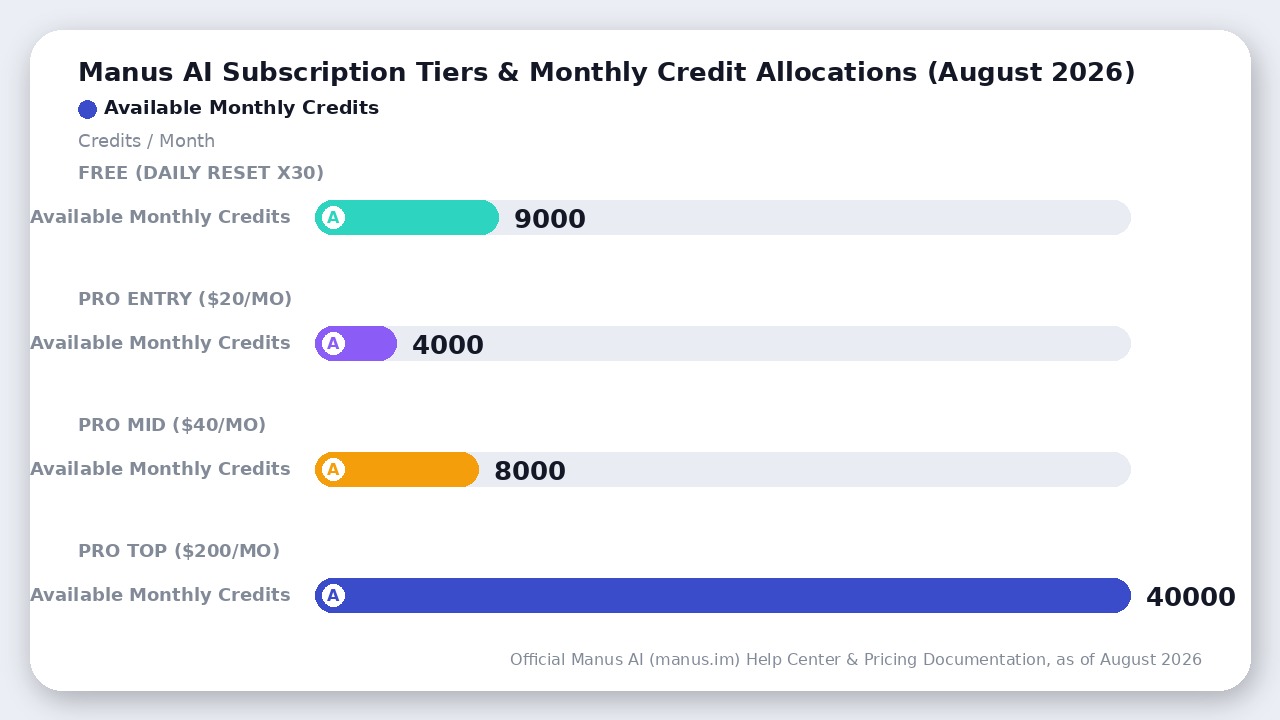
Here is the verified pricing structure as of August 2026:
| Plan | Price (Monthly) | Price (Annual Billing) | Included Credits | Concurrent Tasks | Key Capabilities |
|---|---|---|---|---|---|
| Free Plan | $0/mo | $0 | 300 daily refresh credits | 1 concurrent task | Chat Mode + Manus 1.6 Lite in Agent Mode, 2 scheduled tasks |
| Pro Entry | $20/mo | ~$16.60/mo ($200/yr) | 4,000 credits/mo | 20 concurrent tasks | Chat Mode + Manus 1.6 Lite, 1.6, & 1.6 Max, 20 scheduled tasks, advanced research |
| Pro Mid | $40/mo | ~$33.20/mo ($400/yr) | 8,000 credits/mo | 20 concurrent tasks | 7-day free trial, all Pro Entry capabilities with double monthly credit allocation |
| Pro Top | $200/mo | ~$166.00/mo ($2,000/yr) | 40,000 credits/mo | 20 concurrent tasks | High-frequency execution, deep research batches, maximum credit allowance |
| Team Plan | $20/seat/mo | ~$16.60/seat/mo | Pooled credits | Shared team queue | Central admin dashboard, zero data-training terms, SSO, audit logs |
Source: Official Manus Help Center and Pricing Documentation, verified August 2026.
The Credit Trap to Watch Out For
While the entry price of $20 per month appears straightforward, credit consumption in Manus AI is variable. Unlike an LLM API where you can calculate precise input/output costs per 1,000 tokens, Manus burns credits based on the operational complexity of the task environment:
- Light Query (Direct search + summarization): Consumes ~30 to 80 credits.
- Deep Competitive Landscape (10–15 website navigations, table extraction, CSV export): Consumes ~250 to 500 credits.
- Full Code Build & Deployment (Scaffolding a React dashboard, testing shell scripts, deploying demo): Consumes ~600 to 1,500 credits.
On the Pro Entry plan (4,000 credits), running three to four complex research iterations a day will exhaust your monthly quota within a week. The Free tier’s 300 daily refresh credits do not roll over; they expire every 24 hours. If you plan to use Manus daily as a core operational assistant, budget for the $40/mo (8,000 credits) or $200/mo tier.
How Manus Works Under the Hood: The Cloud Sandbox Architecture
To understand why Manus differs from standard conversational interfaces, consider how it interacts with digital environments.
When a prompt is submitted, Manus initiates a multi-agent control loop inside an isolated virtual machine:
- Planning Orchestrator: Breaks the prompt into discrete, verifiable sub-goals.
- Tool-Enabled Sub-Agents: Depending on the sub-goal, the agent deploys specialized tool heads:
- Browser Agent: Runs a headless browser instance capable of rendering JavaScript, solving basic navigation flows, clicking buttons, extracting tables, and taking full-page screenshots to visually verify rendering.
- Terminal Agent: Spawns a sandboxed Linux bash environment to write Python scripts, run data transformations with pandas, compile TypeScript, or call third-party APIs.
- Document Engine: Compiles extracted findings directly into downloadable Microsoft Excel workbooks, interactive slide decks, Markdown reports, or zipped source code repositories.
- Self-Correction & Verification: If a script execution throws a stack trace or a webpage fails to load, Manus reads the error output, adjusts its script or selector parameters, and re-executes automatically before returning the result.
This execution sandbox prevents the AI from touching your local machine, operating entirely within cloud-isolated compute containers.
Where Manus AI Genuinely Wins
1. Complex Multi-Source Data Aggregation
Where standard chatbots hallucinate when asked to parse ten dynamic pricing pages, Manus navigates each URL individually, scrolls through rendered elements, extracts raw tables, and normalizes the data into a unified schema. It handles live web research significantly better than basic retrieval-augmented generation (RAG) wrappers.
2. Finished Deliverable Production
Manus does not simply paste code or CSV text into a chat box. It generates formatted .xlsx spreadsheets with calculated formulas, builds clean slide presentations, and packages downloadable project archives with zero manual formatting required on the user’s end.
3. Rapid Prototype Scaffolding
For product managers wanting a working interactive mock of an internal tool, Manus can write backend API routes, configure a lightweight SQLite database, assemble a modern frontend UI, test it in its sandbox, and serve a live demo link in under ten minutes.
Where Manus AI Falls Short
1. Opaque Pre-Execution Cost Estimates
Manus does not tell you how many credits an autonomous run will take before you press execute. An agent that gets stuck in a loop attempting to scrape a heavily bot-protected site can burn through hundreds of credits before timing out.
2. Authenticated Session Fragility
While Manus can interact with publicly accessible web data seamlessly, navigating behind complex CAPTCHAs, two-factor authentication (2FA) prompts, or enterprise Single Sign-On barriers often causes the autonomous loop to stall or request manual user intervention.
3. Not an IDE Replacement for Full-Scale Engineering
Manus is built for general task execution, not deep code-base maintenance. For enterprise software engineering across a multi-million-line monorepo with branch controls, tools like Devin or Claude Code provide superior language-server awareness, Git integration, and diff reviews.
Manus AI vs. Western Alternatives
| Capability / Metric | Manus AI | OpenAI Operator / ChatGPT Agent | Devin (Cognition AI) |
|---|---|---|---|
| Primary Focus | General-purpose autonomous workflows & research | Consumer & business web task automation | Autonomous software engineering & DevOps |
| Runtime Environment | Cloud Linux virtual machine & headless browser | Cloud browser sandbox | Full developer cloud container & code workspace |
| Entry Price | Free (300 daily credits) / $20/mo Pro | Bundled in ChatGPT subscriptions | Enterprise developer tier pricing |
| Data Residency | US & Singapore | US (Microsoft Azure / OpenAI) | US (AWS / Secure Enclaves) |
| Zero-Training Terms | Included on Team & Enterprise plans | Enterprise / Team accounts | Standard enterprise agreements |
| Deliverable Output | Reports, spreadsheets, slides, full web apps | Browser actions, summaries, web form tasks | Git branches, pull requests, deployed code |
For general productivity, autonomous web research, and executive deliverables, Manus offers a broader out-of-the-box toolkit than developer-only agents, while pricing remains significantly lower than dedicated software engineering systems. When comparing general Chinese AI model capabilities on standard reasoning benchmarks, teams often compare foundation models directly—such as in our analysis of DeepSeek vs Qwen—but Manus differentiates itself by being an execution platform rather than an underlying raw model API.
The Verdict
Manus AI wins this profile as the most complete general-purpose autonomous agent available for research, data compilation, and rapid prototyping.
Unlike traditional chatbots that require constant prompting, Manus delivers tangible, formatted output—spreadsheets, dashboards, and reports—with minimal supervision. Furthermore, Butterfly Effect has resolved the compliance and access hurdles that typically complicate Chinese-origin software: servers are hosted in the United States and Singapore, payments process cleanly in USD via Stripe, and Team plans guarantee zero model training on customer data.
The condition that flips the verdict: If your workflow requires deterministic per-token cost modeling, air-gapped on-premise data residency, or deep monorepo Git integrations, Manus AI’s volatile credit consumption and proprietary cloud sandbox make it a poor fit. For autonomous multi-step market intelligence, competitive analysis, and rapid digital execution, Manus is worth a paid Pro or Team deployment.
Frequently asked questions
What is Manus AI and who makes it?
Manus AI is a cloud-based autonomous agent developed by Butterfly Effect (蝴蝶效应), an AI product company founded by Chinese entrepreneurs and based in Singapore. Unlike interactive chatbots, Manus AI accepts high-level objectives, creates execution plans, and uses headless browsers and virtual terminals to build finished deliverables like spreadsheets, slides, and web applications without step-by-step user prompting.
Where does Manus AI store user data?
According to Manus AI’s official trust documentation, hosted data and agent sandboxes reside on cloud infrastructure located in the United States and Singapore. International data transfers are governed by standard contractual clauses (SCCs). On Team and Enterprise plans, Manus contractually prohibits underlying foundation model providers from using customer prompt data or generated outputs for model training.
Can I use Manus AI outside of China with a regular credit card?
Yes. Manus AI is built for international availability via manus.im. It does not require a mainland Chinese phone number or government ID verification. International users can register using standard email or Google authentication and pay directly in USD using standard credit cards, Apple Pay, or Google Pay via Stripe.
How do Manus AI credits work?
Manus AI uses a usage-based credit consumption model rather than fixed token counters. A simple research task might consume 50 to 150 credits, whereas complex full-stack web builds, multi-page data scraping, or extensive document formatting can deplete 400 to 1,200 credits per run. The Free tier resets with 300 daily credits, while paid Pro tiers provide fixed monthly credit allocations starting at 4,000 credits for $20 per month.
Is Manus AI open-source or self-hostable?
No. Manus AI is a proprietary, cloud-hosted closed platform. Butterfly Effect does not publish open-weight model checkpoints or self-hostable runtime containers for Manus AI. Users seeking full self-hosting and local data isolation must look toward open-source frameworks like OpenManus or Hermes Agent on their own infrastructure.

Leave a Reply