

If you are trying to build a web application using AI in 2026, you have likely hit a wall with generic code assistants. You don’t want a tool that just spits out code snippets for you to copy-paste; you want an environment that builds, runs, and deploys a complete application from a prompt.
In the “vibe coding” landscape, Lovable vs Bolt.new is the definitive heavyweight matchup. Both promise to turn natural language into fully functional web apps in minutes. But they are built on fundamentally different architectures, and picking the wrong one will either lock you out of your own backend or drain your wallet in a matter of hours.
Here is the short answer: Lovable wins for non-technical founders and product teams shipping polished, database-driven MVPs. Bolt.new wins for developers who want a full-stack Node.js sandbox with raw file-system access and zero hosting lock-in.
The 30-Second Answer
- Pick Lovable if: You are a non-coder, startup founder, or designer who needs a highly polished, visually stunning SaaS MVP with user authentication, database persistence, and clean UI components (shadcn/ui) that work out of the box. You want the AI to handle the architecture while you focus on the product.
- Pick Bolt.new if: You are a developer or technical builder who wants a full-stack environment (React frontend + Node.js/Express backend) running directly in your browser. You want to edit the raw source code side-by-side with the AI and deploy to your own infrastructure without platform restrictions.
Lovable vs Bolt.new: At a Glance
| Feature | Lovable (lovable.dev) | Bolt.new (bolt.new) |
|---|---|---|
| Architecture | Multi-agent code generator (Vite/React + Tailwind) | Browser-based WebContainers (Node.js runtime) |
| Backend Integration | Deep native Supabase integration | Built-in Node.js backend + Bolt Cloud Postgres |
| UI & Design Quality | Exceptional (shadcn/ui, Tailwind, custom themes) | Standard / Functional (customizable but raw) |
| Code Access | Full Git export, GitHub sync, manual editing | Built-in IDE, direct code editing, file tree access |
| Pricing Model | Unified Credit System (Edits + Hosting) | Token-Based System (Context-dependent) |
| Entry Price (Pro) | $25/month (as of July 2026) | $25/month (as of July 2026) |
Pro Tier Pricing Breakdown
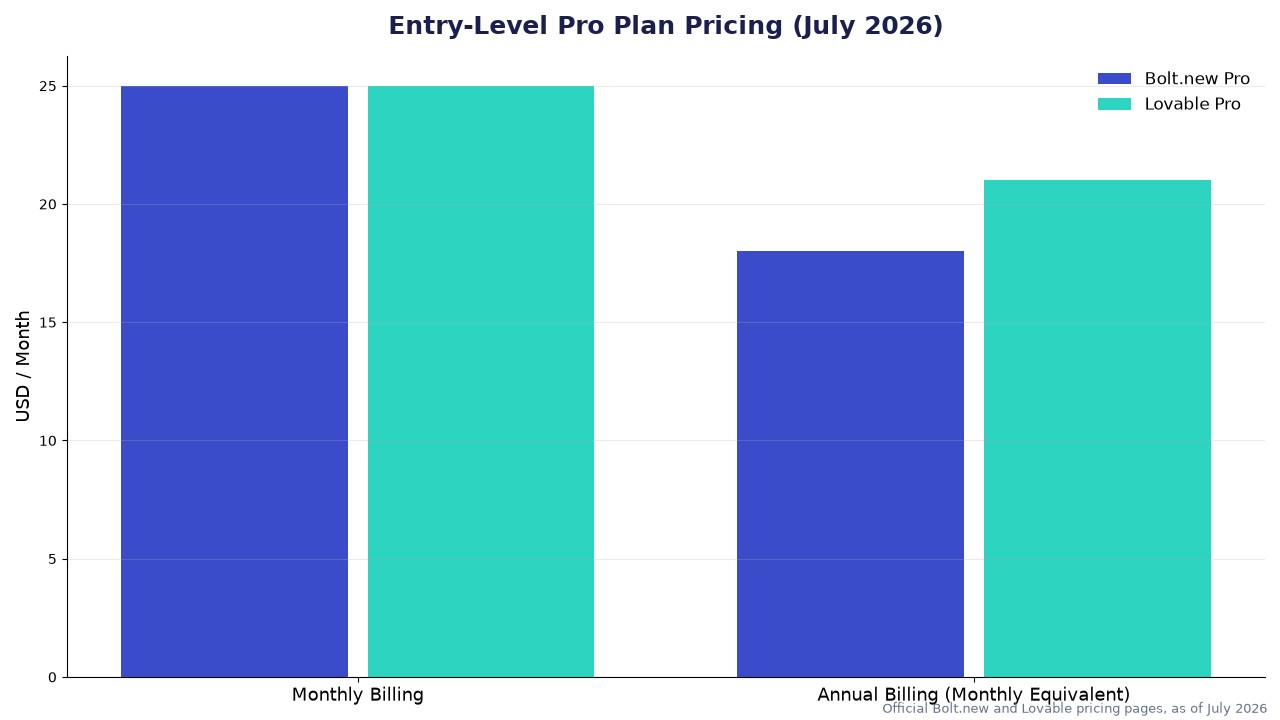
To get started on a paid plan, both platforms charge an entry-level price of $25/month on a month-to-month basis as of July 2026. However, if you are willing to commit to a year, you can secure substantial discounts on both platforms. As of July 2026, Bolt.new Pro drops to $18/month (billed annually at $216/year), saving you 28% compared to monthly billing. Meanwhile, Lovable Pro drops to $21/month (billed annually at $252/year), saving you 16% (or $48/year) compared to paying month-to-month. This monthly equivalent pricing matches the plans compared in our chart below.
The “Token Tax” vs. the “Credit Burn”
To understand the real cost of these platforms, you must look past the flat $25/month price tag (as of July 2026) of their entry-level Pro tiers. The billing mechanics of these two tools dictate how you can build.
Bolt’s Exponential Token Tax
Bolt.new is built on StackBlitz’s WebContainers technology, which runs a full Node.js operating system directly in your browser. While this is an engineering marvel, it introduces a massive financial limitation: the token tax.
Because Bolt runs the entire project locally, every single prompt you write requires the AI to read your updated file system to maintain context. As your application grows from a single landing page to a 20-component SaaS app, the context payload grows exponentially.
- The Trap: On day one, a prompt like “change the button to green” might cost you 10,000 tokens. On day twenty, with a mature codebase, that exact same prompt can easily cost 500,000 to 1,000,000 tokens because the AI has to ingest the entire codebase again.
- Users frequently report burning through Bolt’s entire 10-million-token Pro allowance on a single complex project because of this context scaling and repetitive debugging loops. Unused tokens do roll over for one additional month on paid plans, which helps, but it doesn’t solve the underlying math.
Lovable’s Unified Credit Model
Lovable operates on a structured credit system. Instead of charging you for every raw token passed to the LLM, Lovable charges based on the complexity of the action.
- A simple style change costs roughly 0.5 credits.
- Adding user authentication costs roughly 1.2 credits.
- Generating a complete, interactive landing page costs roughly 1.7 credits.
Historically, the biggest complaint against Lovable was its “dual-layer billing”. You paid for build credits, but running your deployed app (hosting, database, runtime AI features) was billed separately under Lovable Cloud.
However, in a major update on June 1, 2026, Lovable completely unified its billing. They moved to a single, transparent credit balance that covers both building and running your apps. If your app sits idle, it costs nothing; if it gets traffic or calls internal AI features, it gently draws from your unified credit pool. This eliminates the surprise hosting bills that used to plague early adopters.
Database and Backend: Built-in Node.js vs. Supabase Native
If you are building a real application, you need a database and user authentication. This is where the architectural split becomes a fork in the road.
Lovable’s Supabase Ecosystem
Lovable does not try to build a custom backend inside the browser. Instead, it relies on Supabase as its default backend engine.
When you ask Lovable to add a database or user login, it automatically scaffolds the corresponding tables, establishes foreign key relationships, and writes the Row Level Security (RLS) policies inside your Supabase instance.
- The Dec 31, 2024 Deprecation Trap: If you are reading older reviews, they will mention Lovable’s legacy “sync” mechanism. Note that Lovable deprecated this legacy integration on December 31, 2024. All new builds use their modern, direct Supabase integration, which is significantly more stable but requires you to connect your own Supabase account. This is actually a benefit: you retain 100% ownership of your database and user data from day one.
Bolt’s In-Browser Node Server
Bolt.new generates a genuine Node.js backend (typically using Express) running inside your browser container. It also offers built-in Postgres databases via Bolt Cloud.
Because you have a real server, you can write custom API routes, integrate arbitrary npm packages, and handle complex backend logic that serverless setups struggle with.
- The Catch: Running a real Node server means you (and the AI) have to manage server state, environment variables, and connection pools. When the AI writes buggy backend code, the server crashes. While Bolt v2 features a self-healing runtime that automatically reads console errors to fix bugs, complex state-management issues on larger apps still require manual developer intervention.
Design Fidelity & UI Polish
There is a stark contrast in the visual quality of the apps generated by these two platforms.
- Lovable’s UI is elite. It defaults to a highly modern, clean design system built on Tailwind CSS and shadcn/ui components. It understands spacing, typography, and modern SaaS design patterns intuitively. When you ask Lovable to build a dashboard, it looks like something designed by a mid-level frontend engineer, not a generic template.
- Bolt.new’s UI is functional but raw. Because Bolt is developer-centric, its primary focus is getting the full-stack architecture running. The visual output can sometimes feel generic or dated, requiring heavy prompting and manual CSS tweaks to achieve a premium consumer-grade look.
Where Bolt.new Actually Wins
Despite Lovable’s superior UI and cleaner pricing structure, Bolt.new holds a massive advantage for technical users:
- Direct Code Editing: Bolt.new features a full side-by-side IDE. You can open any file, manually rewrite a line of code, and watch the preview update instantly. Lovable is designed to be controlled via chat prompts; while you can edit code, the workflow heavily pushes you to let the AI agent do the typing.
- No Platform Lock-in: Bolt generates standard Vite/React and Node.js projects. You can download the zip file, run
npm install, and host it on Vercel, Netlify, or your own VPS instantly. Lovable’s deployment is tightly coupled with Lovable Cloud and Supabase, making independent hosting slightly more complex to configure manually. - Collaborative Team Pricing: On Bolt’s Teams plan ($30/member/month as of July 2026), teams get administrative controls and shared workspaces. However, be aware of a critical limitation: tokens are allocated per member and cannot be pooled. If your lead builder runs out of tokens, they cannot borrow from an idle designer’s allotment.
The Verdict
Choose Lovable if:
You want to build a functional, beautiful SaaS MVP, internal tool, or client portal, and you do not want to write raw code. Lovable’s unified credit system, native Supabase database integration, and world-class design output make it the fastest path to a production-ready application for non-technical founders.
Choose Bolt.new if:
You are a developer who wants a rapid prototyping sandbox. If you need a custom Node.js server, want direct access to the raw file system, and plan to transition the code to your local VS Code environment once the scaffold is built, Bolt.new is the superior tool.
FAQ
Can I export my code from both platforms?
Yes. Both Lovable and Bolt.new generate clean, human-readable React code. You can sync both to GitHub or download the source code as a ZIP file to continue development locally in Cursor or VS Code.
Does Lovable support custom databases other than Supabase?
While Supabase is the natively integrated default, you can connect any external database (like PostgreSQL, MySQL, or MongoDB) to your Lovable app by writing custom API integrations or using serverless edge functions.
How does Bolt.new’s token rollover work?
Starting in July 2025, unused tokens on Bolt’s paid plans roll over for exactly one additional month (meaning they are valid for up to 2 months total). Free plan tokens do not roll over and reset monthly, subject to a 300,000 daily token cap.

Leave a Reply