

If you are building a modern web application, choosing between Clerk vs Auth0 is one of the most consequential infrastructure decisions you will make. While both platforms save you from writing custom hashing algorithms and session cookies, they approach identity from entirely different worlds. One is built for developer velocity; the other is built for enterprise complexity.
But beyond the developer experience (DX) debate, there is a massive, multi-thousand-dollar pricing trap buried in Auth0’s paid plans that most teams only discover when it is too late.
Clerk vs Auth0: The 30-Second Answer
- Pick Clerk if you are building a React or Next.js SaaS application, want to launch in under 30 minutes with beautiful pre-built UI components, and need a generous, flat-rate pricing model that safely scales to 50,000 users.
- Pick Auth0 if you are a regulated enterprise, need to connect to legacy databases, require synchronous custom authentication pipelines (Actions), or must support native SCIM provisioning out of the box.
The Feature and Pricing Matchup
The following table compares the actual limits and costs of both platforms as of July 2026.
| Dimension | Clerk | Auth0 (by Okta) |
|---|---|---|
| Free Tier Limit | 50,000 Monthly Retained Users (MRUs) | 25,000 Monthly Active Users (MAUs) |
| Base Paid Plan | $25/month ($20/mo billed annually) | $35/month (B2C Essentials) / $150/month (B2B Essentials) |
| Overage Rate | $0.02 per MRU above 50,000 | Tiered sliding scale (no free buffer on paid plans) |
| Setup Experience | Pre-built React/Next.js UI components | Hosted “Universal Login” redirect page |
| B2B Organization Support | 100 free MROs, then $1/MRO (requires $100/mo B2B add-on for custom roles) | 5 free (Free plan), 10 (B2C Essentials), unlimited on B2B Essentials |
| Enterprise SSO (SAML) | 1 connection included, then $75/mo each (connections 2-15) | 1 connection included on Free/B2B, then $100/mo each (up to 15 connections) |
| SCIM Provisioning | Requires developer involvement / third-party | Built-in, tenant-scoped (included on Free & B2B) |
| Custom Code Execution | Asynchronous Webhooks | Synchronous Auth0 Actions (Node.js) |
Source: Official Clerk and Auth0 pricing pages, verified July 2026.
The $1,400/Month Trap: Understanding the Auth0 “Essentials Cliff”
On paper, both free tiers look incredibly generous. Auth0 offers up to 25,000 Monthly Active Users (MAUs) for $0/month, while Clerk offers up to 50,000 Monthly Retained Users (MRUs) for $0/month.
The trap is sprung the moment your application needs a single production-grade feature that is gated behind a paid plan.
Suppose you want to set up separate Production and Development environments, get standard email support, or enforce role-based access control (RBAC). To do this on Auth0, you must upgrade to the Essentials plan.
Here is the catch: Auth0’s paid plans do not inherit your free-tier user buffer.
Instead of paying a flat subscription fee plus usage overages, Auth0’s Essentials plan charges you for every single active user on a sliding scale starting from user 1.
Under the B2C Essentials plan, Auth0’s pricing scales as follows (as of July 2026):
* 500 active users: $35/month
* 5,000 active users: $350/month
* 10,000 active users: $700/month
* 20,000 active users: $1,400/month
If your application has 20,000 active users:
* On the Free plan, you pay $0/month.
* The moment you upgrade to Essentials to get separate environments, your monthly bill jumps to $1,400/month (as of July 2026).
* If you need advanced security features on the Professional plan, that same 20,000-user database will push you into custom enterprise negotiations.
By contrast, Clerk’s Pro plan costs $25/month (as of July 2026) and still includes the first 50,000 MRUs. You only pay $0.02 per user if you exceed that 50,000 threshold.
Let’s look at the math for a 20,000-user application (as of July 2026):
* Clerk Pro: $25/month.
* Auth0 Essentials (B2C): $1,400/month.
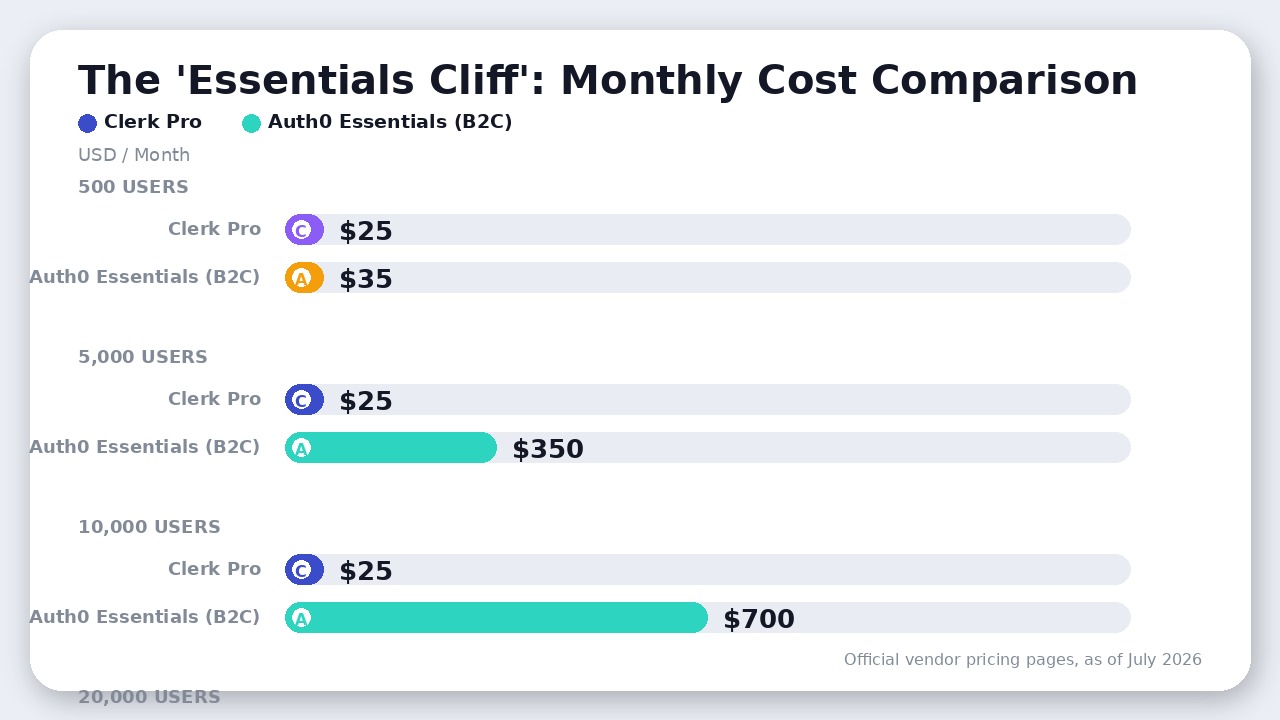
This is a 56x price difference for the exact same audience. If you are running a high-volume B2C consumer app or an early-stage B2B SaaS with a freemium model, upgrading Auth0 is a financial death sentence.
The Architectural Divide: Native Components vs. Universal Redirect
The difference in developer experience (DX) between these two platforms is night and day.
Clerk: The King of Next.js DX
Clerk is built specifically for modern React and Next.js applications. Instead of forcing you to build custom login forms or deal with redirect states, Clerk provides fully styled, drop-in React components: <SignIn />, <SignUp />, <UserButton />, and <OrganizationSwitcher />.
These components mount directly inside your application’s layout. You can style them using Tailwind CSS or Clerk’s appearance prop. It integrates natively with Next.js middleware in under ten minutes:
// middleware.ts
import { clerkMiddleware, createRouteMatcher } from '@clerk/nextjs/server';

const isProtectedRoute = createRouteMatcher(['/dashboard(.*)']);

export default clerkMiddleware(async (auth, req) => {
  if (isProtectedRoute(req)) {
    await auth.protect();
  }
});
Auth0: The Universal Login Pattern
Auth0 relies heavily on the Universal Login pattern. When a user clicks “Log In,” they are redirected away from your application to an Auth0-hosted domain (e.g., your-tenant.us.auth0.com), where they input their credentials before being redirected back.
While this redirect is highly secure and isolates your application from credential-handling, it introduces a jarring UX transition unless you spend hours customizing the hosted page and setting up a custom domain.
The Lock-in Tradeoff
Both platforms are fully hosted SaaS, meaning your user credentials live in their databases.
With Clerk, you are heavily locked into their frontend ecosystem. If you decide to migrate to an open-source library like Better Auth or a database-native solution like Supabase Auth (which also offers 50,000 free MAUs), you must rewrite your entire frontend, as Clerk’s SDKs are tightly coupled to React.
With Auth0, you can connect your own external user database (like your own PostgreSQL instance) using “Custom Database Connections”. However, this feature is gated behind the Professional plan (starting at $240/month for up to 500 MAUs, as of July 2026).
Where Auth0 Actually Wins: Enterprise Federation and SCIM
Despite the pricing horror stories, Auth0 remains the industry standard for a reason. It is a battle-tested Customer Identity and Access Management (CIAM) broker built for complex enterprise deployments.
1. Extensibility (Auth0 Actions)
Auth0 allows you to write custom Node.js scripts (called Actions) that run synchronously at various points in the authentication lifecycle (e.g., post-login, pre-registration). This lets you enrich tokens with custom claims, trigger external APIs, or run real-time fraud checks.
Clerk’s extensibility relies on webhooks, which are asynchronous and cannot block or modify the authentication token mid-flight.
2. Native SCIM and Self-Service SSO
In B2B SaaS, enterprise clients expect SCIM (System for Cross-domain Identity Management) to automatically provision and deprovision users from their identity providers (like Okta or Entra ID).
Auth0 recently added Self-Service SSO and SCIM support directly to its Free plan (as of July 2026), making B2B identity federation highly accessible out of the box.
Clerk’s organization features are excellent for basic B2B multi-tenancy, but Clerk does not natively support SCIM without heavy developer involvement or integrating a third-party tool like WorkOS.
3. Compliance and Regional Isolation
If you operate in highly regulated industries (like healthcare under HIPAA, or fintech requiring FedRAMP), Auth0’s custom Enterprise plans offer private cloud deployments, multi-region high availability, and strict data residency compliance. Clerk is cloud-hosted only, and your user data lives strictly in Clerk’s US-based infrastructure.
The Verdict
Choosing between Clerk vs Auth0 comes down to your user volume and compliance requirements:
- Choose Clerk if you are building a modern web app (especially using React or Next.js), value developer speed, and want a generous, predictable cost structure that won’t punish you for growing to 50,000 users. It is as simple to set up as using Resend for transactional emails.
- Choose Auth0 if you are a regulated enterprise, need complex identity federation (like linking legacy databases), require synchronous custom authentication pipelines (Actions), or must support native SCIM provisioning out of the box.
Frequently Asked Questions
Is Clerk’s free tier really 50,000 users?
Yes. In February 2026, Clerk expanded its free tier to include 50,000 Monthly Retained Users (MRUs) per application, up from the previous limit of 10,000.
Does Auth0 charge for inactive users?
No. Auth0 bills based on Monthly Active Users (MAUs), which means users who log in or perform an authentication action during the billing cycle. However, on paid plans, you are billed for every active user from user 1 on a sliding scale.
Can I migrate my users from Clerk to Auth0 (or vice versa)?
Yes, both platforms allow you to export your user database. However, because passwords are encrypted with secure hashes, you cannot export raw passwords. You will either need to perform a “lazy migration” (capturing passwords as users log in) or force a password reset for all users.
Final Recommendation
Clerk is the clear winner for modern React and Next.js applications up to 50,000 users, offering superior developer experience and a predictable flat-rate Pro plan. Auth0 should only be chosen for legacy database migrations or highly regulated enterprise compliance.

Leave a Reply