

Bruno wins this matchup for nearly every backend engineer, QA tester, and product team building modern APIs, but the reason isn’t just about escaping SaaS subscription fees. While Postman has expanded into a broad, cloud-hosted API lifecycle management platform, Bruno takes a strict local-first approach: storing API collections directly on your filesystem as plain-text files version-controlled by Git. Unless your organization requires a hosted public API documentation portal, cloud-hosted mock servers, or centralized corporate governance across hundreds of non-technical stakeholders, Bruno delivers a drastically faster, private, and zero-lock-in alternative.
The 30-Second Answer
- Pick Bruno if: You want a fast, local-first API client that stores requests as plain-text
.brufiles inside your Git repository, executes requests directly from your computer without cloud sync, and provides unlimited collection runs for $0.- Pick Postman if: You need an all-in-one enterprise API platform that hosts public developer portals, automatically generates client SDKs across dozens of languages, provides cloud-hosted mock servers, and enforces corporate API governance.
Bruno vs Postman: Overview & Core Features
| Feature / Dimension | Bruno (as of July 2026) | Postman (as of July 2026) |
|---|---|---|
| Primary Architecture | Local-first desktop app (MIT core) | Cloud-first SaaS platform with desktop client |
| Storage Format | Plain-text .bru files in local filesystem |
Proprietary JSON or Postman Cloud database |
| Version Control | Native Git (branches, commits, PRs, diffs) | Postman Cloud sync with optional Git bridge |
| Mandatory Account | No (Works 100% offline without login) | Yes (Requires account and login) |
| Free Tier Collection Runs | Unlimited local runs | Unlimited runs (formerly capped at 25/mo) |
| Starting Paid Plan | Pro ($6/user/month, billed annually) | Solo ($9/user/mo) / Team ($19/user/mo) |
| Enterprise Plan | Ultimate ($11/user/month, billed annually) | Enterprise ($49/user/month, billed annually) |
| Request Execution | Direct local execution | Direct or Postman Cloud proxy server |
| Protocol Support | REST, GraphQL, gRPC, WebSockets, SSE, MQTT | REST, GraphQL, gRPC, WebSockets, Webhooks, MQTT, Socket.IO |
| Source: Official vendor documentation and pricing pages, as of July 2026. |
Storage Architecture: Plain-Text .bru Files vs Monolithic Cloud JSON
The fundamental divide between Bruno and Postman is how they represent and store API definitions.
Postman manages collections in its cloud database or exports them as monolithic, thousands-of-lines-long JSON blobs. When teams attempt to store Postman JSON exports in Git, even minor edits—like tweaking a header or changing a query parameter—reformat large sections of the file. Resolving Git merge conflicts on Postman JSON files is notoriously painful, forcing non-paying teams to sync collections manually over Slack or email.
Bruno solves this by inventing .bru—a human-readable domain-specific language designed specifically for text-based API declarations. In Bruno, every API request is stored as a lightweight .bru file in a directory structure on your local disk:
collections/
  ├── auth/
  │   ├── login.bru
  │   └── refresh-token.bru
  └── users/
      ├── get-user.bru
      └── update-profile.bru
Because requests live on your filesystem alongside your application code, collaborating on API collections in Bruno uses standard Git operations. Engineers make changes, review line-by-line diffs in GitHub or GitLab Pull Requests, and merge updates using standard code review workflows. Much like modern AI-assisted coding tools like Cursor, Bruno treats your API specification as code rather than proprietary cloud state.
Data Privacy & Security: Direct Local Execution vs Cloud Proxies
For security-conscious organizations, healthcare providers, and fintech companies, Postman’s cloud-centric architecture presents real compliance hurdles. By default, Postman syncs collections, environment variables, request payloads, and history to Postman’s servers. If a developer accidentally hardcodes a bearer token, staging credential, or API key into an environment variable, that sensitive data is automatically uploaded to the cloud.
Furthermore, Postman routes requests through proprietary cloud infrastructure unless explicitly configured otherwise. If Postman’s cloud experiences downtime, offline local API testing can stall.
Bruno operates under a strict offline-by-design model:
- Zero Mandatory Cloud Sync: Bruno has no built-in cloud sync servers or user login system. Your collections, environments, and secret tokens remain exclusively on your computer.
- Direct Local Execution: HTTP, gRPC, and WebSocket requests originate directly from your machine to your target environment. No middleman proxy sees your headers, payloads, or internal IP addresses.
- Native
.envSecret Handling: Bruno integrates directly with local.envfiles, keeping sensitive production tokens isolated from Git commits.
This architecture makes Bruno compliant out-of-the-box for air-gapped environments and strict SOC 2 or HIPAA policies without forcing you to buy enterprise-grade cloud isolation add-ons.
Pricing Models & The Hidden SaaS Tax
Pricing structures highlight a stark philosophical difference between the two tools. Postman’s pricing incentivizes locking teams into per-seat SaaS tiers, while Bruno follows an open-core desktop model.
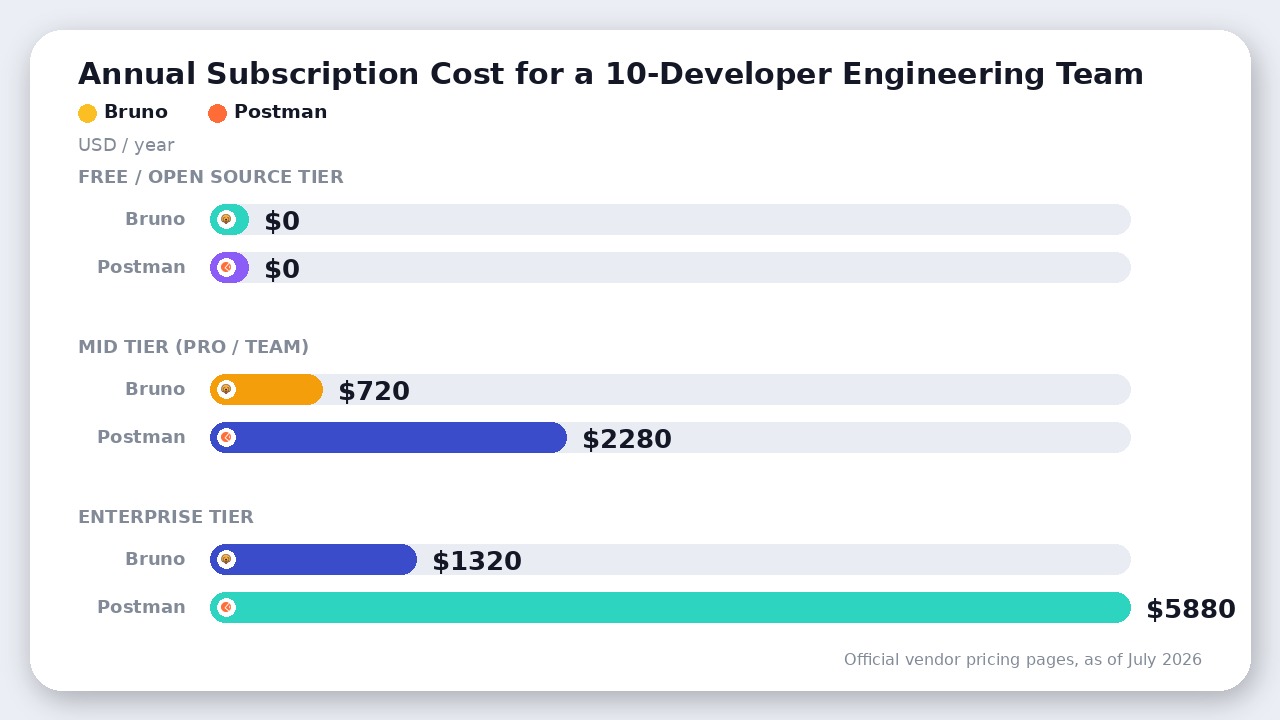
According to official pricing pages as of July 2026:
Postman Pricing Structure
- Free Tier ($0): Designed for individual developers (limited to 1 user per team). Includes 50 AI credits per month, core API client features, specs, mock servers, and unlimited Collection Runner executions.
- Solo ($9/user/month, billed annually): Designed for individual power users. Adds 400 AI credits/month, data-driven testing with exports, custom-branded docs, unlimited custom domains, and expanded API monitoring.
- Team ($19/user/month, billed annually): Adds team collaboration workspaces, unlimited workspace viewers, basic role-based access control (RBAC), and SDK generation.
- Enterprise ($49/user/month, billed annually): Unlocks the full Enterprise API Catalog, Private API Network, advanced RBAC, governance, audit logs, and approval workflows.
Bruno Pricing Structure
- Open Source ($0): The core MIT-licensed desktop client and CLI runner are completely free and open-source. Includes unlimited requests, unlimited local collection runs, scripting, and support for REST, GraphQL, gRPC, WebSockets, and SSE.
- Pro ($6/user/month, billed annually): Adds built-in graphical Git UI controls (branch checkout, diff views, stash, merge conflict resolution), unlimited workspaces, and secret manager integrations.
- Ultimate ($11/user/month, billed annually): Designed for large organizations needing unlimited OpenAPI syncs, purchase order invoicing, custom terms/DPAs, and priority support.
The Real-World Cost Difference
Consider a typical 10-developer engineering team as of July 2026:
* On Postman Team ($19/user/mo), the team pays $2,280/year. On Postman Enterprise ($49/user/mo), that bill reaches $5,880/year.
* On Bruno Open Source, that same team pays $0/year while versioning .bru files through their existing GitHub repo. If they upgrade to Bruno Pro ($6/user/mo) for graphical Git controls, the total cost is $720/year—saving $1,560 annually compared to Postman Team while retaining full data ownership.
Where Postman Actually Wins
While Bruno is the superior API client for core development, Postman remains the industry heavyweight for full-lifecycle API platform management. Bruno explicitly avoids building cloud hosting infrastructure, which leaves several enterprise use cases squarely in Postman’s territory:
- Hosted Public API Documentation: Postman allows companies to publish interactive, public-facing API portals hosted on custom domains with built-in search and try-it-out consoles. Bruno can export static HTML documentation files, but you must host and deploy them yourself.
- Cloud-Hosted Mock Servers: Postman lets teams set up cloud mock servers with a single click, allowing frontend developers to build against simulated backend responses before endpoints are implemented. Bruno requires running mock servers locally or setting up third-party containers.
- Automated SDK Generation: Postman can automatically parse API schemas and generate client libraries across 10+ programming languages (Python, TypeScript, Go, Java, etc.).
- Enterprise API Governance: Large organizations with hundreds of API teams use Postman’s API Network, API Catalog, and linting governance rules to enforce company-wide architectural standards before endpoints go to production.
The Verdict
For years, developers tolerated Postman’s mandatory cloud logins and bloated UI because no lightweight alternative matched its feature set. Bruno has effectively broken that monopoly by proving that plain-text Git versioning is superior to proprietary cloud databases for managing API requests.
- Choose Bruno if you are an engineer, QA tester, or software team building APIs. Bruno is faster, completely private, natively version-controlled with Git, and eliminates per-seat SaaS costs for core testing.
- Choose Postman only if you are an enterprise platform organization responsible for managing an API catalog, hosting public developer portals, or enforcing corporate API governance across non-technical teams.
Frequently Asked Questions
Can I import my existing Postman collections into Bruno?
Yes. Bruno includes a built-in collection importer that converts Postman v2.1 collection JSON files and environment files into Bruno .bru directory structures in seconds.
Does Bruno support automated collection runs in CI/CD pipelines?
Yes. Bruno provides @usebruno/cli, an open-source command-line tool. You can run bru run inside GitHub Actions, GitLab CI, or Jenkins pipelines without paying for extra execution credits or licenses.
Is Bruno completely open source?
Bruno uses an open-core licensing model. The core desktop app, CLI runner, and plain-text .bru format are licensed under the open-source MIT license. Advanced developer features (such as built-in GUI Git conflict resolution tools and enterprise OpenAPI syncs) are covered under commercial Pro and Ultimate plans.
Final Recommendation
Bruno wins for engineering teams who want fast, local-first API testing and Git version control without cloud lock-in or per-seat SaaS taxes. Postman remains necessary only for organizations requiring centralized enterprise API governance, public documentation portals, and automated client SDK generation.

Leave a Reply