

Evaluating Zapier vs n8n comes down to a direct tradeoff between ecosystem convenience and structural cost efficiency. For non-technical teams running basic two-step automations across obscure SaaS tools, Zapier provides an unmatched 9,000+ connector catalog and zero-maintenance infrastructure. But for engineering teams, AI agent developers, and high-volume operations, n8n delivers superior workflow logic, native AI integration, self-hosting privacy, and a pricing model that scales cleanly without punishing multi-step complexity.
In this comparison, we break down the mathematical traps, architectural limits, and operational realities of running both platforms in 2026.
The 30-Second Answer
- Pick n8n if: You build multi-step or AI-heavy workflows, care about data privacy (GDPR/HIPAA compliance), or spend over $100/month on Zapier task overages. n8n’s per-execution billing on cloud—or free unlimited runs on self-hosted infrastructure—makes it dramatically cheaper at scale.
- Pick Zapier if: You have no dedicated technical resources, run linear automations with fewer than 3 steps, and depend on niche SaaS platforms where only pre-built, no-code integrations exist.
Zapier vs n8n: Quick Comparison Table
| Dimension | Zapier | n8n |
|---|---|---|
| Core Philosophy | Managed no-code SaaS for business users | Low-code, open-source workflow platform for technical teams |
| Pricing Unit | Per Task (every external action step burns 1 task) | Per Execution (entire workflow run = 1 execution) |
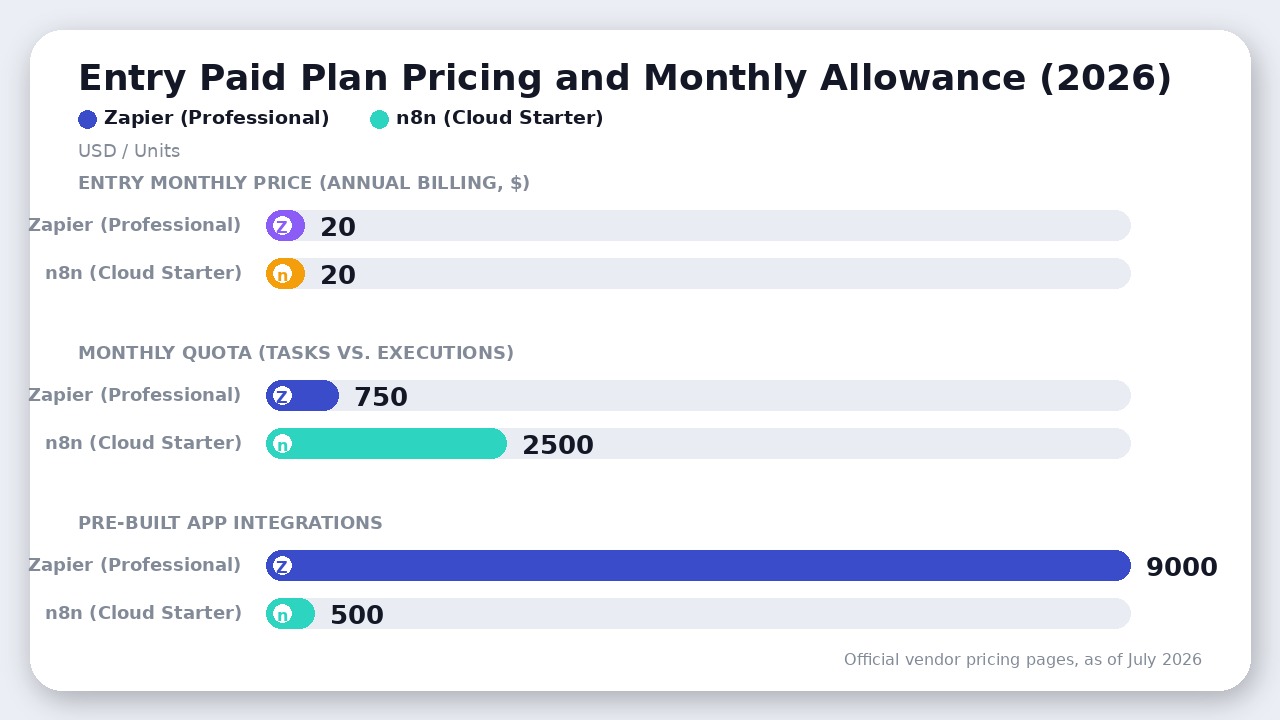
| Lowest Paid Tier | $19.99/mo (annual) / $29.99/mo (monthly) for 750 tasks | $20/mo (annual) / $24/mo (monthly) for 2,500 executions |
| Free Tier | 100 tasks/mo, 2-step Zaps only | Community Edition is free forever self-hosted with unlimited executions |
| Self-Hosting Option | None (Cloud SaaS only) | Fully self-hostable via Docker, npm, or single-click VPS |
| App Integrations | 9,000+ pre-built native apps | 500+ native nodes + generic HTTP / GraphQL node |
| AI & LLM Building | Zapier AI Actions, Copilot, Agent builder | Native LangChain nodes, multi-agent orchestration, vector memory |
| Data Privacy | Vendor cloud processing | On-premises data control & sovereign deployment |
Prices verified against vendor pricing documentation as of July 2026.
Zapier vs n8n: The Core Architectural Differences
1. The Math Trap: Task-Based vs. Execution-Based Pricing
The fundamental divide in any Zapier vs n8n pricing evaluation lies in how each platform counts usage.
Zapier bills by the task. A task is defined as every external action step your workflow successfully executes. Triggers do not cost tasks, and built-in helper tools (like Filter, Formatter, and Paths) consume 0 tasks on paid plans as of July 2026. However, every external SaaS action, CRM update, database write, API call, and notification step burns 1 task each.
Consider a standard lead processing workflow with 6 external action steps:
1. Trigger: Webhook receives a new lead (0 tasks).
2. Action 1: Clearbit node enriches lead data (1 task).
3. Action 2: Salesforce node creates or updates lead (1 task).
4. Action 3: Outreach node enrols lead in sequence (1 task).
5. Action 4: Slack node sends team notification (1 task).
6. Action 5: Database node logs the event (1 task).
7. Action 6: Gmail node sends confirmation email (1 task).
Executing this single workflow 500 times per month burns 3,000 tasks on Zapier (6 external action steps × 500 runs). On Zapier’s Professional tier ($19.99/month as of July 2026), which includes a base allowance of 750 tasks, this single workflow forces an upgrade to higher task tiers or triggers overage charges, quickly pushing monthly spend past $75/month.
Conversely, n8n Cloud bills by the execution. An execution represents one full run of the workflow from start to finish, regardless of whether that workflow contains 3 steps or 30 steps. Running that exact same 6-action lead process 500 times consumes 500 executions, fitting easily within n8n Cloud Starter’s 2,500 monthly execution limit ($20/month as of July 2026).
If you choose to self-host n8n’s Community Edition on a $5/month virtual private server (VPS), you pay $0 in execution fees, running hundreds of thousands of multi-step workflows without a task tax.
2. Technical Ceiling & Developer Experience
Zapier is engineered to prevent users from breaking things. Its linear step builder makes starting simple, but complex branching logic requires nested Paths that become difficult to maintain. Custom code steps (Python or JavaScript) are isolated with tight execution timeouts and memory limits.
n8n is built around a visual canvas designed for node-based graph logic. You can split workflows into parallel execution branches, merge datasets with custom JavaScript or Python expressions, loop over JSON arrays, and handle errors gracefully using dedicated error triggers.
For engineering teams comparing n8n with dedicated code platforms, detailed comparisons like n8n vs Make or durable execution tools like Trigger.dev vs Inngest highlight how n8n bridges the gap between visual UI and raw code.
3. AI Workflows and Agentic Capabilities
Both platforms have aggressively added AI functionality, but their implementations reflect their core audiences:
- Zapier AI: Focuses on pre-built assistant surfaces like Zapier Copilot (prompt-to-Zap creation) and Zapier Central. It provides simple OpenAI and Anthropic action nodes to summarize text or extract entities inside a Zap.
- n8n AI: Implements native LangChain architecture under the hood. n8n provides pre-built nodes for LLMs (OpenAI, Anthropic, Ollama for local LLMs), Vector Stores (Pinecone, Qdrant), Memory (Redis, Window Buffer), and Agents. You can build autonomous AI agents inside n8n that iteratively invoke tools, execute code, query vector memory, and format outputs before returning a result.
Where Zapier Actually Wins
Despite n8n’s cost and logic advantages, Zapier remains dominant for specific operational environments:
- Long-Tail SaaS Integrations: Zapier connects to over 9,000 applications. If your company relies on niche industry tools (such as obscure real estate CRMs, legacy ERPs, or boutique form builders), Zapier likely has a working authentication flow ready out of the box. n8n offers around 500+ native nodes; connecting unlisted apps requires using its generic HTTP Request node and configuring API headers manually.
- Zero Infrastructure Maintenance: Zapier is 100% managed SaaS. There are no Docker containers to update, no database migrations to run, and no server instances to monitor. For non-technical teams, the time saved avoiding infrastructure management often justifies higher monthly software bills. Those evaluating Zapier against other commercial SaaS tools can see similar trade-offs in our Zapier vs Make analysis.
- Organization-Wide Self-Service: Non-technical staff in marketing, HR, or sales can independently build, test, and troubleshoot basic Zaps without submitting tickets to engineering.
The Verdict
Choose n8n as your default automation platform. Its execution-based pricing model, advanced node logic, native AI agent architecture, and self-hosting capabilities make it superior for modern tech stacks, growth teams, and engineering organizations.
Choose Zapier only if your team lacks technical support entirely, relies on linear 2-step workflows, or depends on long-tail SaaS integrations that lack accessible REST APIs.
Final Recommendation
n8n wins for technical teams, AI workflow builders, and scaling operations due to execution-based pricing and native AI nodes. Zapier remains the go-to for non-technical users who prioritize 9,000+ zero-maintenance app connectors above long-term software costs.

Leave a Reply