

Supabase wins this backend matchup for most production applications, but the reason isn’t just because it uses PostgreSQL. It comes down to standard relational data flexibility, predictable bandwidth pricing, and avoiding proprietary lock-in as your app scales. However, if you are building a deeply collaborative, real-time React application where state invalidation gives you nightmares, Convex presents an extraordinarily fast alternative that removes virtually all backend glue code.
The 30-Second Answer
- Pick Supabase if you need standard PostgreSQL, full SQL query capabilities, complex relational schemas, built-in vector search with
pgvector, or want zero lock-in with full self-hosting freedom.- Pick Convex if you are building a Next.js or React app with complex live state, want automatic WebSocket updates without managing cache invalidation, and prefer writing end-to-end TypeScript functions instead of SQL and RLS policies.
Comparison Overview: Supabase vs Convex
| Dimension | Supabase | Convex |
|---|---|---|
| Database Core | Open-source PostgreSQL 15 / 17 | Managed Document store with relational IDs |
| Data Query Layer | SQL, PostgREST, GraphQL, ORMs | End-to-end TypeScript queries & mutations |
| Real-Time Engine | Postgres Change Data Capture (CDC) & Broadcast | Native Reactive Query Engine over WebSockets |
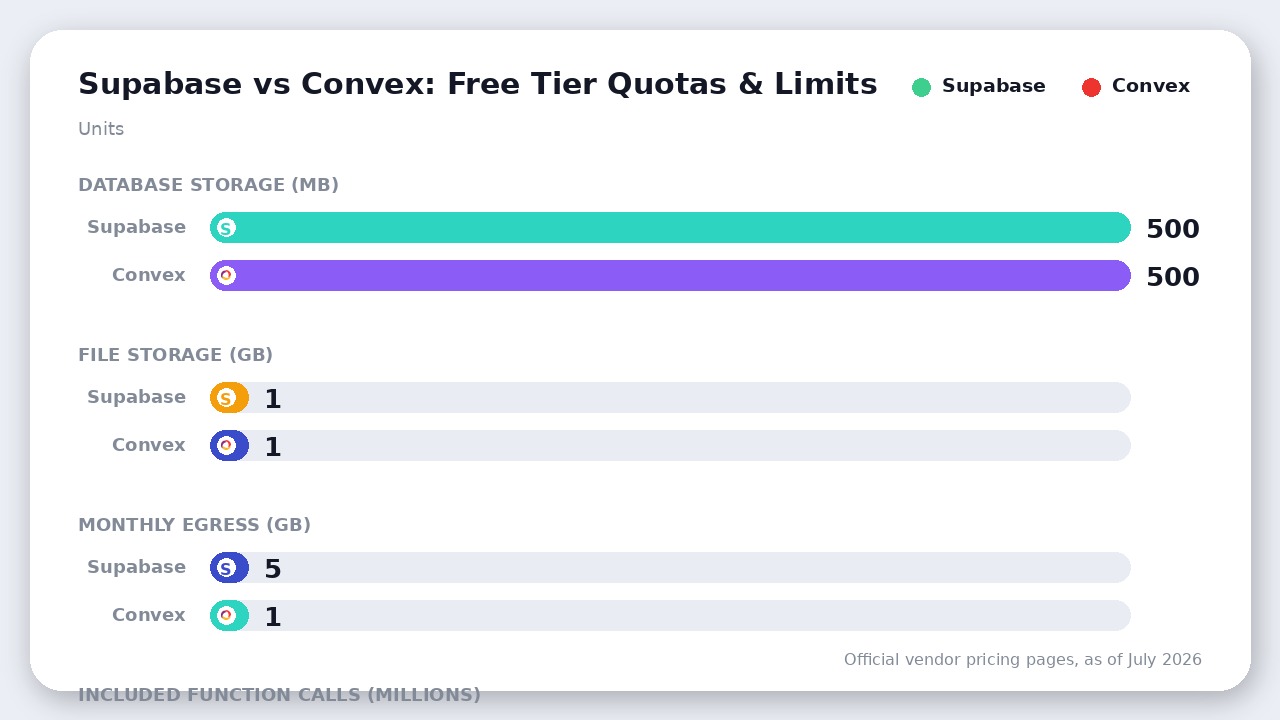
| Free Tier | 500 MB DB, 1 GB Storage, 50K MAUs, 5 GB Egress | 500 MB DB, 1 GB Storage, 1M function calls, 1 GB Egress |
| Entry Paid Tier | Pro: $25/month (flat base + compute credit) | Professional: $25/developer seat/month |
| Vector Search | Native pgvector extension |
Native document vector search indices |
| AI Agent Fit (MCP) | Official Supabase MCP server shipped in 2026 | Pure TypeScript schemas (easily read by coding agents) |
| Vendor Lock-in Risk | Low (Standard Postgres dump / Docker self-host) | Moderate (Proprietary runtime / FSL 1.1 license) |
Architecture & Data Modeling: SQL Control vs. Reactive TypeScript
Supabase gives you a dedicated PostgreSQL database surrounded by managed APIs, Authentication, S3-compatible Storage, and Edge Functions. When you provision a Supabase project, you retain full access to standard Postgres. You can write complex joins, stored procedures, common table expressions (CTEs), and run analytical queries using tools like Metabase or custom scripts. Data access security is enforced at the database level using Postgres Row Level Security (RLS) policies. If you already know SQL or use modern TypeScript ORMs (such as in our Drizzle vs Prisma breakdown), Supabase fits naturally into your existing workflow.
Convex takes a fundamentally different route: it discards standard SQL in favor of a reactive TypeScript runtime. Instead of exposing a database connection string or requiring ORMs, Convex asks you to write server-side TypeScript functions divided into queries (read-only, cached), mutations (transactional writes), and actions (side-effects like calling external APIs). Data is stored as JSON-like documents organized into tables, with relational associations managed using document IDs.
Because Convex schemas and functions are defined purely in TypeScript, end-to-end type safety is automatic. When you update a field in your backend schema, your frontend React hooks immediately throw type errors if the UI doesn’t match. There is no code generation step or schema synchronization pipeline to maintain.
Real-Time Engine: Change Data Capture vs. Native Reactive WebSockets
Real-time functionality is where these two backends diverge most sharply in execution:
- Supabase Realtime listens to Postgres Write-Ahead Logs (WAL) via Change Data Capture (CDC) or WebSocket broadcast channels. To reflect real-time changes in a React component, developers manually subscribe to specific table events (
INSERT,UPDATE,DELETE) and write client-side logic to merge those changes into local state (or combine them with state utilities like TanStack Query). While effective, scaling Postgres CDC to tens of thousands of concurrent subscriptions can require explicit channel architecture and index tuning. - Convex is reactive by default. Every read query in Convex is a live WebSocket subscription. When a mutation modifies a document in the Convex database, the platform automatically determines which active client queries are affected, re-executes those queries on the server, and pushes the updated data diffs to subscribing UI components.
In Convex, there is zero cache-busting code, zero polling logic, and zero manual WebSocket listener setup. The UI stays synchronized with the database out of the box.
Pricing Traps & Usage Billing (As of July 2026)
Both platforms provide accessible entry points, but their pricing models scale along very different operational meters.
Supabase Pricing Mechanics
As of July 2026, Supabase offers a Free Tier ($0/month) containing a 500 MB database, 1 GB file storage, 50,000 monthly active users (MAUs), and 5 GB egress, though free databases pause after 7 days of inactivity.
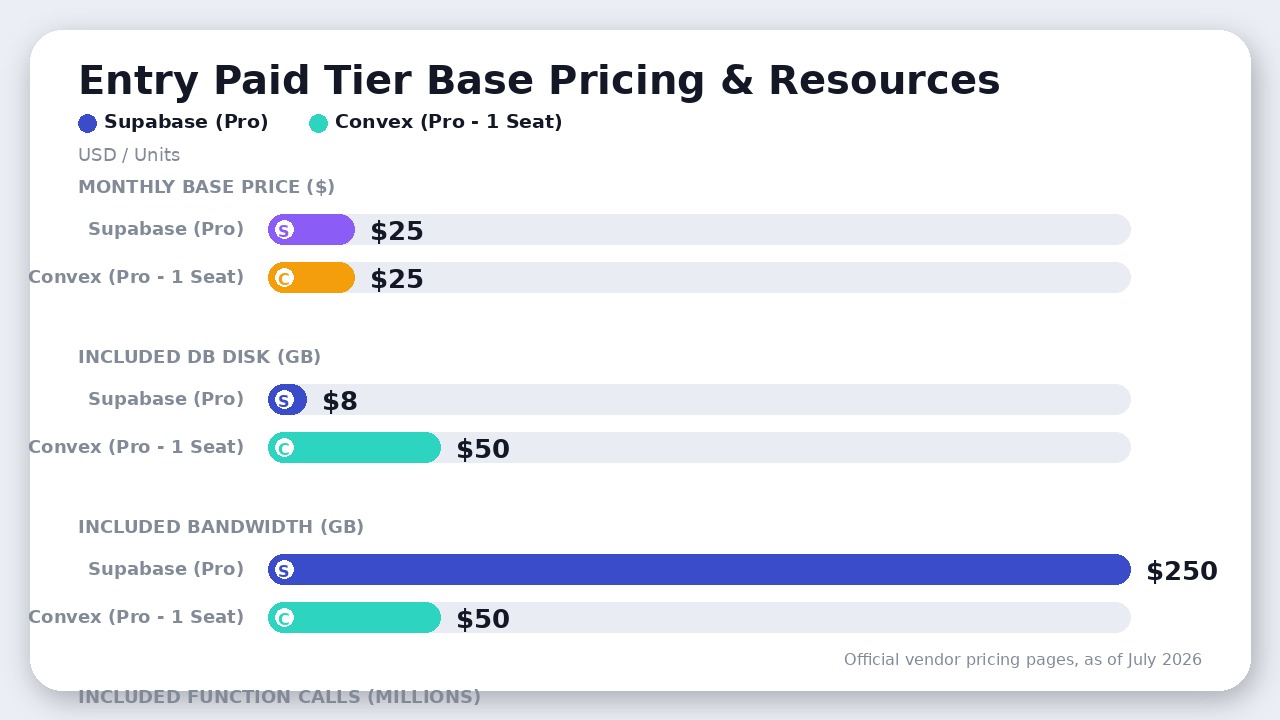
The Pro Plan costs a flat $25/month base fee and includes $10 in compute credits (which covers a Micro compute instance), 8 GB of database disk size ($0.125/GB overage), 100 GB file storage ($0.0213/GB overage), 100,000 MAUs ($0.00325/MAU overage), and 250 GB egress ($0.09/GB overage). If you’re comparing against legacy cloud backends, see our Supabase vs Firebase guide for an in-depth breakdown of bandwidth pricing.
The Supabase Pricing Trap: Supabase’s baseline fee stays predictable at $25/month until your database hits compute bottlenecks. Complex RLS policies evaluated on unindexed tables or heavy aggregation queries can max out CPU usage on the Micro instance, forcing an upgrade to larger compute tiers (Small at +$10/mo, Medium at +$50/mo, up to 16XL instances).
Convex Pricing Mechanics
As of July 2026, Convex’s Starter Tier ($0/month) includes 1 million function calls, 0.5 GB (500 MB) database storage, 1 GB file storage, and 1 GB database bandwidth per month, with pay-as-you-go overages ($2.20 per 1M additional function calls, $0.22/GB database storage).
The Professional Plan costs $25 per developer seat per month. It includes 25 million function calls, 50 GB database storage, 100 GB file storage, and 50 GB egress per month (with usage overages billed at $2.00 per 1M additional function calls and $0.20/GB storage), alongside higher team management limits, log streaming, and daily backups.
The Convex Pricing Trap: Convex bills primarily by compute execution (function calls). If your frontend application makes frequent, unoptimized query calls or subscribes thousands of active clients to rapidly mutating documents (such as live cursor tracking or high-frequency telemetry), your function execution volume can multiply rapidly, scaling usage costs faster than raw database storage.
Where Convex Actually Wins
Convex wins decisively in developer velocity for real-time, interactive, and collaborative applications.
Building features like live multi-user document editing, live chat, or interactive Kanban boards on Supabase requires significant architectural effort: writing granular RLS rules, subscribing to CDC streams, managing optimistic UI updates, and handling reconnection edge cases. On Convex, live reactivity is inherent—you simply call useQuery(api.tasks.get) in React, and the UI updates whenever the underlying data changes.
Furthermore, Convex is exceptionally well-suited for AI-assisted coding (“vibe coding”). Because the database schema, mutations, and client queries are all written in plain, strongly-typed TypeScript within the repository, AI coding assistants (like Cursor, Claude Code, or Windsurf) can read the entire backend state and generate bug-free end-to-end features with far higher accuracy than when wrestling with SQL migrations and RLS policies.
The Verdict
Supabase is the overall winner for most production engineering teams, startup founders, and enterprise applications in 2026. Standard PostgreSQL reliability, zero vendor lock-in, mature SQL analytics tooling, and predictable per-gigabyte bandwidth pricing make Supabase the safest long-term backend foundation. If you need standard relational data modeling, complex analytical queries, pgvector for AI retrieval pipelines, or full self-hosting portability via Docker, Supabase delivers the definitive platform.
Choose Convex if you are building a real-time, highly collaborative React or Next.js application where live WebSocket reactivity is a core product requirement, your team works exclusively in TypeScript, and you want to eliminate state invalidation glue code entirely to ship features in days rather than weeks.
Frequently Asked Questions
Can I use Supabase and Convex together in the same app?
Yes. A common architectural pattern is using Supabase for primary authentication, file storage, and relational PostgreSQL data storage, while leveraging Convex as a dedicated reactive runtime for real-time collaborative features like live chat or multiplayer document canvas state.
Is Convex open source or vendor locked?
The self-hosted Convex backend engine is source-available under the Functional Source License (FSL 1.1), which automatically converts to Apache 2.0 two years after each release. However, because Convex relies on a proprietary document-and-TypeScript execution model, migrating a production application off Convex Cloud to standard SQL requires rewriting your backend API function layer.
Which backend is better for AI apps with vector search?
Supabase provides the native pgvector extension within PostgreSQL, allowing you to run vector similarity searches alongside standard relational SQL queries in a single database. Convex offers built-in vector search indices directly inside document tables. Supabase is generally preferred for large-scale RAG pipelines due to Postgres ecosystem support, while Convex is ideal when AI agents generate and update reactive UI state.
Final Recommendation
Supabase wins for most production SaaS and enterprise-bound products due to standard PostgreSQL portability, robust SQL tooling, and pgvector. Convex wins for real-time collaborative apps built in Next.js where reactive WebSockets and zero-glue-code TypeScript velocity outweigh raw SQL control.

Leave a Reply