

Clerk and Kinde look identical on marketing pages: modern, developer-first authentication platforms designed to save you from writing custom OAuth flows or self-hosting complex identity infrastructure. But under the hood, they solve fundamentally different architectural scopes.
Clerk is a hyper-focused authentication and user management UI framework built primarily around the React and Next.js ecosystems. Kinde is an all-in-one Customer Identity and Access Management (CIAM) platform that bundles authentication, multi-tenant B2B organization management, feature flags, and subscription billing into a single subscription.
Choosing between them comes down to a clear structural trade-off: Do you want the single best drop-in React component experience on the market, or do you want a complete B2B SaaS infrastructure suite that won’t hit you with hidden $100/month add-ons?
The 30-Second Answer
- Choose Clerk if: You are building with Next.js or React, want pre-built UI components (
<SignIn />,<UserProfile />,<OrganizationSwitcher />) that look pixel-perfect in 15 minutes, and plan to stay under 50,000 monthly retained users (MRUs).- Choose Kinde if: You are building a multi-tenant B2B SaaS product, need custom roles and feature flags from day one, or want framework flexibility across 20+ non-React tech stacks without paying enterprise add-on penalties.
Clerk vs Kinde: Key Differences at a Glance
| Feature / Dimension | Clerk | Kinde |
|---|---|---|
| Primary Architecture | Drop-in React Auth UI & User Hooks | All-in-One Auth, Feature Flags & CIAM |
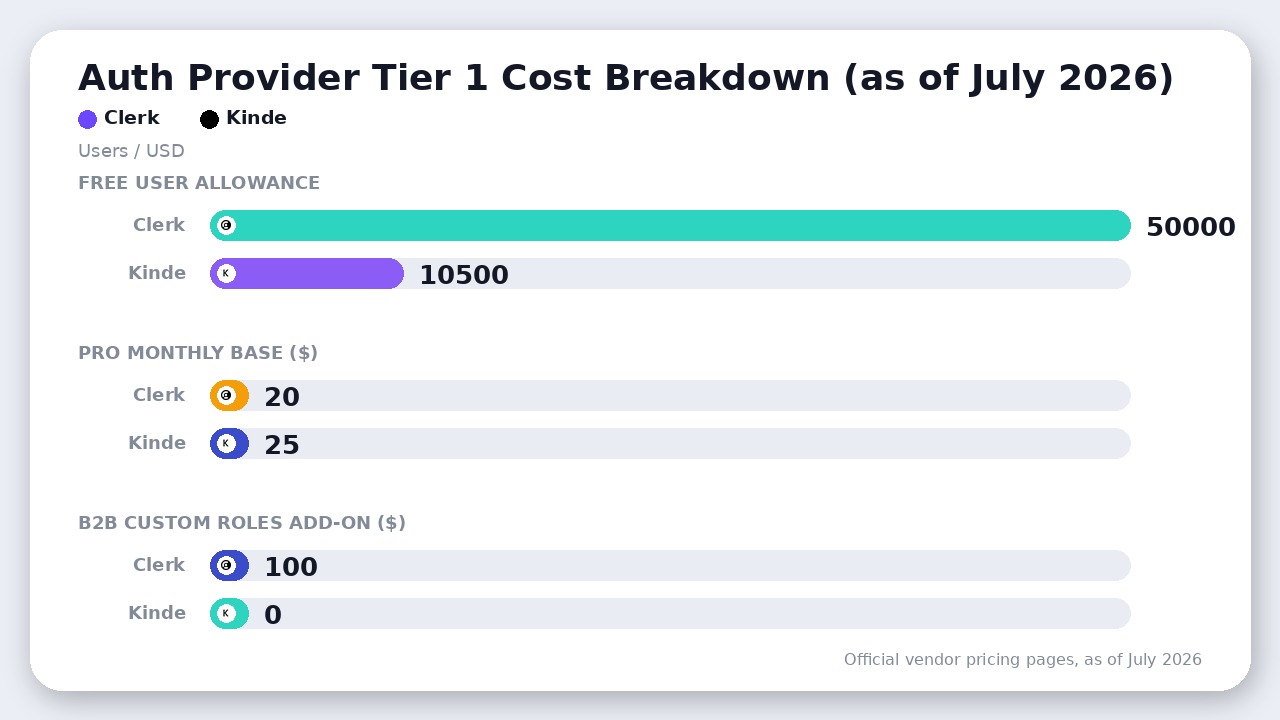
| Free Tier Allowance | 50,000 Monthly Retained Users (MRUs) | 10,500 Monthly Active Users (MAUs) |
| Pro Plan Base Price | $20/mo (billed annually) or $25/mo | $25/mo |
| User Overage Rate | $0.02 per MRU after 50,000 | $0.0175 per MAU after 10,500 |
| B2B Custom Roles | Requires $100/mo B2B Add-on ($85/mo annual) | 2 on Free, Unlimited on Pro ($25/mo) |
| Pre-built Drop-in Components | Exceptional (<SignIn />, <UserProfile />) |
Redirect-based / Hosted UI & Custom SDKs |
| Built-in Feature Flags | No (requires third-party tool) | Yes (10 free, unlimited on Pro) |
| Built-in Subscription Billing | Clerk Billing (Stripe integration, 0.7% fee) | Built-in Kinde Billing (0.7% fee) |
| Framework Support | React, Next.js, Astro, TanStack, Mobile | 21 Frameworks (React, Vue, Svelte, Express, iOS) |
Pricing verified as of July 2026 from official vendor pricing documentation.
1. Developer Experience & Frontend Integration
When evaluating developer experience (DX), Clerk remains the absolute benchmark for frontend developers working in the React and Next.js ecosystem.
Clerk’s core philosophy is zero UI friction. Implementing authentication with Clerk literally takes five lines of code. Wrapping your application in <ClerkProvider> gives you immediate access to pre-built, production-ready components like <SignIn />, <SignUp />, <UserProfile />, and <OrganizationSwitcher />. Following Clerk’s Core 3 update, the platform introduced improved customization APIs, theme editor tools, keyless development mode for frameworks like TanStack Start, Astro, and React Router, and native support for Next.js 16 (proxy.ts).
If you want to customize your login modal, Clerk provides CSS variables and Tailwind classes directly on component props. You rarely have to manage session states manually—useUser() and useAuth() handle server-side rendering (SSR) hydration seamlessly.
Kinde approaches DX from a broader, framework-agnostic perspective. Instead of focusing exclusively on embedded React components, Kinde emphasizes quick SDK implementation across 21 SDKs, including Vue, SvelteKit, Express, Python, Flutter, and iOS.
By default, Kinde directs users to a highly customizable hosted authentication page or lets you bring your own custom HTML and CSS templates. While Kinde’s React SDK provides clean hooks like useKindeAuth(), it does not offer the exact drop-in component suite that Clerk provides. With Kinde, if you want an embedded user profile screen or organization switcher inside your app layout, you will write a bit more UI boilerplate code compared to Clerk’s drop-in component tags.
2. The Pricing & Free Tier Switch
SaaS authentication pricing is famous for unexpected traps as your application scales. Both vendors restructured their pricing models, but they hit developer wallets in completely different places.
Clerk’s Pricing Model: Massive Free User Volume, Gated B2B Features
As of July 2026, Clerk offers one of the most generous free tiers in devtools: 50,000 Monthly Retained Users (MRUs) for $0/month. A user is counted as retained when they return 24+ hours after signing up, meaning dormant one-time signups don’t drain your quota.
Clerk’s Pro plan costs $20/month billed annually ($25/month billed monthly) as of July 2026 and includes the same 50,000 MRU base allowance, charging $0.02 per MRU for additional users. Every plan includes unlimited application instances (staging, dev, production).
The Pricing Trap in Clerk: While Clerk’s free tier user count is massive, B2B multi-tenancy controls are heavily gated. If you need custom RBAC rolesets, organization verified domains, or enterprise connection linking with organizations, Clerk requires the B2B Authentication add-on for $100/month ($85/month billed annually) as of July 2026. If you also need unlimited user impersonation for customer support, that requires the separate Administration add-on for another $100/month ($85/month billed annually). As detailed in our Clerk vs Auth0 breakdown, these add-ons can push your monthly bill from $20 to over $200 before you even reach high user volumes.
Kinde’s Pricing Model: Smaller User Cap, Uncapped B2B Capabilities
Kinde takes the opposite approach. As of July 2026, Kinde’s Free tier provides 10,500 Monthly Active Users (MAUs)—substantially lower than Clerk’s 50,000. However, Kinde includes core B2B multi-tenancy features on its $0 free plan:
– 2 custom roles and 10 permissions
– B2B organization management (5 Monthly Active Organizations included free)
– Custom domains
– 10 feature flags
– Multi-factor authentication (MFA) and social logins
Kinde’s Pro plan costs $25/month as of July 2026 and includes 10,500 free MAUs, with overages billed at $0.0175 per MAU (cheaper than Clerk’s $0.02 rate). Upgrading to Pro instantly unlocks 50 free Monthly Active Organizations ($0.50 per extra MAO), unlimited custom roles and permissions, and unlimited feature flags—with zero $100/month add-on fees required.
For enterprise B2B needs, Kinde offers the Plus plan at $75/month as of July 2026, which includes free Enterprise SSO (SAML/OIDC), domain restrictions, and reduced billing transaction fees (0.6%).
3. B2B Multi-Tenancy & All-in-One Capabilities
If you are building single-tenant consumer apps (B2C), Clerk’s raw user volume advantage makes it hard to pass up. But if you are building B2B SaaS where business customers create accounts, invite team members, assign custom permissions, and manage subscriptions, the platform architectures diverge significantly.
Multi-Tenant Organizations
Both platforms support organizations out of the box, but Kinde treats multi-tenancy as a core primitive rather than a feature layer. In Kinde, an organization can own its own machine-to-machine (M2M) applications, custom properties, and specific branding settings. On Kinde’s Pro plan ($25/month), the first 50 Monthly Active Organizations (MAO) are included free, with additional active organizations priced at $0.50 per MAO/month.
In Clerk, organization features work smoothly via the <OrganizationSwitcher /> and <OrganizationProfile /> UI components, and all plans include 100 Monthly Retained Organizations (MROs) free per app. However, managing custom rolesets or verified domain invitations without upgrading to the $100/month B2B add-on will force you to write custom backend middleware handlers.
Built-in Feature Flags
One of Kinde’s biggest differentiators is its native feature flag system. Rather than subscribing to a separate platform like LaunchDarkly or PostHog just to toggle features for specific user segments or B2B organizations, Kinde includes feature flags directly inside the auth payload.
You can create boolean, string, or JSON flags in Kinde’s dashboard and evaluate them in your code alongside session checks:
// Evaluating feature flags natively in Kinde
const { getFlag } = useKindeAuth();
const isNewDashboardEnabled = getFlag("new_dashboard", false);
Clerk does not offer built-in feature flags; you must integrate an external provider.
Monetization & Subscription Billing
Both platforms now eliminate the awkward split between authentication and payment systems:
– Clerk Billing integrates directly with Stripe to let developers drop a <PricingTable /> component into React apps, charging a 0.7% platform fee on transaction volume.
– Kinde Billing handles plan creation, user upgrades, and recurring subscription checkouts directly within Kinde, charging a flat 0.7% transaction fee (0.6% on the Plus plan) while keeping MAUs free when billed through Kinde.
Where Kinde Actually Wins
To give credit where it’s due, Kinde beats Clerk decisively in three operational scenarios:
- Early-Stage B2B SaaS Budgeting: If you are an early bootstrap founder building a multi-tenant B2B app, Kinde gives you custom roles, permissions, organizations, and custom domains on its $0 free tier or $25 Pro tier. On Clerk, unlocking custom rolesets and verified domain invitations immediately requires the $100/month B2B add-on ($85/month annual), making Kinde 4x to 5x cheaper during early product validation.
- Polyglot & Non-React Stacks: If your backend is Django, Rails, or Go, or your frontend uses Vue, Svelte, or Flutter, Kinde’s official SDK library (21 SDKs) is far more comprehensive. Clerk is undeniably React-first.
- Vendor Consolidation: Kinde eliminates extra SaaS subscriptions out of your stack by combining CIAM, feature flags, and multi-tenant organization management into one dashboard.
The Verdict
There is no ambiguous “both are great” conclusion here. Your choice depends entirely on your frontend tech stack and your business model.
Pick Clerk if:
- You are building a React or Next.js application and want the absolute fastest path to launch.
- You want drop-in UI components (
<SignIn />,<UserProfile />) that require zero design or form state management. - Your app is B2C or developer-focused where you can leverage the massive 50,000 free Monthly Retained Users without needing enterprise B2B role add-ons.
Pick Kinde if:
- You are building a multi-tenant B2B SaaS product that requires custom RBAC roles and organization controls without paying a $100/month add-on fee.
- You want built-in feature flags and multi-tenant management without managing multiple third-party devtools.
- You are using non-React frameworks (Vue, Svelte, Python, Flutter) where Clerk’s drop-in React components offer no advantage.
Frequently Asked Questions
Is Clerk really free for up to 50,000 users?
Yes. As of July 2026, Clerk’s free tier covers up to 50,000 Monthly Retained Users (MRUs) per app. A user is counted as retained when they log in or return 24 hours after signing up. The free tier includes unlimited applications, social logins, and basic organization features.
Can I migrate my users from Clerk to Kinde (or vice versa)?
Yes. Both Clerk and Kinde support standard user data exports and imports via their REST APIs. Password hashes (such as bcrypt or Argon2) can be exported and migrated without requiring your users to reset their passwords.
Does Kinde require using their hosted login page?
No. While Kinde’s default setup uses a hosted login page on your custom domain, Kinde supports bringing your own HTML and CSS templates, as well as building fully custom login interfaces using Kinde’s SDK APIs.
Final Recommendation
Clerk wins for React and Next.js applications building consumer or early B2C software due to its unmatched drop-in UI and massive 50,000 free MRU allowance. However, Kinde wins decisively for multi-tenant B2B SaaS startups because it includes custom roles, organization management, and feature flags out of the box without Clerk's $100/month add-on fee.

Leave a Reply