

Drizzle ORM vs Prisma is the defining debate of the modern TypeScript backend. In 2026, the landscape has fundamentally shifted: Drizzle’s core package (drizzle-orm) overtook the prisma CLI package in weekly npm downloads for the first time (though Prisma’s runtime library @prisma/client still maintains a higher download count when measured separately), and the core Drizzle team was hired full-time by PlanetScale in March 2026 to secure its open-source future. Meanwhile, Prisma 7 dropped its controversial Rust-based query engine in favor of a WebAssembly (WASM) compiler to fight back against serverless cold starts.
If you are starting a greenfield Next.js, Bun, or Node.js project, the standard advice is to pick Drizzle for serverless and Prisma for servers. But that is a lazy compromise that ignores the critical details: a security vulnerability in Drizzle’s raw SQL escaping, a major Cloudflare Workers bug in Prisma 7’s WASM engine, and the hidden costs of Prisma’s operations-based monetization.
Here is the unfiltered technical reality.
The Philosophical Divide: SQL-First vs. Abstraction-First
Before evaluating performance, you must understand the core architectural split between the two tools. This isn’t just syntactic sugar—it dictates how you write code, debug queries, and scale your database.
Prisma is abstraction-first. You define your database schema in a custom Domain-Specific Language (DSL) via a .prisma file. Prisma compiles this schema and generates a highly abstracted TypeScript client. The goal is to hide SQL entirely. You think in terms of nested objects and relations:
const userWithPosts = await prisma.user.findUnique({
  where: { email: 'colleague@stackmatchup.com' },
  include: { posts: true }
});
Drizzle ORM is SQL-first. There is no custom DSL or code-generation step. You write pure TypeScript schemas that map directly to your SQL tables. Drizzle’s philosophy is simple: if you know SQL, you know Drizzle. You write queries that mirror the exact SQL executed under the hood:
const userWithPosts = await db.select()
  .from(users)
  .leftJoin(posts, eq(users.id, posts.userId))
  .where(eq(users.email, 'colleague@stackmatchup.com'));
Because Drizzle schemas are pure TypeScript, you can refactor table names with your IDE’s standard rename tool, split schemas across multiple files, and import them normally. Prisma’s custom DSL forces you to manage a single, often monolithic, .prisma file (and while multi-file schemas are supported, they still require a compilation step).
The Performance Reality: What Prisma 7 Actually Changed
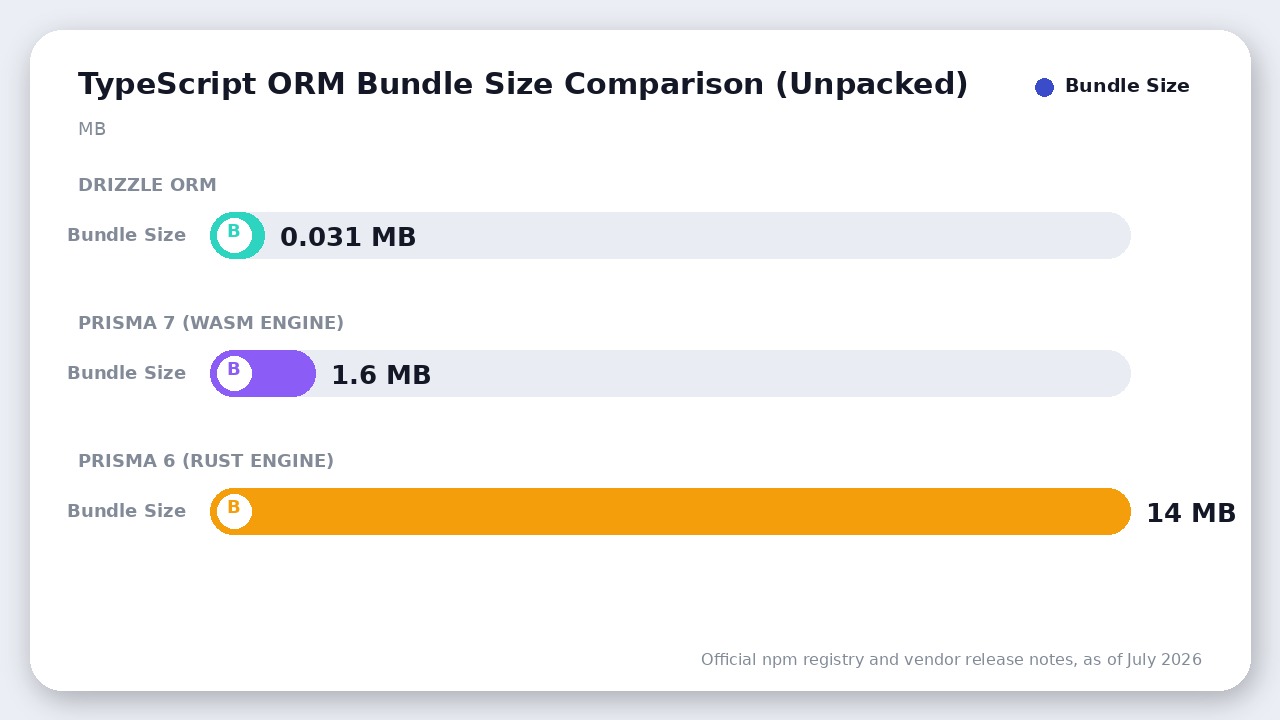
Historically, Drizzle wiped the floor with Prisma on performance. Prisma 6 and earlier relied on a heavy Rust-based query engine binary (~14MB). In serverless environments like AWS Lambda or Vercel, this binary caused massive cold starts (often exceeding 1.2 seconds) and high memory consumption.
Prisma 7 changed the calculus. It deprecated the Rust query engine entirely, replacing it with a pure TypeScript/WASM Query Compiler (~1.6MB unpacked). This 90% reduction in bundle size slashed cold starts by up to 9x, closing the serverless performance gap.
However, Drizzle still holds the performance edge. Because Drizzle is a zero-dependency, headless library (~12KB min+gzipped or ~31KB unpacked), it compiles queries directly to SQL strings in JavaScript with zero engine overhead.
Let’s look at how the bundle sizes and cold starts compare in 2026:
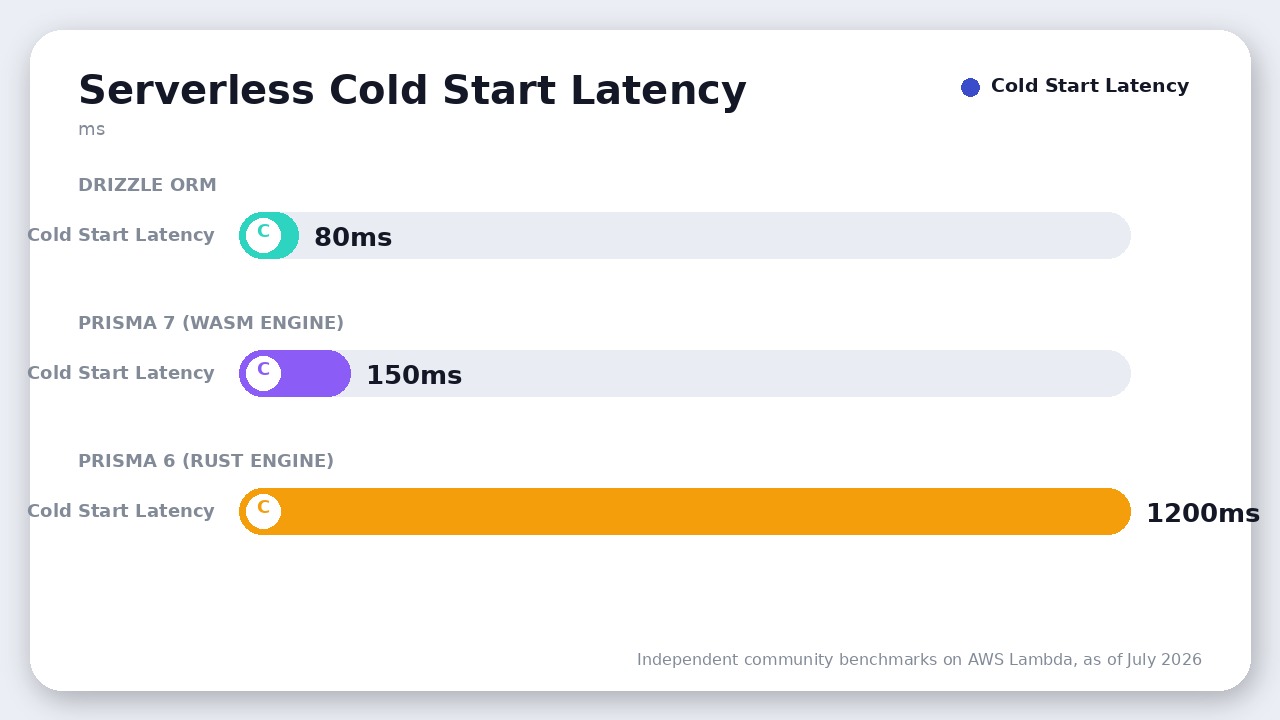
While Prisma 7 closed the cold-start gap significantly, it introduced a new issue: a massive concurrency regression under high load in versions 7.0 through 7.3. Prisma acknowledged this and resolved it in Prisma 7.4 (released in early 2026) by introducing a query plan caching layer. If you are benchmarking Prisma 7, ensure you are on version 7.4.0 or later, or you will see highly erratic query times.
The Edge Runtime Gotcha: Prisma 7’s Cloudflare Workers Bug
Prisma 7’s WASM engine was supposed to make it fully edge-native. But if you are deploying to Cloudflare Workers, there is a massive limitation buried in the issue tracker.
Cloudflare Workers blocks dynamic WASM compilation at runtime for security reasons. Because Prisma 7 compiles its WASM query compiler at runtime, it fails to execute on Cloudflare Workers out of the box. The current workarounds are frustrating: you must either downgrade to Prisma 6.19.0 (reintroducing the older engine architecture) or pay for Prisma Accelerate, their proprietary connection-pooling proxy.
Drizzle, by contrast, has zero WASM compilation overhead and runs natively on Cloudflare Workers, Vercel Edge, and Deno Deploy with zero proxies or workarounds. This is why Hono.js and Astro DB recommend Drizzle as their default ORM.
The Security Tradeoff: Drizzle’s CVE-2026-39356
Drizzle’s “close to the metal” philosophy means you get incredible speed, but you also inherit the security responsibilities of writing raw SQL.
In April 2026, Drizzle was hit with CVE-2026-39356, a critical SQL injection vulnerability. Because Drizzle lacks a heavy query engine layer, it relied on a custom escapeName() function to sanitize SQL identifiers. In all versions prior to 0.45.2 and 1.0.0-beta.20, this function failed to properly escape embedded identifier delimiters. If you passed attacker-controlled input to APIs like sql.identifier() or .as(), attackers could break out of quotes and execute arbitrary SQL.
While the core team quickly patched this, it serves as a stark reminder: when you use Drizzle, you are writing SQL. If you make a mistake with raw inputs, the ORM won’t save you. Prisma’s heavy, highly-abstracted query compiler makes SQL injection almost impossible unless you explicitly use $queryRaw.
Where Prisma Actually Wins: Migrations and Nested Writes
If your team is not composed entirely of SQL experts, Drizzle will eventually introduce friction. This is where Prisma’s maturity shines.
1. Declarative Migrations (Prisma Migrate)
Prisma Migrate remains the gold standard for database migrations. It uses a “shadow database” during local development to detect drift, automatically generate clean SQL migrations, and safely track migration state in a _prisma_migrations table.
Drizzle Kit is incredibly fast, but its migration generation is more imperative. It struggles with complex schema refactors (like renaming a table or splitting a column) and often requires you to manually edit the generated SQL files. Furthermore, if you are migrating a legacy project from Prisma to Drizzle, Drizzle Kit cannot natively consume Prisma’s migration history, forcing you to run a manual schema baseline.
2. Nested Writes
Prisma’s Client API handles complex nested writes effortlessly. You can create a user, their profile, and three blog posts in a single, type-safe transaction:
await prisma.user.create({
  data: {
    email: 'colleague@stackmatchup.com',
    profile: { create: { bio: 'Editorial Intelligence' } },
    posts: { create: [{ title: 'Prisma Wins Writes' }] }
  }
});
Drizzle’s Relational Queries (DRQ) v2 API is strictly read-only. If you want to perform a nested write in Drizzle, you must write multiple imperative insert statements, manually capture the returning IDs, and wrap them in a transaction block. For write-heavy SaaS applications, Drizzle requires significantly more boilerplate.
The Pricing Trap: Operations-Based Billing
Drizzle is fully open-source (Apache 2.0/MIT). There is no “Drizzle Enterprise” or premium cloud tier. The only bill you pay is your database host. If you are deploying to a managed backend like Supabase, your ORM layer costs exactly $0.
Prisma is venture-funded, and their business model relies on upselling you to their paid infrastructure. While Prisma ORM is open-source, they have increasingly pushed developers toward:
* Prisma Postgres: A managed, serverless database service launched in early 2025.
* Prisma Accelerate: A global connection pooler and edge caching proxy.
Prisma Postgres uses an operations-based billing model rather than charging for compute hours. As of July 2026, the pricing plans are structured as follows:
* Free ($0/month): Includes 100,000 operations and 500 MB storage.
* Starter ($10/month): Includes 1,000,000 operations, then $0.0080 per 1,000 operations ($8/million overage).
* Pro ($49/month): Includes 10,000,000 operations, then $0.0020 per 1,000 operations ($2/million overage).
“Operations” are metered at the ORM query level. If your application has a high-traffic dashboard that executes 5 database queries per page load, a modest 1 million page views per month translates to 5 million operations. On the Starter plan, that is:
* 1,000,000 operations: Included
* 4,000,000 operations overage: 4,000 x $0.0080 = $32.00
* Total bill: $42.00/month (excluding storage)
For high-throughput applications, Prisma’s operations-based pricing can quickly become an expensive trap compared to traditional VPS or compute-hour hosting (like Neon or AWS RDS), where databases are billed on raw hardware uptime rather than query counts.
Comparison Table
| Dimension | Drizzle ORM | Prisma |
|---|---|---|
| Primary Philosophy | SQL-first (TypeScript schema) | Abstraction-first (custom DSL schema) |
| Bundle Size | ~31 KB unpacked | ~1.6 MB (Prisma 7 WASM engine) |
| Cold Start Latency | ~80ms | ~150ms (Prisma 7) |
| Edge Compatibility | First-class native support | Partial (Cloudflare Workers WASM bug) |
| Migrations | Imperative (Drizzle Kit) | Declarative (Prisma Migrate) |
| Nested Writes | Manual transaction boilerplate | Native, out-of-the-box support |
| Pricing Model | 100% Free (Open source library) | Free ORM; Premium cloud upsells |
| Pricing (as of July 2026) | $0 (no licensing fees) | Free ORM; Prisma Postgres from $10/mo |
Source: Official vendor documentation as of July 2026.
The Verdict
Drizzle ORM and Prisma are both outstanding tools in 2026, but they serve entirely different deployment patterns and team structures.
Choose Drizzle ORM if:
* You are deploying to serverless or edge environments (Vercel Edge, Cloudflare Workers).
* Your team is highly fluent in SQL and wants absolute control over query performance.
* You want a lightweight, zero-dependency runtime with no proprietary infrastructure upsells.
Choose Prisma if:
* You are running on traditional, long-running servers (Railway, Fly.io, AWS EC2) where cold starts do not matter.
* Your team has mixed database skills and benefits from a highly abstracted, human-readable schema language.
* Your application relies heavily on complex nested writes and declarative, hands-off migrations.
The Verdict
Drizzle wins for modern serverless, edge, and SQL-fluent teams who want zero-overhead performance. Prisma remains superior for traditional servers where complex nested writes and declarative migrations outweigh bundle size.

Leave a Reply